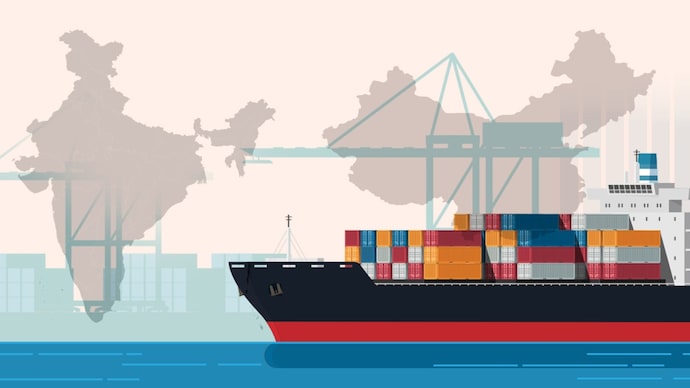
India’s exports to china rose by an eye-catching 90 per cent year-on-year in November, triggering optimism in some quarters about a potential shift in the country’s long-standing trade imbalance with its largest import partner. However, a closer look at the data suggests that this spike does little to alter the broader trajectory of India–China trade.
Despite the strong November performance, India’s imports from China continue to grow at a much faster pace than exports, ensuring that the trade deficit remains structurally wide. Analysts warn that the latest numbers reflect short-term commodity movements rather than a sustained export-led turnaround.
According to a detailed analysis by the Global Trade Research Initiative (GTRI), the November export jump was driven largely by a limited set of products, including naphtha, iron ore, shrimp, and select electronic components. This concentration underscores the lack of diversification in India’s export basket to China.
Trade experts note that these commodities are highly sensitive to changes in Chinese demand cycles, global prices, and inventory adjustments. As a result, export spikes of this nature have been seen before—and have often been followed by sharp corrections.
In fact, similar export surges were recorded in earlier years but failed to translate into a durable upward trend. The current rise, analysts argue, reflects tactical buying by Chinese firms rather than a strategic shift in bilateral trade relations.
Long-term data reinforces this assessment. According to figures compiled by the Centre for Monitoring Indian economy (CMIE), India’s exports to China have largely remained range-bound for over a decade. Exports rose sharply from $0.95 billion in 2001–02 to a peak of $21.2 billion in 2020–21, but have struggled to regain momentum since then.
Exports declined to $14.3 billion in 2024–25 and further to $12.2 billion in 2025–26 (up to November). While exports during April–November this year were up 33 per cent compared to the same period last year, this growth follows several years of stagnation and contraction.
Imports Keep Rising, Year After Year
Imports from China, in contrast, tell a completely different story. India’s inbound shipments from China have climbed steadily from $2 billion in 2001–02 to $65 billion in 2020–21. The pace accelerated sharply thereafter, reaching $94.6 billion in 2021–22 and crossing $113.5 billion in 2024–25.
In the current financial year alone, imports from China have already touched $84.3 billion in just the first eight months, pointing to another record year unless there is a dramatic slowdown.
Roughly 80 per cent of these imports consist of electronics, machinery, chemicals, pharmaceuticals intermediates, and plastics—inputs that are deeply embedded in India’s industrial and manufacturing ecosystem. This structural dependence makes import compression difficult without major domestic capacity expansion.
| Indicator | Exports to China | Imports from China |
|---|---|---|
| 2001–02 | $0.95 billion | $2 billion |
| 2020–21 (Peak) | $21.2 billion | $65 billion |
| 2024–25 | $14.3 billion | $113.5 billion |
| 2025–26 (Till Nov) | $12.2 billion | $84.3 billion |
| Estimated Trade Deficit 2025 | ~$106 billion | |
This divergence explains why India’s trade deficit with China continues to widen even in years when exports show temporary strength. In 2021–22, for instance, exports exceeded $21 billion, yet imports were close to $95 billion, resulting in a massive deficit.
By 2024–25, as exports weakened further and imports surged, the trade gap approached $100 billion. The GTRI estimates that the deficit could rise to around $106 billion in 2025, underlining the scale of the imbalance.
Volatile Export Basket
Product-level data highlights the volatility in India’s exports to China. Naphtha exports rose from $1.83 billion in 2021–22 to $1.91 billion in 2022–23, before falling sharply to about $1.26 billion in 2023–24 and remaining subdued thereafter.
Iron ore exports have been even more erratic—dropping from $2.49 billion to $1.40 billion, then surging to $3.64 billion, only to fall again to $1.89 billion the following year.
Shrimp exports have shown relatively greater stability but still fluctuate with global demand, rising from $823 million to $924 million before slipping to $798 million and then $773 million.
Monthly data from CMIE further illustrates the uneven nature of export growth. Exports to China rose by 11 per cent in April, 28 per cent in July, 42 per cent in October, and 90 per cent in November. Such irregular spikes suggest episodic demand rather than structural change.
Crucially, even when imports grow at a slower rate of 15–18 per cent, they add far more in absolute terms due to their much larger base. This arithmetic ensures that the trade deficit continues to widen.
In essence, while the November export surge is statistically accurate, it does not alter the fundamentals of India–China trade. India remains heavily dependent on Chinese industrial inputs, while its exports are confined to a narrow and volatile set of commodities.
Until India succeeds in expanding high-value manufacturing, strengthening domestic supply chains, and diversifying its export basket, headline export jumps will remain short-lived—and the trade gap with China will continue to grow.
For breaking news and live news updates, like us on Facebook or follow us on Twitter and Instagram. Read more on Latest Business on thefoxdaily.com.






COMMENTS 0