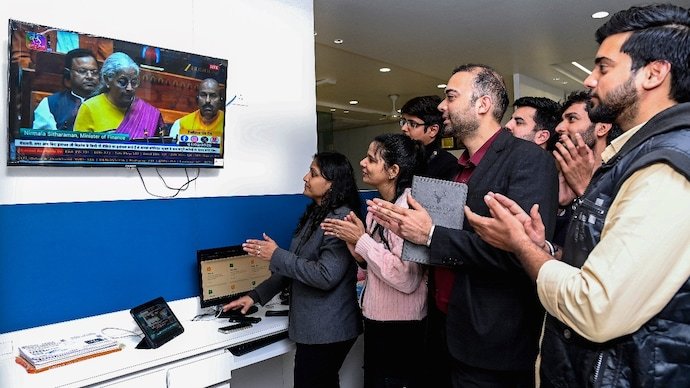
The Union Budget 2026 may not have delivered headline-grabbing giveaways, but it clearly reinforces the Modi 3.0 government’s long-term economic strategy. Infrastructure expansion, manufacturing self-reliance, technology adoption, and support for small businesses remain at the core of policy priorities. At the same time, the Budget takes a tougher stance on speculative trading, large corporates, and affluent investors.
With a 10% increase in capital expenditure to Rs 12.2 lakh crore, the government has once again underlined its belief that infrastructure-led growth is the engine of economic expansion. Roads, railways, logistics, and urban development are expected to benefit directly, while allied sectors such as technology, manufacturing, and services stand to gain indirectly.
However, measures aimed at curbing speculative excesses in financial markets and revising the taxation of share buybacks indicate that the Budget is also focused on discipline and stability. Below is a clear, sector-wise breakdown of the winners and losers of Budget 2026.
Budget 2026: Key Winners
1. Infrastructure and Logistics
Infrastructure remains the single biggest beneficiary of Budget 2026. The government has allocated Rs 12.22 lakh crore for capital expenditure, marking an increase of over 11% compared to the previous fiscal year.
This spending will be directed toward building and upgrading roads, railways, ports, urban utilities, and logistics networks. A major highlight is the proposal to develop seven new high-speed rail corridors as “growth connectors,” linking major economic hubs such as Delhi, Mumbai, Pune, Hyderabad, Bengaluru, Chennai, Varanasi, and Siliguri.
On the logistics front, the government plans to operationalize 20 new national waterways and develop a dedicated freight corridor connecting Dangkuni in West Bengal to Surat in Gujarat, significantly improving freight efficiency and reducing transportation costs.
2. Manufacturing and Strategic Industries
In line with the “Make in India” and supply-chain resilience agenda, Budget 2026 strongly supports strategic manufacturing sectors. Semiconductors, rare earth minerals, and biopharmaceuticals have received special attention amid global supply disruptions and geopolitical uncertainties.
The announcement of Semiconductor Mission 2.0, with an outlay of Rs 8,000 crore, aims to accelerate India’s chip-making ecosystem at a time when global semiconductor shortages are expected to intensify.
Additionally, mineral-rich states such as Odisha, Kerala, Andhra Pradesh, and Tamil Nadu are set to benefit from newly announced rare earth corridors, especially as china tightens export controls in the backdrop of its trade tensions with the United States.
3. Small and Medium Enterprises (SMEs)
Recognising the credit challenges faced by small businesses, the government has announced a Rs 10,000-crore dedicated fund to support SMEs. This move is expected to ease liquidity stress and encourage expansion and job creation.
Further, an additional Rs 2,000 crore allocation to the Self-Reliant India Fund in 2026–27 will provide a boost to micro-enterprises and startups, strengthening the grassroots entrepreneurial ecosystem.
4. AI, IT, and Services Sector
Artificial Intelligence emerged as a recurring theme in Budget 2026, with Finance Minister Nirmala Sitharaman mentioning AI a record eleven times in her speech. The government linked AI development directly to its “Viksit Bharat” vision.
A key incentive is a tax exemption for cloud service providers setting up data centres in India, extended all the way to 2047. This is expected to attract global tech players and strengthen India’s digital infrastructure.
The announcement of ‘Bharat-VISTAAR’, a multilingual AI platform integrated with agri-stack portals, aims to improve farm productivity through data-driven insights.
Additionally, over 15,000 secondary schools and 500 higher education institutions will establish content creator labs, while new skilling initiatives—such as the launch of Samarth 2.0 for textiles—aim to enhance employability for millions of young Indians.
Budget 2026: Key Losers
1. Traders, Businesses, and Speculative Investors
To curb excessive speculation in financial markets, the government has doubled the Securities Transaction Tax (STT) on Futures and Options (F&O) trading from 0.02% to 0.05%. This move is expected to dampen high-risk retail participation in derivatives trading.
The Budget has also changed the taxation framework for share buybacks. Earlier seen as a tax-efficient way for companies to return surplus cash, buybacks will now be taxed as capital gains, increasing the tax burden—especially for large shareholders.
2. High-Net-Worth Individuals (HNIs) and Wealthy Investors
High-net-worth individuals are among the clear losers in Budget 2026. The removal of certain interest deduction benefits on investments will raise the effective tax burden on select financial products.
These measures signal the government’s intent to shift the tax structure toward greater equity, even if it means higher costs for affluent investors.
Budget 2026 at a Glance: Winners vs Losers
| Category | Impact |
|---|---|
| Infrastructure & Logistics | Major winner due to higher capex and new rail, road, and waterway projects |
| Manufacturing & Semiconductors | Strong boost through Semiconductor Mission 2.0 and rare earth corridors |
| SMEs & Micro Enterprises | Positive impact via new funds and credit support |
| AI, IT & Services | Big winner with AI focus, data centre tax breaks, and skilling initiatives |
| Speculative Traders | Negative impact due to higher STT on F&O trades |
| HNIs & Large Investors | Higher tax burden from changes in buyback and investment taxation |
Bottom Line
Union Budget 2026 reinforces continuity rather than disruption. It rewards sectors aligned with long-term national priorities—such as infrastructure, manufacturing, technology, and skills—while tightening regulations and taxes on speculative activity and wealth concentration.
For businesses and investors, the message is clear: build, manufacture, innovate, and create jobs—or be prepared to face a tougher fiscal environment.
For breaking news and live news updates, like us on Facebook or follow us on Twitter and Instagram. Read more on Latest Business on thefoxdaily.com.






COMMENTS 0