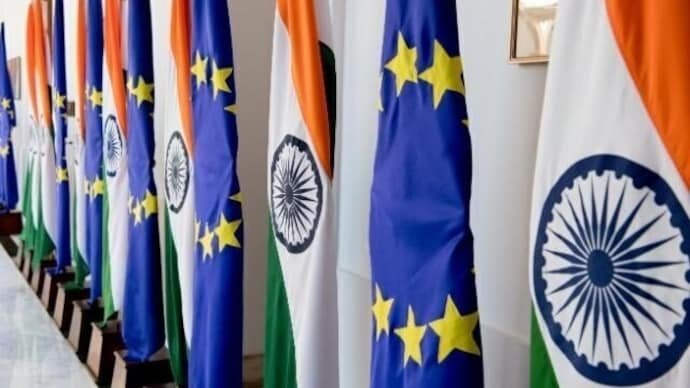
A high-level summit in New Delhi today is expected to achieve what nearly two decades of negotiations could not. India and the European Union (EU) are likely to formally announce the conclusion of talks on their comprehensive free trade agreement (FTA), moving the pact into its final approval and ratification stage.
The scale of the partnership underscores the significance of the moment. The European Union remains one of India’s largest and most strategic trading partners, and the numbers clearly explain why a free trade agreement has long been viewed as critical.
In the financial year 2024–25, India’s total goods trade with the EU stood at approximately USD 136.53 billion. Exports amounted to USD 75.85 billion, while imports were valued at USD 60.68 billion, making the EU India’s largest goods export destination.
India also recorded a goods trade surplus of USD 15.17 billion with the EU during the same period, reinforcing Europe’s importance as a stable and high-value market for Indian exporters.
In services, trade with the EU reached USD 83.10 billion in 2024, spanning key areas such as business services, information technology, telecommunications, and professional consulting.
Nearly 17 per cent of India’s total exports are directed toward the EU. Under the proposed FTA, Indian companies are expected to gain smoother and more predictable access to this vast market of over 450 million consumers.
Cheaper European Cars on the Horizon
Automobiles remain one of the most closely watched—and politically sensitive—components of the India–EU trade deal. India’s auto market has historically been among the most protected globally.
At present, customs duties on fully built European cars range from 70 per cent to 110 per cent, depending on engine size and price, making imported vehicles prohibitively expensive for most Indian consumers.
Under the FTA framework currently under discussion, India has reportedly agreed to sharply reduce these tariffs to around 40 per cent initially for a limited quota of imported cars priced above approximately USD 17,700 (₹16.3 lakh), according to sources familiar with the negotiations.
Over time, these duties could be lowered further to about 10 per cent, bringing India closer to international tariff norms.
If implemented, this would represent the most significant opening of India’s automobile market to European manufacturers such as Volkswagen, Mercedes-Benz, BMW, Renault, and Stellantis, potentially making premium models far more affordable.
Fully electric vehicles, however, are likely to remain excluded from these tariff cuts for at least the first five years. This safeguard is aimed at protecting domestic EV investments by Indian manufacturers such as Tata Motors and Mahindra & Mahindra.
Electronics, Textiles, and Market Access
Beyond automobiles, the most substantial changes are expected in goods trade. Indian textiles and garments currently face duties of around 10 per cent in the EU market.
These tariffs are expected to be gradually reduced, helping Indian exporters compete more effectively with rivals such as Bangladesh and Vietnam in Europe’s large apparel market.
At the same time, European electronics, machinery, and industrial inputs are likely to become more affordable once select tariffs are removed. This could lower production costs for Indian manufacturers that rely on specialised imported components.
Reports also suggest that Indian exporters of electronics and machinery may find it easier to enter European markets as technical and regulatory barriers are streamlined.
Over time, consumers may see modest price reductions on certain high-value imports, while exporters could benefit from deeper penetration into one of the world’s wealthiest and most stable markets.
Skilled Mobility and Services Trade
Services already form a central pillar of India’s economic relationship with Europe, with trade valued at USD 83.1 billion.
The FTA is expected to introduce clearer and more predictable mobility rules for Indian professionals working in sectors such as IT, engineering, consulting, and business services.
The proposed framework includes simplified entry criteria, improved transparency, and faster processing for short-term work assignments.
Even a modest increase in services exports could significantly boost India’s foreign earnings, while skilled professionals would gain access to a broader range of temporary opportunities across European markets.
What About Agriculture and Farm Trade?
Agriculture remains one of the most politically sensitive chapters in the India–EU FTA and is not expected to see broad tariff liberalisation.
Both sides have treated farm and dairy products with caution to avoid domestic political backlash, effectively ring-fencing agriculture from major tariff cuts.
EU officials have confirmed that products such as dairy and sugar are excluded, while the bloc has protected its own markets for beef, rice, and sugar. India, meanwhile, has retained high tariffs on farm and dairy goods to safeguard millions of small and marginal farmers.
As a result, consumers are unlikely to see major changes in agricultural imports or food prices under the current agreement structure.
That said, India’s food and beverage exports to the EU—worth about USD 4.2 billion in 2024—continue to grow, led by coffee, tea, spices, seafood, and fruits, indicating scope for expansion in select processed and niche segments.
Industry Costs and Carbon Regulations
The EU’s Carbon Border Adjustment Mechanism (CBAM) is set to play a crucial role in shaping future trade in steel and aluminium.
During the transition phase, exporters will be required to declare the carbon emissions embedded in each shipment before a carbon-linked levy is imposed once the mechanism is fully operational.
India has pushed for more flexible reporting norms and longer transition periods as part of the FTA discussions. Analysts estimate that full CBAM compliance could increase steel production costs by 3 to 8 per cent, depending on emissions intensity.
This burden is expected to fall primarily on exporting industries rather than domestic consumers, limiting the impact on retail prices within India.
Geographical Indications and Investment Rules
According to officials, the agreement comprises 24 chapters, covering investment protection, intellectual property rights, labour mobility, and regulatory cooperation.
The EU has sought stronger investment safeguards, including clearer dispute resolution mechanisms and predictable regulatory frameworks, as outlined in its official negotiating mandate.
Geographical indications (GIs) have been another complex area of negotiation. Europe has pushed for broader protection for its wines, cheeses, and specialty foods, while India has sought enhanced recognition for its own GIs such as Darjeeling tea, Basmati rice, Banarasi sarees, and Kolhapuri chappals.
Mobility provisions for skilled professionals are equally critical. India has consistently pressed for simpler and more predictable short-term entry rules for IT and consulting professionals, given their importance to India’s fast-growing services exports.
Together, these chapters aim to reduce legal uncertainty, improve operational efficiency, and create a more stable environment for long-term investment between India and the EU.
An FTA that lowers costs on key goods such as cars and electronics, expands access to services, and strengthens investor confidence could add tens of billions of dollars to India’s exports over the next decade.
For consumers, the most visible impact is likely to be lower prices on select European products and improved service availability as Indian firms deepen their footprint across Europe.
For breaking news and live news updates, like us on Facebook or follow us on Twitter and Instagram. Read more on Latest Business on thefoxdaily.com.






COMMENTS 0