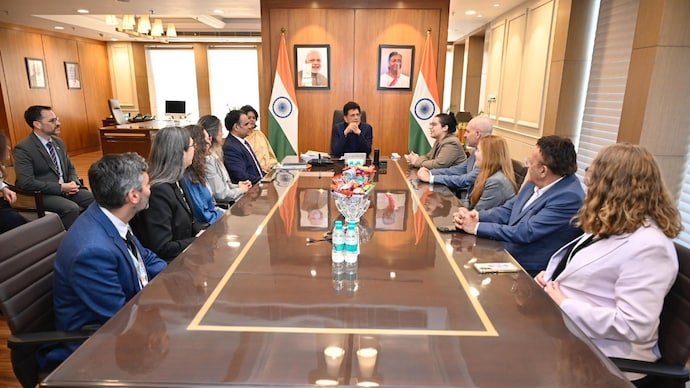
- Commerce Minister Piyush Goyal Calls FTA Talks a ‘Major Step’
- Key Areas Covered in India–Israel FTA Negotiations
- Israel Sees FTA as a Breakthrough Opportunity
- PM Modi’s Two-Day Visit to Israel
- Netanyahu’s “Hexagon of Alliances” and Regional Strategy
- A Strategic Partnership Since 2017
- What the India–Israel FTA Could Mean
In a significant diplomatic and economic development, India and Israel have officially commenced the first round of negotiations for a proposed Free trade Agreement (FTA) in New Delhi. The talks come just ahead of Prime Minister Narendra Modi’s scheduled visit to Israel, underlining the growing strategic and economic partnership between the two nations.
The launch of FTA discussions marks a major milestone in India–Israel bilateral relations and signals both countries’ intent to deepen trade, investment, and technological cooperation.
Commerce Minister Piyush Goyal Calls FTA Talks a ‘Major Step’
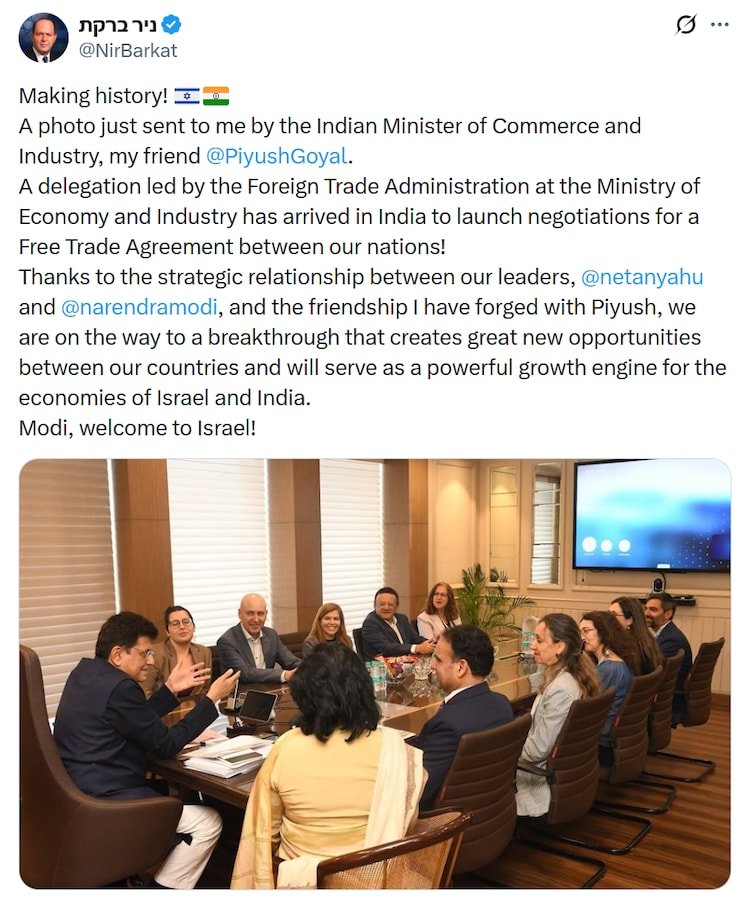
Union Commerce and Industry Minister Piyush Goyal met with an Israeli delegation visiting India for the negotiations. He described the beginning of formal FTA talks as a crucial step toward expanding bilateral commercial engagement.
In a post on X (formerly Twitter), Goyal stated that the negotiations aim to unlock new opportunities for businesses and citizens in both countries. According to him, the agreement has the potential to significantly boost trade volumes, streamline regulatory frameworks, and foster innovation-driven collaboration.
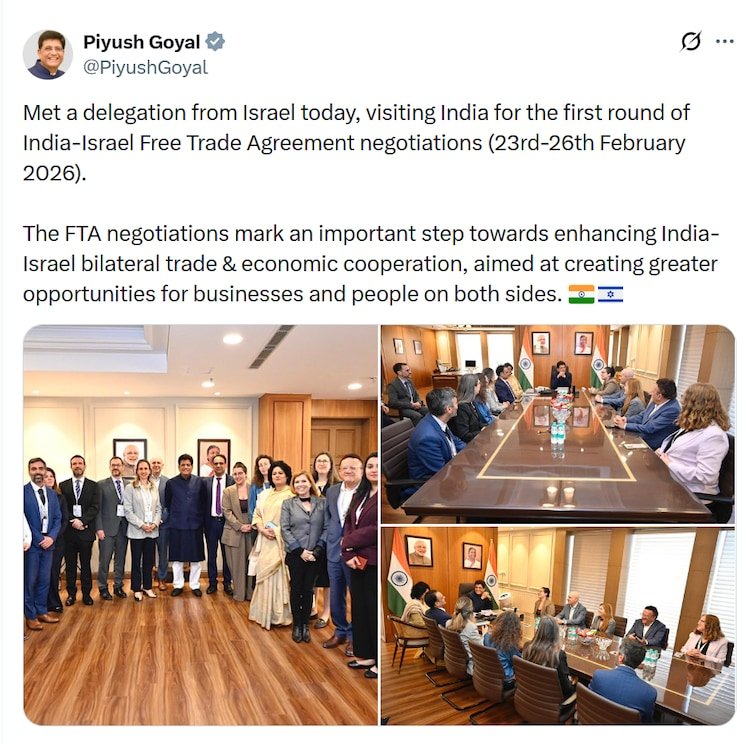
“The FTA negotiations mark an important step towards enhancing India-Israel bilateral trade & economic cooperation, aimed at creating greater opportunities for businesses and people on both sides,” he noted.
Key Areas Covered in India–Israel FTA Negotiations
According to sources familiar with the discussions, trade and technical experts from both countries are holding detailed deliberations covering a wide range of subjects essential for a comprehensive trade pact.
| Negotiation Area | Focus of Discussion |
|---|---|
| Trade in Goods | Tariff reductions and market access for key products |
| Trade in Services | IT, technology, professional services, and innovation sectors |
| Rules of Origin | Criteria to determine product origin for preferential treatment |
| Sanitary & Phytosanitary Measures | Food safety and agricultural product standards |
| Technical Barriers to Trade | Regulatory standards and compliance mechanisms |
| Customs & Trade Facilitation | Simplifying procedures to ease cross-border trade |
| Intellectual Property Rights | Protection of patents, trademarks, and innovation assets |
These discussions reflect the ambition to craft a modern, high-quality trade agreement that supports innovation, manufacturing, and technology-led growth.
Israel Sees FTA as a Breakthrough Opportunity
Israel’s Minister of Economy and Industry, Nir Barkat, expressed optimism about the negotiations, describing them as a potential breakthrough in bilateral relations.
“We are on the way to a breakthrough that creates great new opportunities between our countries and will serve as a powerful growth engine for the economies of Israel and India,” Barkat stated.
His remarks highlight Israel’s strategic interest in expanding economic engagement with India, one of the world’s fastest-growing major economies.
PM Modi’s Two-Day Visit to Israel
Prime Minister Narendra Modi is set to arrive in Israel for a two-day visit, during which he will hold extensive bilateral talks with Israeli Prime Minister Benjamin Netanyahu. The discussions are expected to cover a broad spectrum of issues, including:
- Trade and economic cooperation
- Agriculture and water management
- Research and technological collaboration
- Defense and security partnerships
Defense cooperation remains a cornerstone of India–Israel relations, with Israel being one of India’s key suppliers of advanced military platforms and defense systems.
Netanyahu’s “Hexagon of Alliances” and Regional Strategy
On the eve of PM Modi’s visit, Israeli Prime Minister Benjamin Netanyahu outlined what he termed a “hexagon of alliances,” positioning India as a central partner alongside Israel, Greece, and Cyprus. According to Netanyahu, the emerging strategic framework aims to counter what he described as “radical axes” in the West Asian region.
The inclusion of India in this strategic grouping underscores New Delhi’s rising geopolitical influence and its expanding footprint in West Asia.
A Strategic Partnership Since 2017
India and Israel elevated their ties to a Strategic Partnership during Prime Minister Narendra Modi’s landmark visit to Israel in July 2017. That visit marked a historic moment, as Modi became the first Indian Prime Minister to visit Israel.
Since then, cooperation has expanded across multiple sectors:
- Innovation and Startups
- Cybersecurity and Scientific Research
- Agriculture and Water Technology
- Defense and Security
- Trade and Investment
Economic ties have steadily grown, supported by structured dialogue mechanisms and investment frameworks. In September, both nations signed a Bilateral Investment Agreement aimed at boosting trade flows and protecting investor interests. Earlier, during Commerce Minister Piyush Goyal’s November visit to Israel, the two sides finalized the terms of reference to formally launch FTA negotiations.
What the India–Israel FTA Could Mean
If successfully concluded, the India–Israel free trade agreement could significantly increase bilateral trade volumes, reduce tariff barriers, encourage cross-border investments, and deepen collaboration in high-tech sectors.
With negotiations now officially underway and high-level political engagement intensifying, the proposed FTA represents not just a trade pact, but a strategic economic pillar in the evolving India–Israel partnership.
As Prime Minister Modi’s visit unfolds, the progress of these negotiations will be closely watched by industry leaders, policymakers, and global markets alike.
For breaking news and live news updates, like us on Facebook or follow us on Twitter and Instagram. Read more on Latest Business on thefoxdaily.com.






COMMENTS 0