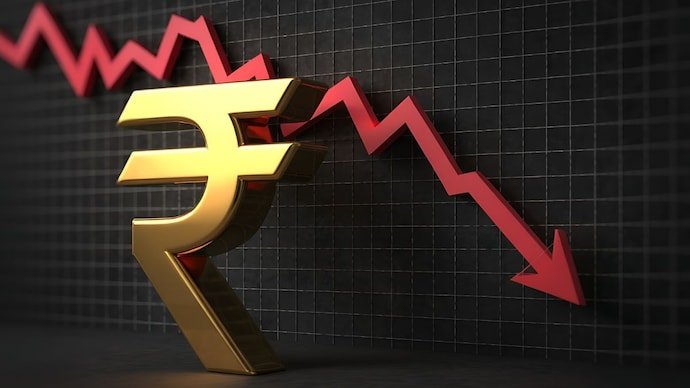
The Indian Rupee has fallen to a historic low, nearing the 94 mark against the US dollar, as rising crude oil prices and escalating geopolitical tensions in West Asia continue to weigh heavily on the currency. On Monday, the rupee slipped to Rs 93.89, marking one of its weakest performances in recent history.
Crude Oil Surge Puts Pressure on Rupee
One of the primary reasons behind the rupee’s sharp decline is the surge in global crude oil prices. In recent weeks, oil prices have climbed above $110 per barrel due to worsening geopolitical conditions in West Asia.
For a country like India, which imports more than 80% of its crude oil requirements, this increase has immediate financial implications. Since oil imports are paid in US dollars, higher crude prices mean India needs more dollars to buy the same quantity of oil, thereby increasing demand for the US currency and weakening the rupee.
Market experts note that sustained high crude prices could significantly expand India’s import bill, adding continued pressure on the domestic currency.
| Factor | Impact on Rupee |
|---|---|
| Crude Oil Above $110 | Higher import bill, increased dollar demand |
| India’s Oil Dependency | Over 80% imports increase vulnerability |
| Global Uncertainty | Investors shift to safe-haven assets like USD |
| Foreign Capital Outflows | Rupee weakens as investors convert to dollars |
| US Bond Yields > 4.4% | Attracts global investors away from emerging markets |
Geopolitical Tensions and Strong Dollar Add Pressure
The ongoing conflict in West Asia has increased global uncertainty, prompting investors to move their funds into safer assets such as the US dollar. This trend strengthens the dollar globally while weakening emerging market currencies like the Indian rupee.
Since the beginning of the conflict, the rupee has already depreciated by nearly 3%, making it one of the sharpest short-term declines in recent times.
Impact on Economy and Inflation
The weakening rupee does not just affect currency markets — it has broader economic consequences. Imports, including fuel, electronics, and industrial raw materials, become more expensive when the rupee loses value.
This rise in import costs can lead to higher Inflation, ultimately impacting household budgets and reducing consumer purchasing power across the country.
Foreign Investment Outflows Intensify Decline
Another major factor contributing to the rupee’s fall is the steady outflow of foreign capital from Indian markets. In recent weeks, foreign investors have been pulling money out of equities, converting rupees into dollars in the process.
This shift is largely driven by better returns in the United States, where bond yields have crossed 4.4%. In times of uncertainty, investors prefer safer and higher-yielding assets, making US markets more attractive.
RBI’s Role in Managing Volatility
The Reserve Bank of India (RBI) has been intermittently intervening in the currency markets by selling dollars to stabilize the rupee. However, the central bank does not aim to defend any specific exchange rate level.
Instead, the RBI’s approach focuses on ensuring a gradual and controlled depreciation, avoiding sudden or sharp fluctuations that could disrupt financial stability.
Outlook: Will the Rupee Fall Further?
Market analysts believe the rupee may continue to remain under pressure in the near term. According to estimates, it could trade within a weaker range of 93.00 to 94.25 against the US dollar.
If crude oil prices remain elevated and geopolitical tensions persist, the currency could potentially weaken further toward the 94–95 range.
The current depreciation reflects a broader global trend driven by rising oil prices, capital outflows, and a strengthening US dollar. Rather than being an isolated event, the rupee’s fall highlights the growing external pressures on the Indian economy.
Conclusion
The rupee’s slide to record lows underscores the interconnected nature of global markets, where geopolitical developments, commodity prices, and capital flows play a crucial role.
As the situation in West Asia continues to evolve, the trajectory of crude oil prices and global financial conditions will remain key determinants of the rupee’s future movement.
For breaking news and live news updates, like us on Facebook or follow us on Twitter and Instagram. Read more on Latest Business on thefoxdaily.com.






COMMENTS 0