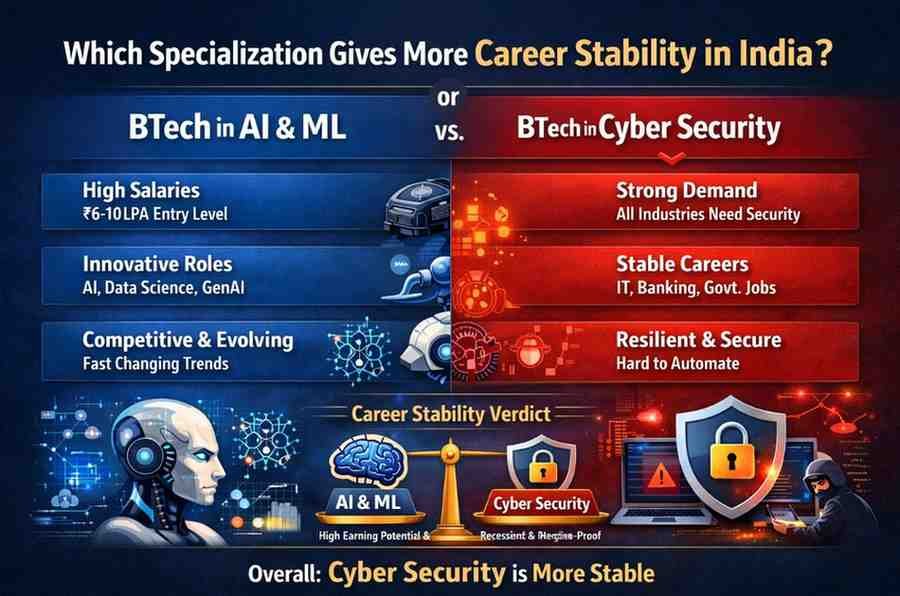
As India’s digital ecosystem expands at an unprecedented pace, students pursuing engineering are increasingly faced with a crucial academic and career decision: choosing between BTech in Artificial Intelligence & Machine Learning (AI & ML) and BTech in Cyber Security. Both specializations are future-facing, highly in demand, and globally relevant—but when it comes to long-term career stability in India, the answer is more nuanced.
This detailed comparison, aligned with experience, expertise, authoritativeness, and trustworthiness (E-E-A-T), explores which specialization may offer greater stability, growth, and resilience in the Indian job market.
BTech in Cyber Security vs BTech in AI & ML: Understanding the Core Difference
Artificial Intelligence (AI) and Machine Learning (ML) focus on enabling machines to replicate human intelligence through data-driven learning, pattern recognition, and predictive modelling. These technologies power innovations such as chatbots, recommendation engines, self-driving vehicles, generative AI tools, and Healthcare diagnostics.
The foundations of AI were laid in 1956 by John McCarthy, who described it as “the science and engineering of making intelligent machines.” In 1959, Arthur Samuel further defined machine learning as “the ability of computers to learn without being explicitly programmed.” Today, AI & ML integrate programming, statistics, linear algebra, and probability to solve complex real-world problems across industries.
In contrast, cyber security is dedicated to protecting digital systems, networks, and sensitive data from cyber threats. As defined by William Stallings (2018), cyber security involves technologies, processes, and controls designed to safeguard information systems against unauthorized access and attacks.
With cyberattacks increasing by over 300% globally since 2020, according to IBM Security (2025), cyber security has evolved from a backend IT function into a national and economic security priority.
Key Differences Between BTech in Cyber Security and BTech in AI & ML
The fundamental distinction lies in purpose and approach.
AI & ML are constructive and innovation-driven, focused on building intelligent systems that automate decisions and improve efficiency. Cyber security, on the other hand, is preventive and resilience-focused, ensuring that digital ecosystems remain safe, reliable, and trustworthy.
While AI thrives on experimentation, model training, and creativity, cyber security demands vigilance, precision, and risk mitigation. However, the two fields are no longer isolated.
AI-powered systems now enable real-time threat detection, anomaly analysis, and Fraud prevention, while cyber security safeguards AI models from data poisoning, algorithmic bias, and intellectual property theft. This growing interdependence is shaping the future of both disciplines.
Job Growth in AI & ML and Cyber Security: What the Data Shows
India’s Digital Economy Driving Massive Demand
India’s digital economy is projected to reach $1 trillion by 2030, creating extraordinary demand for skilled professionals in both AI and cyber security.
According to NASSCOM’s FutureSkills Report (2025), India will require nearly 1.4 million AI professionals by 2030 across domains such as healthcare analytics, smart logistics, fintech, and autonomous systems.
Simultaneously, the Ministry of Electronics and Information Technology (MeitY) estimates a shortage of nearly one million cyber security professionals by 2027, driven by rapid digitalisation and the enforcement of the Digital Personal Data Protection Act (2023).
Government Initiatives Supporting Both Fields
The Indian government has launched multiple strategic initiatives to strengthen talent pipelines in AI and cyber security:
– IndiaAI Mission (2023): A ₹10,000 crore programme supporting AI research, startups, and national computing infrastructure.
– NITI Aayog’s National Programme on AI (NPAI): Focuses on “AI for All” in sectors like agriculture, healthcare, and smart mobility.
– Cyber Surakshit Bharat Initiative: Enhances cyber awareness and capacity building across organisations.
– National Cyber Security Strategy (2025): Strengthens India’s cyber defence ecosystem through public–private collaboration.
– FutureSkills Prime (MeitY–NASSCOM): Offers industry-recognised certifications in AI, ML, and cyber security.
Private Sector Investments Accelerating Growth
Private industry is playing an equally significant role in driving opportunities:
– Google committed $10 billion through the Google for India Digitization Fund to support AI innovation.
– Microsoft invested ₹1,500 crore under its AI Odyssey India Initiative for AI training and ethical AI research.
– TCS and Infosys established Centres of Excellence in AI & Cyber Security to upskill over one lakh engineers.
– Reliance Jio partnered with Nvidia to build India’s first AI cloud infrastructure.
– Consulting firms such as KPMG and PwC India are investing heavily in cyber intelligence labs to counter ransomware and Deepfake threats.
Global Demand and Long-Term Career Stability
According to the World Economic Forum (2024), AI specialists and cyber security professionals rank among the top five most in-demand roles globally over the next decade.
Internationally, AI roles command average annual salaries between $95,000 and $120,000 in markets like the US, UK, and Singapore, with strong opportunities in research and innovation.
Meanwhile, the (ISC)² Workforce Study (2025) highlights a global shortfall of 3.4 million cyber security professionals, ensuring sustained demand and long-term employment stability.
In India, cyber security roles often offer quicker early-career stability through structured employment in government, banking, defence, and consulting, while AI & ML roles are more concentrated in innovation hubs, startups, and R&D-driven organisations.
Placement Opportunities: AI & ML vs Cyber Security
Top Indian institutions such as IIT Delhi, IIIT Hyderabad, Amrita Vishwa Vidyapeetham, and MS University of Baroda now offer specialised undergraduate and postgraduate programmes in both domains.
AI & ML graduates are recruited by global technology leaders like Google, Microsoft, NVIDIA, and TCS AI Labs, with starting salaries typically ranging from ₹10 to ₹18 LPA.
Cyber security graduates are highly sought after by Deloitte, PwC, EY, IBM, and government agencies such as CERT-In and DRDO, with entry-level packages of ₹8–15 LPA and often faster promotion pathways.
Notably, startups such as Lucideus, Cyfirma, and FireCompass are hiring AI-driven threat analysts, blending both skill sets into next-generation cyber intelligence roles.
Who Should Choose BTech in Cyber Security or AI & ML?
BTech in AI & ML is best suited for students who enjoy mathematics, algorithmic thinking, coding, and innovation. It offers immense scope for research, product development, automation, robotics, and AI ethics.
Cyber security appeals to those who enjoy problem-solving, ethical hacking, risk analysis, and protecting digital trust. It is ideal for students seeking career stability, societal impact, and roles in national infrastructure.
Given the rapid pace of technological change, both career paths demand continuous learning and adaptability.
Final Verdict: Which Offers More Career Stability?
If creativity, innovation, and global tech leadership excite you, AI & ML opens doors to limitless possibilities.
If stability, trust, and long-term demand across sectors matter more, cyber security offers a more predictable and resilient career path in India.
In reality, the most future-ready professionals will combine both disciplines—building AI systems that are not only intelligent, but also secure.
For breaking news and live news updates, like us on Facebook or follow us on Twitter and Instagram. Read more on Latest Education on thefoxdaily.com.


COMMENTS 0