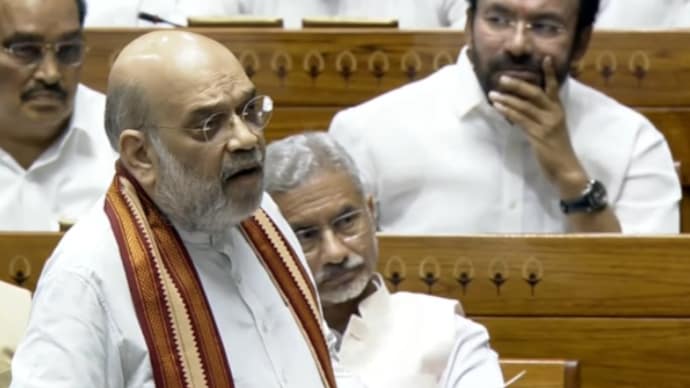
In a significant political development, Union Home Minister Amit Shah on Tuesday submitted a comprehensive dossier to Rajya Sabha Chairman CP Radhakrishnan after the congress party sought verifiable evidence regarding allegations that opposition leaders had insulted the national song Vande Mataram. The move came during a heated parliamentary debate on the cultural and historical significance of the national song.
Congress MP Jairam Ramesh demanded that any claims made during the discussion be supported by factual documentation and formally placed on the House record. Responding promptly, Amit Shah wrote to the Chairman, urging him to ensure that only verified and authenticated information becomes part of the official parliamentary proceedings.
In his letter, Shah stated that he had cited several “incidents of unacceptable conduct” by a few political leaders and parliamentarians in relation to Vande Mataram and the national anthem. He emphasized that these references were not rhetorical but based on real events, prompting him to compile a detailed document outlining each case.
“I respectfully request the Hon’ble Chairman to kindly include these factual details in the official records of the Rajya Sabha,” Shah wrote, asserting that transparency and accuracy are essential when discussing a matter deeply rooted in India’s Cultural Heritage.
Inside the Dossier: Key Incidents Highlighted by Amit Shah
The dossier lists several notable incidents spanning recent years across multiple states and political parties. These cases, according to Shah, demonstrate recurring instances where leaders either refused to sing Vande Mataram or displayed conduct deemed inappropriate toward national symbols.
- December 8, 2025: Congress MP Imran Masood declined to sing Vande Mataram, citing religious beliefs.
- December 8, 2025: Agha Syed Mehdi of the National Conference reportedly refused to sing the national anthem during a parliamentary debate.
- 2019: Samajwadi Party MP Shafiqur Rahman Barq refused to sing Vande Mataram during the Lok Sabha oath-taking ceremony.
- 2025: Jiaur Rahman Barq reiterated his grandfather’s position, publicly stating he would not sing the national anthem.
- 2018: At a Congress event awaiting Rahul Gandhi, only one verse of Vande Mataram was reportedly sung, drawing criticism.
- 2019: Madhya Pradesh Congress MLA Arif Masood refused to sing the national anthem due to religious reasons.
- 2022: Senior Congress leader Siddaramaiah directed party workers not to sing Vande Mataram during a Constitution Day program.
- 2025: The Samajwadi Party opposed a Maharashtra directive mandating the recitation of Vande Mataram in schools.
- 2025: RJD MLA Saud Alam allegedly chose not to stand during the national anthem in the Bihar Assembly.
Each incident in the dossier includes a summary, the year, and individuals involved—an approach aimed at reinforcing the credibility and authenticity of the claims.
Political and Cultural Context of the Debate
Earlier in the day, Amit Shah delivered a strongly worded speech, arguing that the historical “division” of Vande Mataram due to what he termed “appeasement politics” contributed to the conditions that eventually led to India’s partition. His remarks intensified the ongoing debate over the role of national symbols in electoral politics and cultural identity.
Shah criticized the opposition for suggesting that the 150th anniversary discussions surrounding Vande Mataram were politically motivated due to the upcoming West Bengal elections. He insisted that the national song is above party lines and has been a defining element of India’s freedom movement and cultural nationalism.
Opening the debate, Shah described Vande Mataram as a “mantra” that awakened patriotic consciousness during the independence struggle. He reiterated that the song continues to hold immense relevance in shaping India’s future and guiding the nation toward the vision of Viksit Bharat.
Shah also alleged that former Prime Minister Jawaharlal Nehru reduced the poem to only two stanzas, a decision he said was reflective of Congress’s discomfort with the full version of the national song.
Highlighting the enduring significance of the song, Shah added, “Vande Mataram will continue to inspire generations and play a vital role in India’s journey toward becoming a developed nation.”
The latest developments have added a new dimension to the ongoing national conversation on identity, patriotism, and political accountability—making the debate around Vande Mataram more relevant than ever.
For breaking news and live news updates, like us on Facebook or follow us on Twitter and Instagram. Read more on Latest India on thefoxdaily.com.




COMMENTS 0