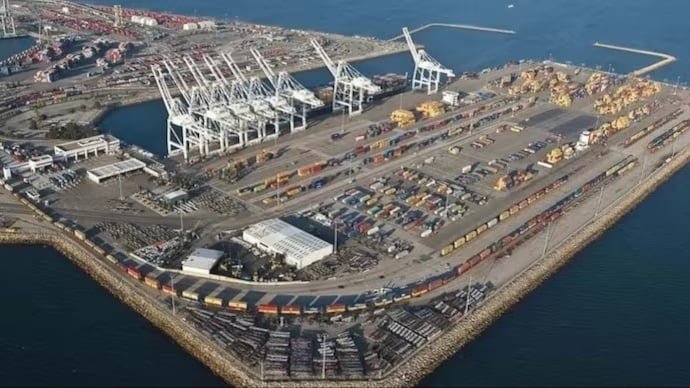
India on Friday said it is in active discussions with the United States to ensure the continuation of its involvement in Iran’s Chabahar Port as the current time-bound Sanctions waiver granted by Washington approaches its expiry later this year.
The waiver, issued by the US Department of the Treasury, is set to expire on April 26, raising concerns over the future of India’s strategic and commercial interests linked to the port.
Responding to questions on the matter, Ministry of External Affairs spokesperson Randhir Jaiswal said that the Indian government remains engaged with US authorities to work out a sustainable arrangement.
“On the question of Chabahar, on October 28, 2025, as you are aware, the US Department of the Treasury issued a letter outlining guidance on the conditional sanctions waiver. This waiver remains valid until April 26, 2026. We continue to work on this arrangement with the US side,” Jaiswal told reporters.
India had secured a six-month waiver in November, which is currently in force. The exemption allows uninterrupted port operations and facilitates trade connectivity with Afghanistan and Central Asia, regions critical to India’s regional outreach and economic diplomacy.
Located on Iran’s southeastern coast, Chabahar Port holds strategic importance as it lies outside the Strait of Hormuz, a narrow maritime chokepoint linking the Arabian Sea to the Persian Gulf and frequently vulnerable to geopolitical tensions.
India is a key development partner in the Chabahar port project, which has long been viewed as a cornerstone of New Delhi’s strategy to enhance regional connectivity while bypassing Pakistan.
To secure a long-term presence at the port, India and Iran signed a 10-year bilateral agreement in 2024, replacing a series of short-term and provisional arrangements that had governed India’s role in the project for years.
Recent developments in Tehran have emerged as a growing concern for Indian policymakers. Iran occupies a central place in New Delhi’s strategic calculus, serving as a gateway not only to Afghanistan and Central Asia but also to Europe through multimodal transport corridors.
Chabahar is also a crucial node in the International North–South Transport Corridor, a flagship connectivity initiative designed to link Mumbai with St. Petersburg and European markets via Iran.
Officials expect the completion of port expansion works and a 700-kilometre railway line connecting Chabahar to Zahedan and Iran’s national rail network by mid-2026. Any disruption to these projects due to sanctions uncertainty or regional instability could significantly affect India’s trade flows, logistics planning, and regional influence.
The INSTC offers India a shorter and more cost-effective alternative to traditional maritime routes, reducing transit time and dependence on longer sea passages. Prolonged instability or delays linked to Iran could undermine years of strategic planning, increase logistics costs, and slow regional integration efforts.
For breaking news and live news updates, like us on Facebook or follow us on Twitter and Instagram. Read more on Latest India on thefoxdaily.com.






COMMENTS 0