- Tangkhul Hui Implemented as Pilot Project
- Operational Success of Tangkhul Hui Breed
- Kombai Breed to Be Inducted in Phases
- Assam Rifles Dog Training Centre: Capacity and Infrastructure
- Training Programs and Specialized Courses
- Operational Achievements and Future Plans
- Strengthening Self-Reliance in Security Forces
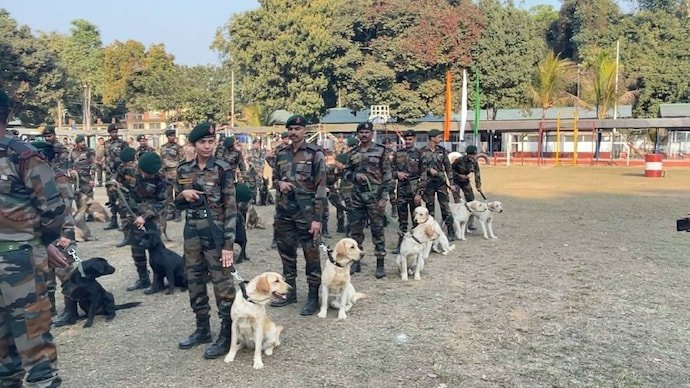
In line with the Centre’s Atmanirbhar Bharat initiative, the Assam Rifles has intensified efforts to induct more indigenous dog breeds into its canine squad. The move is aimed at promoting self-reliance while strengthening operational effectiveness through the integration of resilient native breeds.
A senior official confirmed on Thursday that the paramilitary force is expanding its indigenisation drive by preparing to introduce additional Indian breeds into its working dog units. The initiative reflects a broader push by the Ministry of Home Affairs (MHA) to encourage the use of homegrown resources across security forces.
Tangkhul Hui Implemented as Pilot Project
Officer Commanding Lt Col Alok Palei of the Assam Rifles Dog Training Centre (ARDTC) told PTI that the force has already inducted the Tangkhul Hui breed under a pilot project. The next phase will see the inclusion of the Kombai breed beginning in April.
“The Union Home Minister has consistently promoted Atmanirbhar Bharat across sectors. He has also expressed the desire to see more Indian dog breeds in military and paramilitary dog squads. Since then, we have been actively identifying indigenous breeds that suit our operational requirements,” Palei said.
Following a directive from the Union Ministry of Home Affairs last year, the force initiated a systematic identification process to select suitable native breeds. Currently, Assam Rifles deploys four breeds in its canine wing: Tangkhul Hui, German Shepherd, Labrador Retriever, and Belgian Malinois.
Operational Success of Tangkhul Hui Breed
As part of a trial initiative, six Tangkhul Hui dogs were inducted into the force in 2022. According to Lt Col Palei, the breed has demonstrated strong disease resistance and adaptability to field conditions. All six dogs are presently deployed in narcotics detection roles.
The Tangkhul Hui originates from the Ukhrul district of Manipur and has traditionally been used as a hunting dog. Its endurance and agility have made it particularly suitable for challenging terrains in the Northeast.
Kombai Breed to Be Inducted in Phases
The next indigenous breed set for induction is the Kombai, a native of Tamil Nadu known for its strength, loyalty, and guarding instincts. Assam Rifles plans to introduce the breed in stages.
“We are currently working to determine the parent stock. The breeding process will span the first three years. As an initial step, we will induct two male and eight female Kombai dogs in April,” Palei stated.
He added that both Tangkhul Hui and Kombai breeds are expected to be fully integrated into the force’s canine squad by March 2027.
Assam Rifles Dog Training Centre: Capacity and Infrastructure
The ARDTC, located in Jorhat district of Assam, is the sole canine training facility within the Assam Rifles. At present, the centre houses 104 dogs and 174 handlers undergoing various phases of training.
Although the authorized strength of the canine unit is 344 dogs, the force currently has 253 dogs deployed across battalions operating in the Northeast and Jammu & Kashmir. Maintaining each working dog requires nine to ten personnel for training, healthcare, and operational readiness. Overall, the force has more than 1,200 trained dog handlers.
Training Programs and Specialized Courses
The ARDTC conducts multiple courses to maintain high professional standards. For handlers, the centre offers:
- A 23-week basic dog handling course
- A four-week dog first aid course
- A two-week refresher course
For canines, the training includes:
- A 12-week basic obedience program
- A two-week refresher module
- A 36-week specialized course covering narcotics detection, explosive detection, and tracking
The 42nd batch of the foundational dog handling course is currently underway. Upon completion, top-performing handlers are selected for advanced training, including a 24-week master trainer course at the CRPF Dog Breeding & Training School. Additionally, personnel are deputed to the Remount Veterinary Corps Centre for a six-month program. Trained staff subsequently return to ARDTC as instructors, strengthening institutional expertise.
Operational Achievements and Future Plans
Highlighting the effectiveness of the canine unit, Lt Col Palei noted that the squad played a key role in the seizure of a large narcotics consignment trafficked from Myanmar into a Northeastern state in September 2025. While operational details were not disclosed, the incident underscored the strategic importance of well-trained detection dogs.
Looking ahead, Assam Rifles is exploring dual-purpose canine training modules. These would combine assault capabilities with tracking, as well as assault functions integrated with explosive detection skills. The force is also considering training search and rescue dogs to assist during natural disasters and humanitarian emergencies.
Strengthening Self-Reliance in Security Forces
The induction of indigenous breeds like Tangkhul Hui and Kombai reflects a strategic shift toward self-reliance in India’s security ecosystem. By leveraging native breeds that are naturally adapted to local climates and terrains, Assam Rifles aims to enhance operational efficiency while supporting the broader objectives of Atmanirbhar Bharat.
As the integration process progresses, the initiative may serve as a model for other armed and paramilitary forces seeking to balance operational excellence with national self-sufficiency.
For breaking news and live news updates, like us on Facebook or follow us on Twitter and Instagram. Read more on Latest India on thefoxdaily.com.

COMMENTS 0