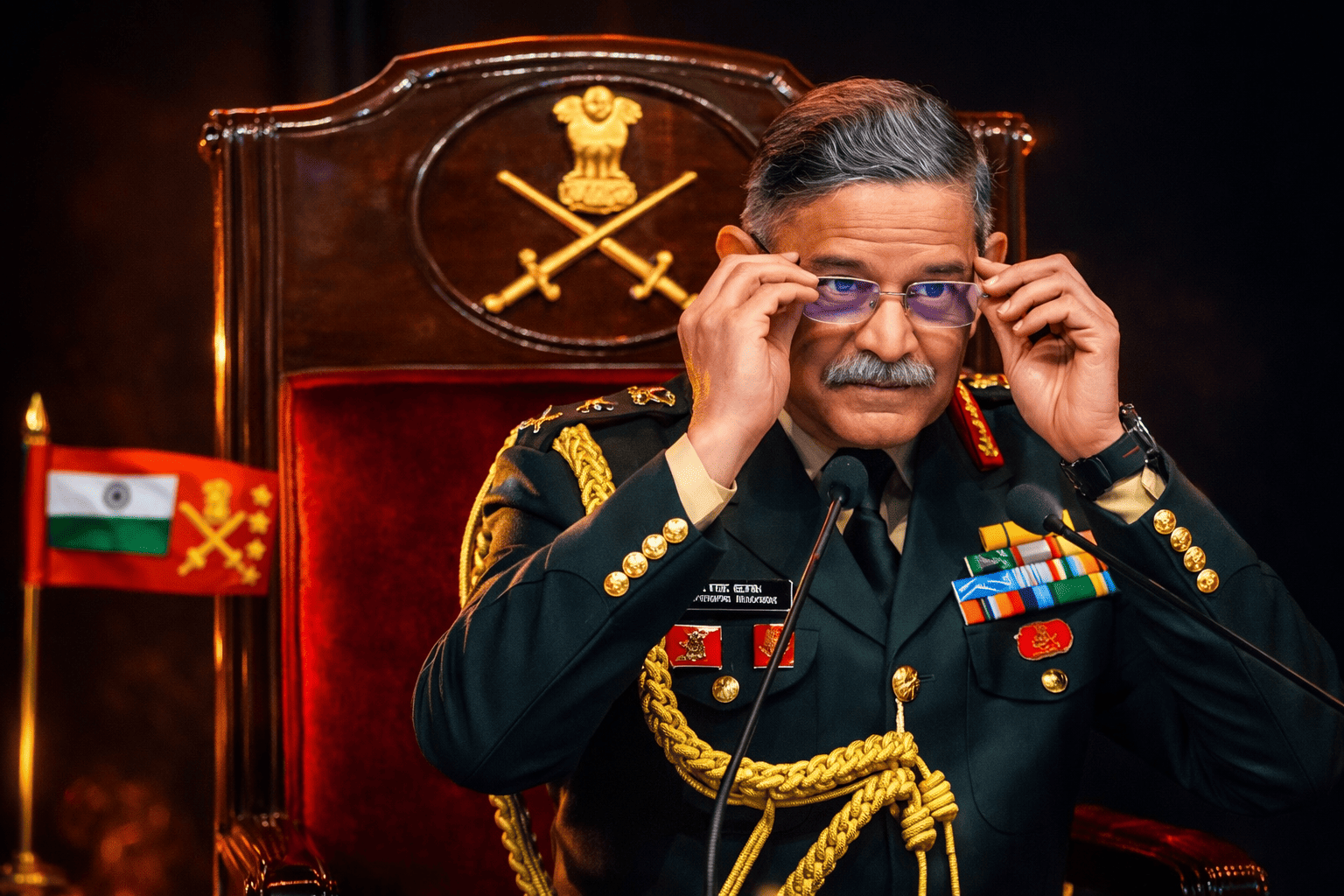
On Tuesday, Army Chief General Upendra Dwivedi firmly restated India’s long-standing and unequivocal position that the 1963 Shaksgam Valley agreement between china and Pakistan is unlawful, illegitimate, and unacceptable to New Delhi.
Addressing the issue, General Dwivedi underscored that India has never acknowledged the so-called agreement in which Pakistan purportedly handed over Indian territory to China. “India does not accept this agreement. We have never recognised it,” he said, reinforcing New Delhi’s consistent diplomatic and military stance on the matter.
His remarks come amid growing concern in India over China’s expanding infrastructure activity in the Shaksgam Valley, a region New Delhi maintains is illegally occupied Indian territory.
The Ministry of External Affairs (MEA) has repeatedly stated that Pakistan illegally transferred approximately 5,180 square kilometres of Indian territory in the Shaksgam Valley to China in 1963. MEA spokesperson Randhir Jaiswal recently reiterated that India has “never recognised the so-called China–Pakistan boundary agreement” and has consistently termed it unlawful and void.
Jaiswal further reaffirmed India’s rejection of the China-Pakistan Economic Corridor (CPEC), which passes through Indian territory under Pakistan’s illegal occupation. He stressed that the entire Union Territories of Jammu & Kashmir and Ladakh are integral and inalienable parts of India—a position that has been clearly and repeatedly conveyed to both China and Pakistan.
India’s concerns have intensified following reports that China is undertaking major infrastructure development in the Shaksgam Valley as part of CPEC-linked projects. According to these reports, Beijing is constructing an all-weather road in the region, with nearly 75 kilometres—around 10 metres wide—already completed. Indian officials have warned that such activities risk altering ground realities in an area India considers its sovereign territory.
In response, the MEA has asserted that the Shaksgam Valley is part of Indian territory and that India reserves the right to take “necessary measures” to safeguard its interests. China, however, has dismissed India’s objections, claiming that its construction activities in the region are “beyond reproach.”
These developments have once again highlighted what New Delhi views as China’s contradictory position on Kashmir—publicly terming it a bilateral issue between India and Pakistan while simultaneously pursuing strategic infrastructure projects in parts of the region illegally occupied by Pakistan.
Strategic Importance of the Shaksgam Valley
The Shaksgam Valley, also known as the Trans-Karakoram Tract, lies in the eastern Karakoram range near the Siachen Glacier. It is bordered by Pakistan-occupied Kashmir to the south and west, and China’s Xinjiang region to the north.
The valley holds immense military and strategic significance due to its proximity to the Siachen Glacier—the world’s highest battlefield—and its access routes towards the Karakoram Pass. From Siachen, India is able to closely monitor Pakistani movements, while Chinese activities can be observed via the Karakoram Pass.
As a result, any control or influence over the Shaksgam Valley directly impacts India’s military posture along both the Line of Actual Control (LAC) with China and the Line of Control (LoC) with Pakistan.
Pakistan’s Cession of Indian Territory
China claimed sovereignty over the Shaksgam Valley following the 1963 “boundary agreement” with Pakistan, which involved territory from the Hunza-Gilgit region. India formally objected to the agreement at the time, but Pakistan’s illegal occupation of adjoining areas prevented India from exercising physical control over the valley.
Legally, the Shaksgam Valley became part of Indian territory following the accession of Jammu and Kashmir to India in October 1947. India–China relations deteriorated during the 1950s after Chinese incursions into eastern Hunza. Subsequently, Pakistan under President Ayub Khan moved closer to Beijing and formally ceded the Shaksgam Valley and areas along the Yarkand River to China in 1963, disregarding India’s objections.
Since the Doklam standoff with India, China has significantly stepped up military and infrastructure activity in the region, transforming a territory that legally belongs to India into a major security concern for New Delhi.
With Beijing continuing to consolidate its presence in the Shaksgam Valley, India views the developments as a serious and growing strategic challenge—one that reinforces the need for constant vigilance along its northern frontiers.
For breaking news and live news updates, like us on Facebook or follow us on Twitter and Instagram. Read more on Latest India on thefoxdaily.com.





COMMENTS 0