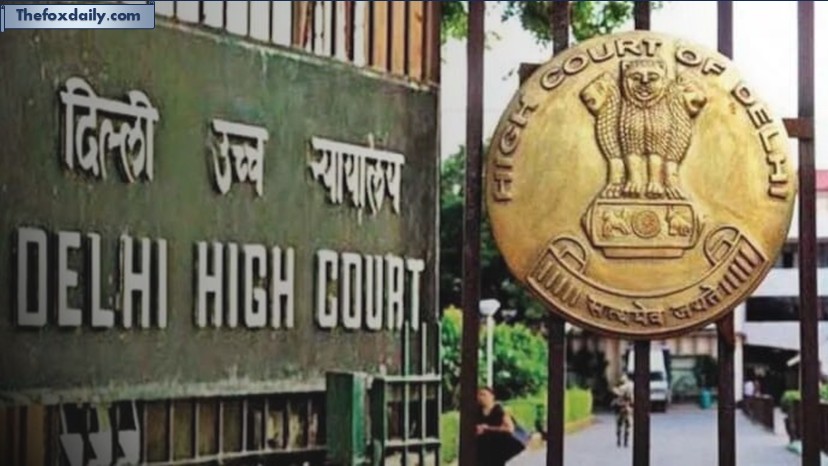
The Delhi High Court has ordered a Family Court judge handling matrimonial disputes to undergo a mandatory and comprehensive refresher training program in matrimonial law before adjudicating further cases. This direction came after the High Court found that the judge had granted a woman’s divorce without recording any evidence and had relied on a provision that does not exist within the statutory framework of the Special Marriage Act (SMA).
A division bench comprising Justices Anil Kshetarpal and Harish Vaidyanathan Shankar set aside the impugned order—challenged by the estranged husband—and remanded the matter back to the family court for a fresh hearing. The bench highlighted serious judicial inconsistencies, noting that the judge had applied SMA provisions even though the divorce petition had been filed under the Hindu Marriage Act (HMA) citing cruelty.
“The Family Court Judge acted unreasonably, not only by deciding the matter without any evidence after hastily closing the wife’s right to lead evidence, but also by applying substantive provisions of the SMA to a petition clearly filed under the HMA, and further relying upon a provision that does not exist in the SMA statute book,” the High Court stated in a strongly worded order.
The High Court also dismissed the family court judge’s explanation that the decree of divorce was granted to save judicial time and avoid prolonged litigation. The bench emphasized that procedural shortcuts cannot be used to override statutory requirements or due process.
“Such basic mistakes in procedure and law cannot be justified by citing the need to ‘save court time’. The overall conduct displayed by the learned Family Court Judge reflects a worrying lack of understanding of fundamental legal principles, the correct application of statutory provisions, and the jurisdictional limits within which a court must operate,” the High Court observed.
The bench cautioned that continued disregard of statutory frameworks in the name of expeditious disposal of cases would severely undermine the justice system. “If courts determine cases in this manner—ostensibly for rapid disposal but in complete disregard of applicable statutory provisions—it will lead to an inevitable collapse of the administration of justice. Courts cannot set aside the law for convenience or haste,” the order stated.
The bench further noted that this was not an isolated instance. It remarked that the same judge had, on several occasions, ignored clear statutory mandates. Consequently, the High Court directed that the judge must undergo a detailed refresher program in Matrimonial Laws at the Delhi Judicial Academy before taking up any further matrimonial matters.
“The same learned Judge has, in various matters before this Bench, repeatedly violated clear statutory mandates. While appellate courts exist to correct errors, they cannot allow situations where judgments are based on nonexistent laws or where proceedings violate statutory frameworks,” the High Court emphasized.
The division bench also took strong exception to the family court judge’s remark that marriages solemnised under the SMA “cannot be regarded as a holy union”. Calling the interpretation misguided, the High Court said the remark was an unwarranted extrapolation based on a selective and flawed reading of matrimonial statutes.
The matter reached the family court in Delhi after the Supreme Court transferred multiple matrimonial proceedings between the couple—married in 2011—from a West Bengal court. The transfer was granted following a plea by the woman, who works as a lecturer at the University of Hull in the United Kingdom and has been residing there since August 2023.
Responding to the woman’s plea, the Supreme Court shifted the cases to the national capital to ensure convenience and proper judicial access, as she faced significant difficulties pursuing the litigation in West Bengal while living abroad.
For breaking news and live news updates, like us on Facebook or follow us on Twitter and Instagram. Read more on Latest India on thefoxdaily.com.


COMMENTS 0