- ALL AIR MONITORING STATIONS RECORD ‘SEVERE’ AQI
- NCR CITIES ALSO GRAPPLE WITH DANGEROUS AIR
- DENSE FOG SEVERELY IMPACTS VISIBILITY
- IMD ISSUES DENSE FOG WARNING
- WEAK WINDS WORSEN POLLUTION CONDITIONS
- GRAP STAGE-IV ENFORCED ACROSS DELHI-NCR
- METEOROLOGICAL FACTORS BEHIND AQI SPIKE
- 5-POINT EMERGENCY ACTION PLAN ACTIVATED
- CONSTRUCTION AND MINING ACTIVITIES HALTED
- SCHOOLS SHIFT TO HYBRID LEARNING MODE
- HEALTH ADVISORY ISSUED FOR RESIDENTS
- BRIEF RESPITE EARLIER THIS WEEK
- UNDERSTANDING AQI AND HEALTH RISKS
- AUTHORITIES URGE EXTREME CAUTION
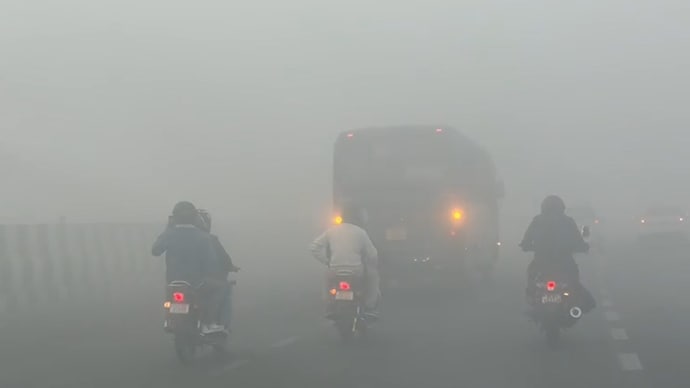
Air pollution in Delhi and its surrounding regions worsened dramatically on Sunday, a day after the city slipped into the “severe” category. A thick blanket of toxic smog enveloped the national capital and large parts of the National Capital Region (NCR), pushing pollution levels to dangerous extremes and severely reducing visibility.
According to data released by the Central Pollution Control Board (CPCB), Delhi’s average Air Quality Index (AQI) rose from 431 on Saturday to 461 by 7 a.m. on Sunday, placing it firmly in the “severe+” zone.
ALL AIR MONITORING STATIONS RECORD ‘SEVERE’ AQI
Data from all 40 air quality monitoring stations across Delhi showed readings in the “severe” category, with several locations nearing the maximum measurable AQI limit.
Rohini recorded an AQI of 499, followed closely by Bawana at 498, Vivek Vihar at 495, and Ashok Vihar and Wazirpur at 493 each. Narela logged 492, while Anand Vihar stood at 491.
Other heavily polluted areas included ITO (485), Mundaka (486), Punjabi Bagh (478), Nehru Nagar (476), Chandni Chowk (470), and Okhla (470), highlighting the widespread nature of the crisis.
Even traditionally greener zones failed to escape the toxic air, with Najafgarh recording an AQI of 404 and Lodhi Road touching 400.
NCR CITIES ALSO GRAPPLE WITH DANGEROUS AIR
The pollution crisis extended well beyond Delhi, with several NCR cities reporting alarming AQI levels.
Ghaziabad registered an AQI of 460, while Noida reported a reading of 470, both categorised as “severe.” Gurugram’s air quality remained “very poor” at 348, and Faridabad recorded an AQI of 220, falling under the “poor” category.
DENSE FOG SEVERELY IMPACTS VISIBILITY
The severity of pollution became visibly evident during the early morning hours as dense fog and mist engulfed large parts of the city, drastically reducing visibility.
At the Indira Gandhi International (IGI) Airport, low-visibility protocols were implemented after visibility dropped to near-zero levels in certain pockets. While flight operations continued, pilots were advised to follow precautionary procedures due to fluctuating visibility conditions.
IMD ISSUES DENSE FOG WARNING
The India Meteorological Department (IMD) warned that visibility at IGI Airport could fall to as low as 100 metres during dense fog conditions early Sunday, before improving to around 800 metres under shallow fog later in the day.
The IMD also forecast moderate to dense fog across several parts of Delhi during the early hours of December 14, with shallow to moderate fog likely to persist over the next few days.
WEAK WINDS WORSEN POLLUTION CONDITIONS
In its daily weather bulletin, the IMD attributed the deteriorating air quality to unfavourable meteorological conditions, including the presence of a strong subtropical westerly jet stream over northwest India and a western disturbance lingering over north Pakistan.
The agency warned that mist, haze, and fog are likely to persist during night and morning hours, although partly cloudy skies may prevail over Delhi for the next 48 hours before clearer conditions set in.
GRAP STAGE-IV ENFORCED ACROSS DELHI-NCR
In response to the worsening pollution trend, the Sub-Committee of the Graded Response Action Plan (GRAP) under the Commission for Air Quality Management (CAQM) convened an emergency meeting on Saturday night.
Following a steady AQI rise from 431 at 4 p.m. to 441 by 6 p.m., the panel decided to enforce all Stage-IV (“Severe+”) measures across the entire NCR with immediate effect.
METEOROLOGICAL FACTORS BEHIND AQI SPIKE
CAQM clarified that the sudden deterioration in air quality was primarily driven by adverse weather conditions rather than an abrupt rise in emissions.
Key factors included a shift in wind direction from westerly to easterly, a sharp drop in wind speed—sometimes to calm conditions—and increased moisture in the lower atmosphere due to the approaching western disturbance.
Such winter conditions trap pollutants close to the surface, preventing dispersion and intensifying fog and smog formation.
5-POINT EMERGENCY ACTION PLAN ACTIVATED
Under Stage-IV GRAP restrictions, a stringent five-point emergency action plan has been rolled out across Delhi-NCR.
While LNG, CNG, electric vehicles, and BS-VI diesel vehicles are allowed, the entry of BS-IV diesel trucks—except those carrying essential goods or providing critical services—has been prohibited.
The operation of BS-IV and older diesel-powered heavy goods vehicles registered in Delhi has also been completely banned, barring essential services.
CONSTRUCTION AND MINING ACTIVITIES HALTED
All construction and demolition activities have been suspended, including linear public infrastructure projects such as roads, flyovers, pipelines, highways, and power transmission lines.
Mining operations, stone crushers, and related industrial activities across the NCR have also been ordered to shut down until further notice.
SCHOOLS SHIFT TO HYBRID LEARNING MODE
To safeguard children’s health, the Delhi government and NCR state authorities have directed schools to conduct classes for students from Classes VI to IX and XI in a hybrid mode, combining online and offline teaching wherever feasible.
Authorities may consider extending hybrid learning to additional NCR regions, giving students and parents the option to opt for online classes.
State governments have also been advised to consider further emergency steps, including odd-even vehicle schemes and the closure of colleges and non-essential commercial activities.
HEALTH ADVISORY ISSUED FOR RESIDENTS
CAQM has urged residents to strictly follow the Citizen Charter under GRAP.
Children, senior citizens, and individuals with respiratory, cardiovascular, or chronic illnesses have been advised to remain indoors as much as possible and wear masks if outdoor movement is unavoidable.
BRIEF RESPITE EARLIER THIS WEEK
Delhi had witnessed a short-lived improvement earlier in the week, with AQI levels dropping to 282 on Tuesday and 259 on Wednesday.
However, the relief was temporary. Pollution levels began rising again from Thursday, returned to the “severe” category on Saturday, and worsened further on Sunday.
UNDERSTANDING AQI AND HEALTH RISKS
As per CPCB guidelines, AQI is calculated using eight pollutants—PM2.5, PM10, nitrogen oxides, sulphur dioxide, ozone, carbon monoxide, ammonia, and lead.
AQI values above 401 fall under the “severe” category and can affect even healthy individuals, while levels between 301 and 400 are classified as “very poor.”
Prolonged exposure may lead to respiratory distress, cardiovascular complications, reduced lung function, and eye and throat irritation.
AUTHORITIES URGE EXTREME CAUTION
Authorities have urged residents to minimise outdoor activity, avoid strenuous exercise, use public transport, and reduce vehicle usage to curb emissions.
With hazardous smog continuing to blanket Delhi-NCR and unfavourable weather conditions persisting, concerns are mounting that dangerous air quality levels could continue in the coming days, placing further strain on public health and daily life in the capital.
For breaking news and live news updates, like us on Facebook or follow us on Twitter and Instagram. Read more on Latest India on thefoxdaily.com.





COMMENTS 0