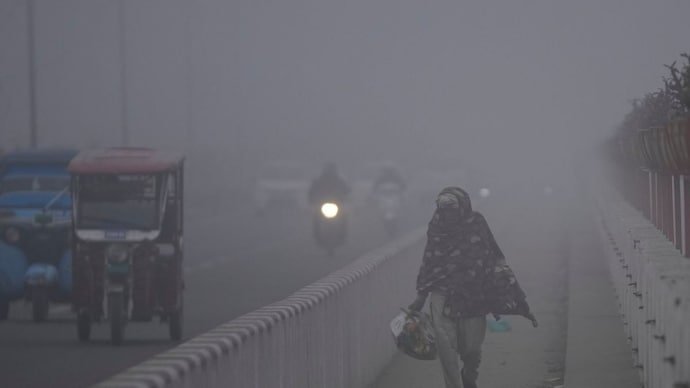
Delhi-NCR woke up to a harsh winter spell on Saturday, engulfed in a toxic mix of thick fog, biting cold, and dangerously high pollution levels. Visibility dropped to alarming lows across large parts of the region, disrupting flight operations, slowing road and rail traffic, and adding to the discomfort of residents already battling an intense cold wave.
According to the India Meteorological Department (IMD), the national capital recorded a minimum temperature of 7 degrees Celsius on Saturday, while the maximum temperature settled at around 22 degrees Celsius. A dense blanket of fog spread across north India during the early morning hours, significantly affecting visibility in several states.
Fog conditions remained dense to extremely dense across punjab, Haryana, and Uttar Pradesh. In Uttar Pradesh, cities such as Saharanpur, Ghaziabad, Bareilly, Gorakhpur, and Kanpur reported very dense fog with near-zero visibility. Meanwhile, Lucknow, Varanasi, and Prayagraj experienced dense fog, with visibility reduced to between 50 and 100 metres as of 6.30 am.
Weather data from the IMD showed that Delhi-NCR continued to experience cold and dry winter conditions around 8.30 am, with no precipitation recorded at any monitoring station. Maximum temperatures ranged between 19.0 and 22.5 degrees Celsius. Safdarjung and Ayanagar registered the highest maximum temperature of 22.5 degrees Celsius, which was 2.9 and 3.1 degrees above normal, respectively. Palam recorded a comparatively lower maximum of 19.0 degrees Celsius, remaining slightly below normal.
Minimum temperatures across the region stayed unusually low, fluctuating between 4.4 and 5.7 degrees Celsius. Safdarjung recorded the lowest minimum temperature at 4.4 degrees Celsius, followed closely by Ayanagar at 4.9 degrees Celsius, both significantly below seasonal averages. Palam reported the highest minimum temperature at 5.7 degrees Celsius.
Over the past 24 hours, most stations recorded a marginal rise in both maximum and minimum temperatures, except for a slight dip in minimum temperature at Ridge. The absence of rainfall indicated persistent dry weather conditions, further aggravating pollution levels.
The combination of dense fog and hazardous smog prompted authorities to reimpose Graded Response Action Plan (GRAP) Stage III restrictions across Delhi-NCR to curb worsening air quality.
#WATCH | Delhi | A thick layer of toxic pollution engulfed the national capital. Visuals from the ITO area show extremely poor air quality. As per CPCB data, the AQI in the region stood at 402, categorised as ‘Severe’. GRAP-III restrictions have been reimposed across Delhi-NCR.
#WATCH | Delhi | Dense layer of toxic smog engulfs the national capital. Visuals from the ITO area. CPCB claims that the AQI in the area is at ‘402’, categorised as ‘Severe’. GRAP-III restrictions reimposed in Delhi-NCR. pic.twitter.com/xmYP9O75VE
— ANI (@ANI) January 17, 2026
According to the Central Pollution Control Board (CPCB), Delhi’s overall Air Quality Index stood at 368 at 7 am, placing it in the “very poor” category. Several air quality monitoring stations across the city recorded AQI levels above 400, indicating “severe” pollution.
Among the worst-affected areas were Anand Vihar (442), Patparganj (433), Chandni Chowk (427), Nehru Nagar (423), Vivek Vihar (420), and Jahangirpuri (416). Other locations such as Dwarka, ITO, Sonia Vihar, and Wazirpur continued to remain in the “very poor” category, while the area around IGI Airport recorded an AQI of 304.
Neighbouring NCR cities also reported alarming pollution levels, with Gurugram recording an AQI of 345, Noida at 385, Ghaziabad at 380, and Faridabad at 253.
Dense fog in the early morning hours severely affected visibility, leading to delays in flight operations at Indira Gandhi International Airport. Road and rail traffic also moved at a slower pace across several parts of Delhi-NCR as commuters navigated near-whiteout conditions.
#WATCH | Delhi | Several flights were delayed at IGI Airport due to dense fog as the capital continued to experience cold wave conditions. (Visuals from Indira Gandhi International Airport)
#WATCH | Delhi | As cold waves grip the national capital, few flights are delayed at IGI Airport due to fog.
(Visuals from Indira Gandhi International Airport) pic.twitter.com/E4HiQjMerm
— ANI (@ANI) January 17, 2026
The IMD has forecast dry winter weather for Delhi over the next seven days, with clear to partly cloudy skies and no rainfall expected. However, shallow to moderate fog is likely during morning hours before clearing as temperatures rise during the day.
Night-time and early morning conditions are expected to remain cold, with mist or haze affecting visibility on certain days. Daytime temperatures are forecast to gradually rise to between 20 and 25 degrees Celsius after January 16.
Minimum temperatures, however, are expected to stay on the lower side during the first half of the week. From January 18 onwards, night-time temperatures are predicted to increase gradually to between 8 and 10 degrees Celsius, offering some relief from the prevailing cold wave.
For breaking news and live news updates, like us on Facebook or follow us on Twitter and Instagram. Read more on Latest India on thefoxdaily.com.





COMMENTS 0