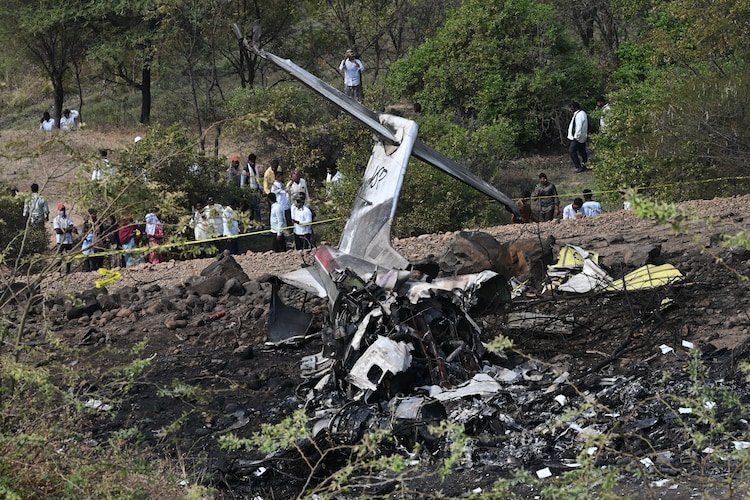
Debate around aviation safety at India’s tabletop runways has intensified following reports of a Learjet accident at Baramati Airport on Wednesday morning. The incident, which occurred during the final phase of landing, has once again brought attention to the inherent challenges posed by elevated runways, particularly amid claims of a problematic approach at the airfield.
The tragedy has drawn comparisons with earlier accidents at similar airports, most notably the 2010 Mangalore air crash that claimed 158 lives and the 2020 Air India Express crash at Kozhikode during heavy monsoon rains, which resulted in 21 fatalities. In both cases, investigations pointed primarily to pilot error, but experts acknowledged that the tabletop runway design significantly amplified the consequences.
Baramati Airport joins a small but notable list of Indian airports with tabletop runways, including Kozhikode, Mangalore, Lengpui, Shimla, and Pakyong. These airstrips are constructed on elevated terrain, often with steep drops at one or both ends, leaving minimal room for error during landing or take-off.
Aviation specialists explain that tabletop runways can create visual or optical illusions, especially during poor visibility, making the runway appear closer or farther than it actually is. This visual misjudgment can complicate an already demanding phase of flight, particularly during descent.
However, not all experts agree that the runway design alone should be blamed. A senior commercial pilot familiar with Baramati airport rejected the notion that the tabletop layout was the primary cause of the crash.
“A tabletop runway is still a runway,” the pilot said. “Whether it is on a plateau, near the sea, or on flat land, the fundamentals remain the same—runway length, touchdown zone, threshold markings, and adherence to procedures.”
According to the pilot, visibility and decision-making during the approach were far more critical factors. At the time of the attempted landing, visibility was reportedly around 3,000 metres—well below the recommended 5,000 metres for safe visual operations.
“Descending below circuit altitude without the runway clearly in sight is a serious error,” he explained, adding that attempting an approach under such conditions significantly increases risk.
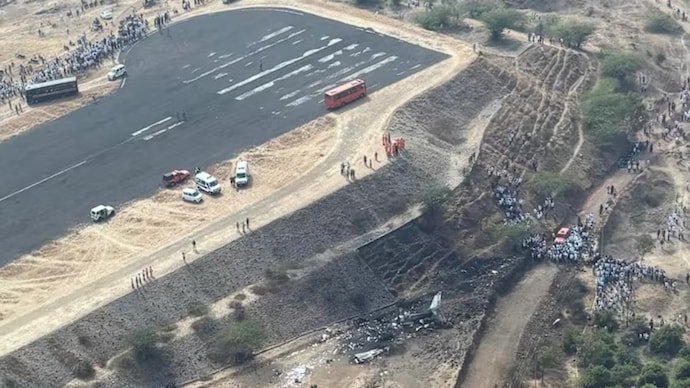
Wreckage from the Learjet was found roughly 200 metres from the edge of the elevated runway, highlighting how little margin exists at tabletop airports once an approach becomes unstable.
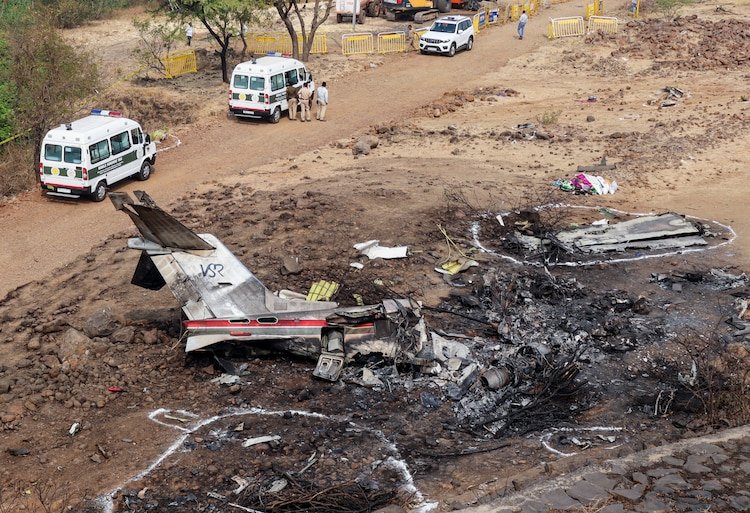
The pilot further stressed the importance of a stabilized approach—where speed, descent rate, and alignment are fully under control. In this case, the aircraft reportedly executed a sudden manoeuvre known as a “wing over,” losing stability before impact.
The accident occurred during the final moments of landing at the relatively small Baramati airport, which sits about 604 metres above mean sea level and does not have advanced landing aids such as an Instrument Landing System (ILS).
Flight tracking data from Flightradar24 indicates that the Learjet 45 (registration VT-SSK), which departed Mumbai at 8:10 am, was attempting a second approach when it crashed near the runway edge at approximately 8:46 am.
Another aviation expert, Commander Naveen Pandita—a former Indian Navy pilot now flying commercially—highlighted the structural risks associated with tabletop runways.
“A tabletop runway is like landing on the tenth floor of a building,” he said. “If you don’t stop precisely where you should, there is virtually no margin for error—only a steep drop.”
Pandita also drew attention to the “black hole effect,” a visual illusion that can occur during approaches in low visibility or poor lighting conditions. “Your brain can misjudge altitude, making you think you are higher than you actually are,” he explained.
“If a pilot reacts to that illusion instead of strictly following instruments, they may end up flying a dangerously low approach—straight toward the edge of the plateau,” he added.
The absence of an ILS at Baramati further complicated the approach, forcing pilots to rely heavily on visual cues and onboard instruments.
“Even the most advanced aircraft is still governed by the laws of physics,” Pandita noted. “Technology helps manage risk, but it doesn’t eliminate it.”
He also pointed out that business jets like the Learjet often approach at higher speeds and lack the powerful thrust reversers and braking systems found on larger commercial aircraft. Combined with sudden updrafts and crosswinds common near plateau edges, these factors can significantly increase landing complexity.
Echoes of Past Tabletop Runway Disasters
The Baramati incident inevitably revives memories of previous tabletop runway disasters in India, underlining the unique hazards of such airfields. In August 2020, an Air India Express Boeing 737 overshot the runway at Kozhikode amid heavy rain and poor visibility, plunging nearly 35 feet into a gorge and killing 21 people.
Following that crash, aviation regulators described tabletop airports as “critical” and called for expanded runway safety areas, improved infrastructure, and stricter operational procedures compared to conventional runways with larger buffer zones.
A decade earlier, another Air India Express flight overshot the tabletop runway at Mangalore, resulting in the deaths of 158 passengers and crew. While pilot error was identified as the primary cause, investigators acknowledged that the airport’s elevated design magnified the severity of the accident.
As investigators now piece together the sequence of events at Baramati, broader questions around pilot training, airport infrastructure, and regulatory oversight are once again in focus—especially as regional air connectivity continues to expand rapidly across India.
For breaking news and live news updates, like us on Facebook or follow us on Twitter and Instagram. Read more on Latest India on thefoxdaily.com.

COMMENTS 0