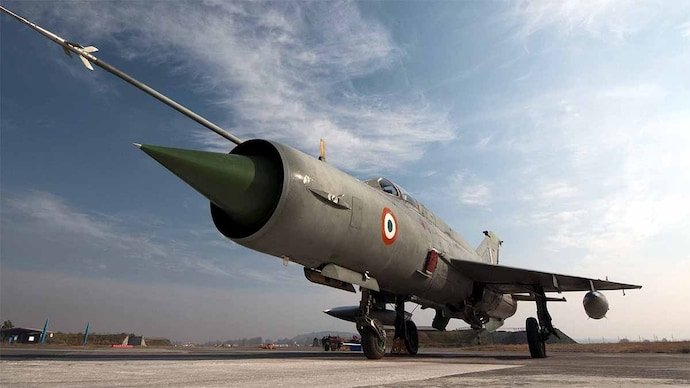
The Indian Air Force’s (IAF) tactical decisions during the 2019 Balakot air combat have long been debated, particularly the deployment of MiG-21 Bison fighter jets against Pakistan’s more advanced F-16s. The discussion intensified after Wing Commander Abhinandan Varthaman’s MiG-21 was shot down during the aerial engagement.
Many defence analysts and observers questioned whether deploying the Soviet-era MiG-21 against modern F-16s was a sound operational choice. These concerns have now been addressed by former Chief of the Air Staff Air Chief Marshal (Retd.) BS Dhanoa, who led the IAF during the Balakot strikes.
Speaking in a recent interview with The Lallantop, India Today Group’s digital platform, Dhanoa acknowledged that questions had been raised over whether more advanced aircraft could have been used during the dogfight.
However, he stressed that the decision was driven by operational realities rather than preference or planning lapses.
When asked why MiG-21 Bisons were flown despite the knowledge that Pakistani F-16s would be involved, Dhanoa responded pointedly, “Did we have better planes?”
Explaining the constraints, he said that only MiG-21s were operationally available at Srinagar airbase at the time. “The geography of the region prevented Su-30 MKIs from reaching the dogfight area in time,” he noted.
Dhanoa further revealed that Hindustan Aeronautics Limited (HAL) was expected to deliver 27 upgraded Mirage 2000 aircraft capable of operating from the region, but only seven had been delivered by then.
“We also had the LCA Tejas, but it did not have the required weapon systems to support that particular mission,” he said.
“We had no choice but to deploy the MiG-21s. Personally, I do not believe the MiG-21 should have been there. Even the Prime Minister has said that if Rafales had been available, the outcome would have been different. But when the enemy attacks, you fight with what you have—there is no other option,” Dhanoa added.
The former IAF chief’s remarks underline the challenges faced by the force during a period of fleet transition and delayed inductions of modern aircraft.
On February 26, 2019, Indian aircraft carried out Airstrikes on a Jaish-e-Mohammad terror camp in Balakot, Pakistan, in retaliation for the Pulwama terror attack. The following day, Pakistani fighter jets attempted to target Indian military installations in Jammu and Kashmir.
In response, the IAF scrambled MiG-21 Bison fighters, leading to a high-intensity aerial engagement with Pakistani F-16s.
During the dogfight, an Indian MiG-21 Bison piloted by Wing Commander Varthaman was shot down, and the pilot was captured by Pakistan. He was released and returned to India two days later.
India has maintained that a Pakistani F-16 was also shot down during the engagement, a claim Pakistan has denied.
The incident reignited debate over the continued use of the MiG-21, one of the oldest fighters still in service, and its deployment against technologically superior aircraft.
Defending the aircraft, Dhanoa emphasized that the MiG-21 Bison is not a basic legacy jet but a significantly upgraded version of the MiG-21bis.
He noted that the Bison variant is equipped with improved avionics, better radar, and modern air-to-air missiles, enhancing its combat capability despite its age.
The episode has since accelerated discussions around fleet modernization, leading to the induction of Rafale fighter jets and a renewed focus on replacing the MiG-21s from frontline service.
For breaking news and live news updates, like us on Facebook or follow us on Twitter and Instagram. Read more on Latest India on thefoxdaily.com.




COMMENTS 0