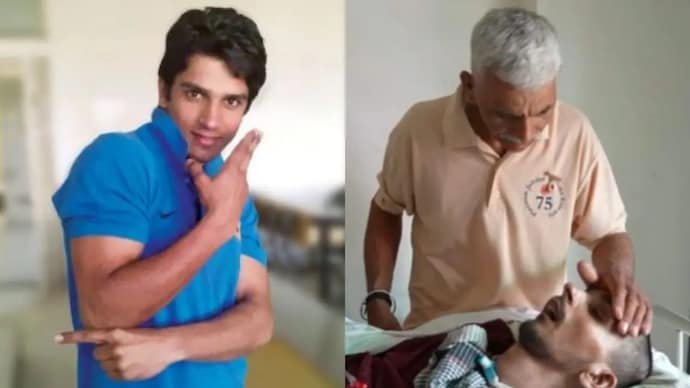
Drawing on my experience covering landmark legal and medical cases, Delhi resident Harish Rana’s struggle has captured national attention as the Supreme Court deliberates on the sensitive matter of passive euthanasia. Harish, who suffered severe brain injuries in 2013, has remained in a persistent vegetative state for 13 years. On Thursday, the Supreme Court reserved its decision on a plea by his parents to withdraw life-sustaining treatment, acknowledging the delicate nature of such requests.
After a tragic accident left him in a vegetative state, the legal battle over Harish Rana’s life-support raises fundamental questions about dignity, suffering, and the right to die.
The bench, composed of Justices JB Pardiwala and KV Viswanathan, described the issue as “sensitive” and said, “We are mortals, too. Who are we to determine who survives or perishes?” They indicated that the court would consider stopping life-sustaining medical care after hearing submissions from the amicus curiae representing Harish’s parents and Additional Solicitor General (ASG) Aishwarya Bhati appearing for the Centre.
The Case of Harish Rana
Harish Rana, a 32-year-old resident of Mahavir Enclave in Delhi, moved to Chandigarh for college during his teens. On August 20, 2013, tragedy struck when he fell from the fourth-floor balcony of his PG apartment, sustaining catastrophic head injuries. Since that day, Harish has been completely disabled, relying on feeding and breathing tubes to survive, with virtually no hope of recovery.
During the hearing, the amicus curiae described the situation as “accelerated natural death” and requested passive euthanasia. She cited the findings of two medical boards confirming Harish’s irreversible condition, arguing that continuing life-sustaining treatment infringed on his right to live with dignity.
Parents Seek Passive Euthanasia
According to the amicus, if passive euthanasia is approved, Harish would be placed in palliative care, with feeding tubes withdrawn and sedatives administered to prevent pain. “He will be made comfortable until his death,” she emphasized, ensuring that the procedure minimizes suffering.
The Supreme Court had earlier acknowledged passive euthanasia in the landmark Aruna Shanbaug case of 2011, although active euthanasia remains prohibited. Shanbaug, a nurse sexually assaulted in 1973, spent over four decades in a vegetative state before passing away from pneumonia in 2015. Following this, the Supreme Court formalized guidelines and legalized passive euthanasia in 2018.
Supporting the amicus, ASG Aishwarya Bhati also advocated for Harish’s euthanasia, noting that this would be the first implementation of the court’s established guidelines. She emphasized that “the omission shouldn’t be the cause of death; the underlying illness should be the cause,” and requested the court formalize protocols for considering the opinions of caregivers of terminally ill patients.
ASG Bhati further highlighted Harish’s suffering over the past 13 years in an incurable vegetative state, stating, “He is on his skin and bones.” Despite extensive arguments, the Supreme Court has not yet delivered its verdict, leaving the nation awaiting a resolution in this emotionally and legally complex matter.
For breaking news and live news updates, like us on Facebook or follow us on Twitter and Instagram. Read more on Latest India on thefoxdaily.com.


COMMENTS 0