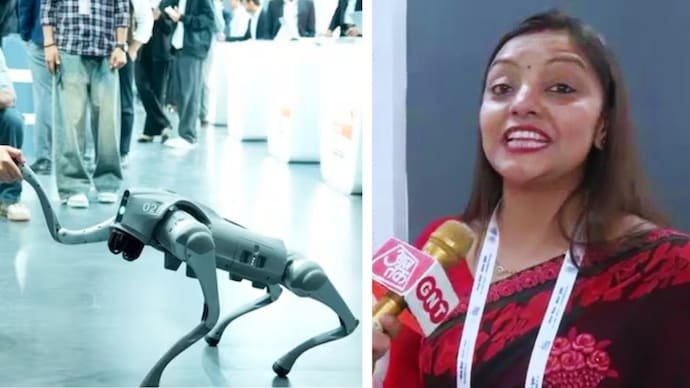
Galgotias University, based in Greater Noida, has found itself at the centre of a growing controversy after allegations surfaced that it showcased a Chinese-made robotic dog as its own innovation at the ongoing AI Summit. In its third clarification within two days, the university attributed the confusion to its Head of Communications, Neha Singh, describing her as “ill-informed” and “not authorised to speak to the press.”
The incident has sparked a broader debate on academic transparency, intellectual honesty, and institutional accountability in India’s rapidly evolving AI ecosystem.
University Issues Public Apology Over AI Summit Incident
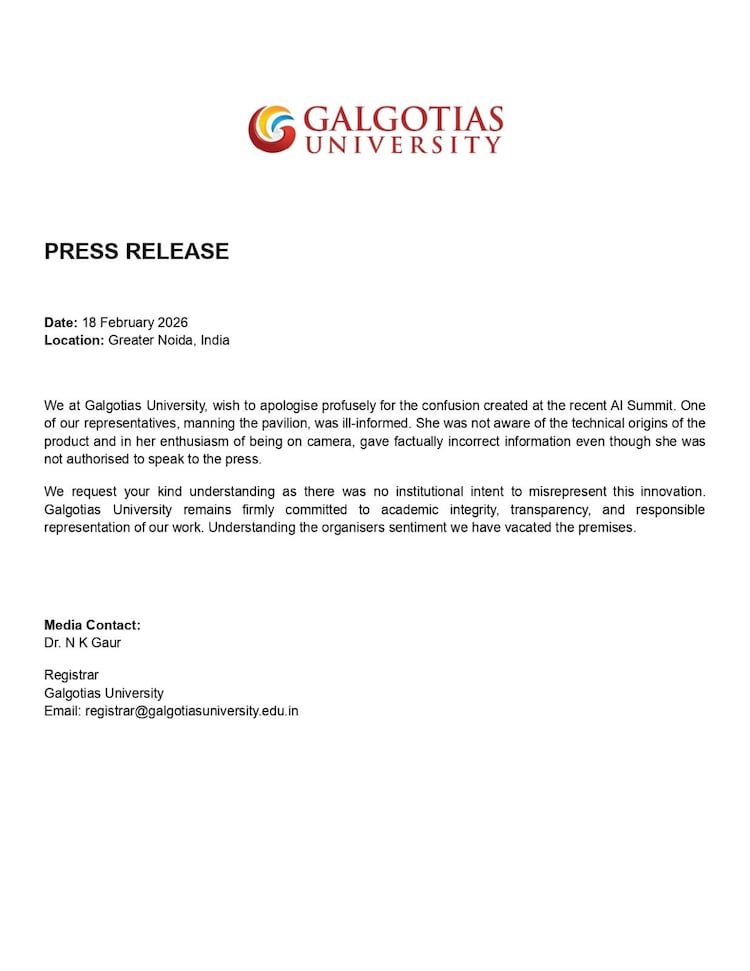
In an official press release dated February 18, Galgotias University expressed regret over the episode, stating that incorrect information had been communicated during media interactions at the summit.
“We at Galgotias University wish to apologise profusely for the confusion created at the recent AI Summit. One of our delegates, who was in charge of the tent, was unaware of the technical origins of the product and, in her enthusiasm of being on camera, gave factually incorrect information, even though she was not authorised to speak to the press,” the statement read.
The university emphasised that there was no institutional intent to misrepresent the origin of the robotic dog and maintained that the episode was the result of miscommunication rather than deliberate deception.
A Viral Video Triggers Backlash on Social Media
The controversy began after a video from the summit went viral on Social Media. In the clip, Neha Singh is seen presenting an AI-powered robotic dog branded as “Orion.” Online users quickly identified the device as the Unitree Go2, a quadruped robot manufactured by Chinese robotics company Unitree and commercially available for approximately USD 2,800 (around Rs 2.3 lakh).
Several social media users alleged that the university appeared to present the robot as an in-house innovation, leading to criticism over academic credibility and ethical standards. The backlash intensified as commentators questioned whether the institution had blurred the lines between demonstration and development.
In response, the university clarified on X (formerly Twitter) that the robotic dog had been purchased from Unitree and was being used strictly as a teaching and learning tool.
“One such stage in that process is the recently purchased robodog from Unitree. It is not merely a machine on display; it is a classroom in motion. Our Students are experimenting with it, pushing its boundaries, and learning in the process. To be clear, neither Galgotias nor we have ever claimed to have constructed this robodog,” the university stated.
The clarification aimed to distinguish between showcasing technology for educational purposes and claiming ownership of its development.
Exit from AI Summit Amid Controversy
Following the online uproar, government sources indicated that the university had been asked to vacate its stall at the AI Summit. However, Galgotias University denied receiving any formal directive from government authorities.
In its latest press statement, the university said it chose to leave the event premises voluntarily, citing the organisers’ sentiment. “We have vacated the premises in consideration of the organisers’ sentiment,” the statement noted.
This move, the university said, was taken to avoid further disruption and to uphold decorum at the high-profile technology gathering.
Government’s Stand: No Non-Original Products at the Summit
As the controversy escalated, the central government clarified that exhibitors at the AI Summit were not permitted to display products that were not their original creations.
IT Secretary S Krishnan stated that the government did not want any exhibitor to present non-original items at the summit. “We do not want such exhibits to continue,” he reportedly said, adding that organisers had requested the university to remove its stall.
The clarification underscored the government’s emphasis on promoting indigenous innovation and ensuring transparency in high-visibility technology platforms.
Community Note Challenge Adds to Debate
Further complicating the matter, an X community note challenged the university’s assertion that it had not claimed ownership of the robotic dog. The note described the institution’s clarification as “inaccurate and misleading,” alleging that the robot had been renamed “Orion” and explicitly presented as developed by the university’s team.
This community-driven fact-check intensified scrutiny, raising broader questions about how educational institutions represent collaborative, imported, or commercially acquired technologies at public forums.
Despite the criticism, Galgotias University has reiterated that there was “no institutional intent to misrepresent this innovation.” It reaffirmed its commitment to academic integrity, transparency, and responsible representation of research and technology initiatives.
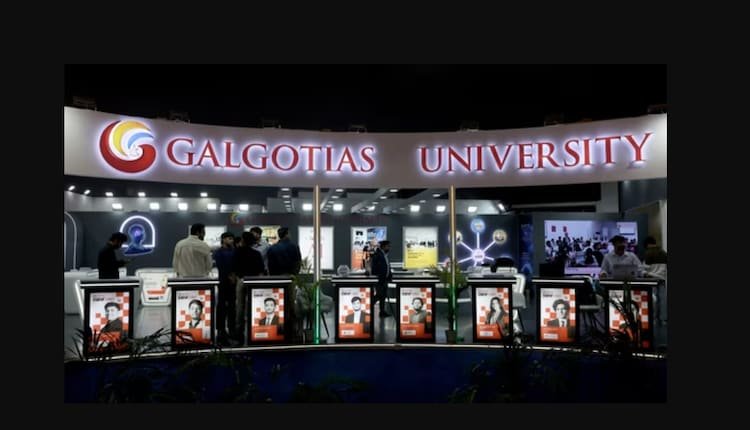
Academic Integrity and the AI Innovation Ecosystem
The episode highlights the delicate balance between demonstrating cutting-edge technology for educational purposes and clearly communicating its origins. In an era where Artificial Intelligence and robotics are central to national innovation narratives, institutions face heightened public scrutiny.
Experts note that while importing advanced hardware for research and training is common practice globally, clarity in communication is critical to maintaining credibility. Universities must ensure that spokespersons are fully briefed and authorised before engaging with the media, particularly at high-profile events.
As the debate continues online, the Galgotias University robot controversy serves as a reminder that in the AI era, reputation and trust are as vital as technological capability. Transparency, clear attribution, and institutional accountability remain essential pillars of sustainable innovation.
For breaking news and live news updates, like us on Facebook or follow us on Twitter and Instagram. Read more on Latest India on thefoxdaily.com.



COMMENTS 0