Nestled within the rugged folds of the Aravalli hills near Jaipur, Mundota Fort is far more than a relic of feudal Rajasthan. Beyond its weathered ramparts and martial past, the fort stands as a quiet custodian of symbols that have endured centuries of political change and cultural memory. Among its most compelling legacies is a historic flag associated with the idea of the “Kush Dhwaj”—a banner believed to reflect the lineage of Kush, the son of Lord Rama.
What was once considered a largely local tradition has recently entered the national conversation, following remarks by spiritual leader Sri Sri Ravi Shankar. He suggested that this flag is linked to the ancient practice of the “Rama Dhwaj,” a ceremonial standard associated with dharma and righteous kingship. In a social media post, Sri Sri Ravi Shankar stated, “The Kachhwaha dynasty, descendants of Kush, have preserved the flag of Prabhu Shri Ram adorned with the Kachnar emblem for centuries.” Today, the Mundota family continues to safeguard this heritage.
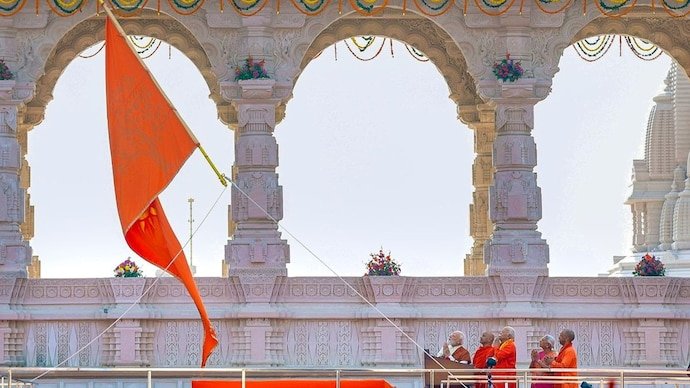
The renewed attention gained greater intensity after Prime Minister Narendra Modi ceremonially raised a saffron dhwaj at the Ram Temple in Ayodhya. The event, widely broadcast and politically charged, sparked both celebration and debate. Central to the discussion was a deceptively simple question: should the Ram Temple flag be saffron, or should it reflect older traditions—such as the white standard historically associated with the Jaipur state, believed by many to be ruled by the descendants of Kush before adopting a multicoloured flag?
To understand this question, one must return to the era when the Jaipur, or Amber, state functioned as a crucial military arm of the Mughal Empire. During this period, the kingdom’s armies, under the leadership of Raja Man Singh—one of the most formidable generals of his time—ventured far beyond Rajasthan, even into the challenging terrain of Afghanistan.
Local tradition holds that four Afghan tribes, each identified by a distinct flag, were defeated by Jaswant Singh, the jagirdar of Mundota Fort, along with his forces serving under Raja Man Singh. These victories were not merely territorial or political. The captured flags of the defeated tribes became powerful symbolic trophies, representing conquest, authority, and subjugation.
At that time, the Jaipur state is said to have flown a pristine white flag. This white standard symbolised sovereignty rooted in raj dharma—justice, moral authority, and purity of rule. According to legend, after the Afghan campaign, the four captured flags, each of a different colour, were thematically combined with Jaipur’s white standard to form a composite banner. The symbolism was unmistakable: diversity unified under a single sovereign authority.
Mundota Fort occupies a distinctive place in this narrative. As a significant jagir within the Jaipur state, it was reportedly gifted the original white flag as a mark of appreciation for loyalty and service. Over time, this flag transcended its role as a state emblem and came to be revered locally as the “Kush Dhwaj.” The fort gradually transformed from a strategic military outpost into a guardian of collective memory, with oral traditions about the banner passed down through generations of local families.
Even as princely states dissolved into the Indian republic and national symbols replaced royal standards, Mundota’s association with the flag endured. Through its connection to Kush, the white flag of Jaipur acquired a spiritual dimension, linking it to the Ramayana and the sacred lineage of Lord Rama.
This legacy resurfaced prominently when Sri Sri Ravi Shankar stayed overnight at Mundota Fort, now restored as a heritage hotel. During his visit, the proprietor, Vikram Singh Rathore, showed him the historic white flag of the former Jaipur state. Shortly thereafter, the spiritual leader publicly referred to it as the “Kush Dhwaj,” drawing parallels with the “Rama Dhwaj.” In doing so, he elevated a regional tradition into a broader civilisational dialogue on dharma, kingship, and continuity.
At the heart of this story lies the symbolism of Kush. In the Ramayana, Kush represents continuity—the transmission of Rama’s ideals of ethical governance and moral leadership. When a banner is called the “Kush Dhwaj,” it transcends Rajput custom and becomes a bridge between sacred narrative and temporal authority. Hoisting such a flag signifies a desire to rule not merely through power, but through righteousness and restraint.
It is precisely this intertwining of faith, history, and authority that made the Prime Minister’s dhwaj ceremony in Ayodhya controversial. Supporters view Modi’s act as a historic affirmation of reclaiming and re-inscribing Rama’s values into India’s public life. Critics, however, argue that when a serving prime minister performs a religious ritual on a national stage, it blurs constitutional boundaries between the state and religion.
The debate extends far beyond Ayodhya. Is the Ram Temple’s dhwaj primarily a religious symbol, a cultural emblem, or a political statement? In such moments, does the prime minister act as the head of government, a devotee, or both? These questions point to a broader reassessment of Indian secularism and the evolving relationship between state power and religious symbolism.
When viewed alongside Ayodhya’s spectacle, Mundota’s “Kush Dhwaj” offers a striking contrast. The flag-raising at the Ram Temple was a carefully choreographed national event with immense political visibility. Mundota’s banner, by contrast, survives largely through local reverence and inherited memory. Its authority stems from belief and tradition rather than constitutional mandate.
This parallel opens several avenues for deeper inquiry. Archival research could compare Mundota’s oral histories with official Jaipur records and military accounts of Raja Man Singh’s Afghan campaigns. The physical attributes of any surviving banner—its fabric, colours, and motifs—may yield further clues. Ayodhya, meanwhile, invites scrutiny of the modern state’s growing engagement with religious symbolism and whether this reflects continuity with pre-modern kingship or a departure from constitutional norms.
If future research substantiates Mundota’s “Kush Dhwaj” as a continuous ceremonial memory, it underscores a deeper truth: in India, flags are more than pieces of cloth. They function as living archives—of faith and governance, conquest and compromise. Together, Modi’s dhwaj hoisting in Ayodhya and the revival of “Kush Dhwaj” narratives in Rajasthan remind US that symbols travel across centuries, changing contexts and meanings, yet retaining their power to inspire belief, debate, and identity.
Seen from this perspective, the controversy is not merely about who raises a flag, but about how India negotiates its past in the language of the present. As Vikram Singh Rathore himself asks, should the Ram Temple’s dhwaj—if it truly echoes the “Kush Dhwaj” under his care—be saffron, or should it be white, bearing the Kachnar insignia of an older moral and historical order?
For breaking news and live news updates, like us on Facebook or follow us on Twitter and Instagram. Read more on Latest India on thefoxdaily.com.






COMMENTS 0