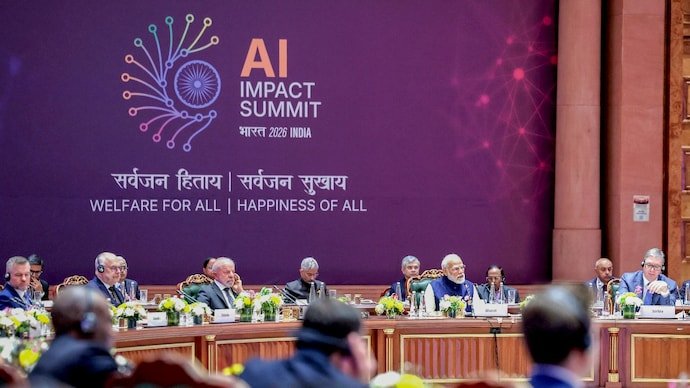
In a major step toward shaping the future of responsible Artificial Intelligence, more than 85 countries and international organizations — including the United States, the United Kingdom, and the European Union — have adopted the Delhi Declaration on the Impact of AI, according to a statement released by India’s Ministry of External Affairs.
The declaration emerged from deliberations at the India AI Summit and reflects a global commitment to ensuring that artificial intelligence serves humanity through inclusive growth, human capital development, and social good.
Inspired by the guiding philosophy of “welfare for all, happiness for all,” the declaration emphasizes a human-centered approach to AI governance and innovation.
Global Consensus on the Seven Pillars (Chakras) of AI Development
The declaration calls for deeper international collaboration and multistakeholder engagement across seven key pillars — referred to as the “Seven Chakras” of the AI Impact Summit. These pillars aim to ensure that AI development is ethical, inclusive, secure, and growth-oriented.
The Ministry of External Affairs noted that participating countries committed to fostering shared understanding, while respecting national sovereignty, on how AI can complement existing international frameworks and initiatives.
| Seven Chakras (Pillars) | Focus Area | Core Objective |
|---|---|---|
| Human Capital Development | AI skill-building & workforce training | Prepare societies for the AI-driven future |
| Access for Social Empowerment | Inclusive AI deployment | Expand access to services and opportunities |
| Trustworthy AI Systems | Security & ethical frameworks | Ensure safety and reliability across AI lifecycle |
| Energy Efficiency | Sustainable AI infrastructure | Promote environmentally responsible AI systems |
| AI for Science | Research & global collaboration | Advance innovation and scientific discovery |
| Democratizing AI Resources | Affordability & access | Enable developing nations to leverage AI |
| Economic Growth & Social Good | Broad AI adoption | Drive inclusive economic and social progress |
Minister Ashwini Vaishnaw Announces Adoption
India’s Information Technology Minister, Ashwini Vaishnaw, confirmed the declaration’s adoption on Social Media platform X, stating that 88 nations and international organizations had signed on to the initiative.
He emphasized that the declaration reflects Prime Minister Narendra Modi’s human-centric approach to artificial intelligence. According to Vaishnaw, the philosophy of “Sarvajana Hitaya, Sarvajana Sukhaya” — meaning welfare for all and happiness for all — serves as the foundation for democratizing AI resources globally.
The declaration signals that AI governance must prioritize people, equity, and sustainable growth rather than purely commercial or geopolitical competition.
Key Focus Areas of the Delhi Declaration on AI
1. Democratizing Access and Affordability
Signatories underscored that equitable access to AI tools, infrastructure, and knowledge is critical. By reducing barriers to entry, all nations — especially developing economies — can create, deploy, and benefit from AI technologies.
2. Economic Expansion and Social Benefit
The declaration promotes the widespread use of AI-driven applications to accelerate economic growth while simultaneously advancing social welfare. AI adoption is seen as a catalyst for innovation, productivity, and inclusive development.
3. Secure and Trusted AI Systems
Participants acknowledged the need for technical safeguards, voluntary industry standards, and appropriate regulatory frameworks that balance innovation with public interest. Ensuring AI systems remain secure and trustworthy throughout their lifecycle is central to this effort.
4. AI for Science and Global Collaboration
AI’s role in advancing global scientific research was highlighted as a strategic priority. The declaration encourages international research partnerships and the use of AI to solve complex global challenges.
5. Access for Social Empowerment
AI should enhance participation in social and economic life by improving access to information, public services, and cross-border digital solutions. Empowerment through AI is framed as a tool for bridging inequalities.
6. Human Capital Development
Preparing the workforce for the AI era is a central pillar. This includes strengthening AI Education, developing specialized skills, training public officials, and raising public awareness about AI’s capabilities and implications.
7. Efficiency, Innovation, and Resilience
The declaration emphasizes building cost-effective and energy-efficient AI systems to widen access and stimulate regional innovation. Sustainable AI infrastructure is viewed as essential for long-term resilience and shared developmental goals.
A Global Framework for Responsible AI Governance
The Delhi Declaration represents one of the broadest multilateral endorsements of a human-centric AI framework to date. By aligning on shared principles while respecting national sovereignty, participating nations aim to build trust, reduce fragmentation, and ensure AI contributes positively to global development.
As artificial intelligence reshapes economies and societies, the declaration positions human capital, inclusivity, sustainability, and social good at the center of AI policy discussions worldwide.
The coming years will determine how these commitments translate into tangible outcomes, but the widespread adoption of the Delhi Declaration signals a growing global consensus: AI must serve humanity, not the other way around.
For breaking news and live news updates, like us on Facebook or follow us on Twitter and Instagram. Read more on Latest India on thefoxdaily.com.





COMMENTS 0