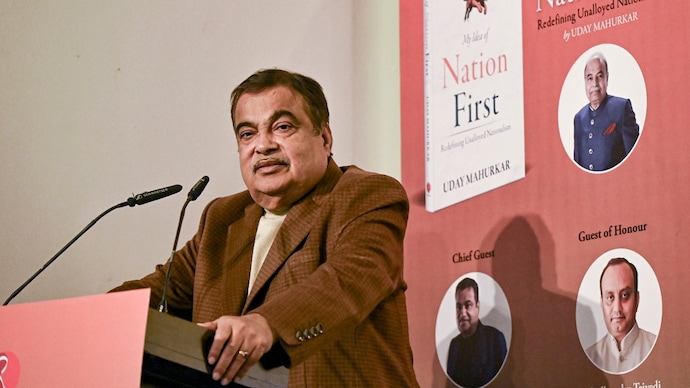
Union Transport Minister Nitin Gadkari has drawn renewed attention to Delhi’s persistent air pollution crisis, remarking that the city’s toxic air affects him physically within days. Addressing an audience at a public event, Gadkari said that despite staying in Delhi for just three days, he experiences allergic reactions due to the capital’s poor air quality.
“I live here for three days, and I get allergies because of this pollution,” Gadkari said candidly, underlining the seriousness of the problem faced daily by millions of residents in Delhi and the National Capital Region (NCR).
The comments were made during the book launch of veteran journalist and former Central Information Commissioner Uday Mahurkar in New Delhi. The 68-year-old senior BJP leader used the platform to speak not just as a policymaker, but also as someone personally impacted by air pollution.
Transport Responsible for 40% of Delhi Pollution: Gadkari
Acknowledging the role of his own ministry, Gadkari admitted that vehicular emissions are a major contributor to Delhi’s deteriorating air quality. “I am the transport minister, and nearly 40 per cent of pollution happens because of transport itself,” he stated.
Experts have long pointed out that emissions from private vehicles, commercial transport, and congestion-related idling significantly worsen pollution levels in Delhi, especially during winter months when weather conditions trap pollutants close to the ground.
| Major Pollution Sources in Delhi-NCR | Estimated Contribution |
|---|---|
| Vehicular Emissions | ~40% |
| Industrial Emissions | ~20% |
| Construction Dust | ~15% |
| Crop Stubble Burning | ~10–15% |
| Other Sources (Waste burning, generators) | ~10% |
Push for Electric and Hydrogen Vehicles
Gadkari stressed the urgent need for India to transition away from fossil fuels and adopt cleaner alternatives. Questioning the country’s continued dependence on polluting energy sources, he asked, “What sort of nationalism is this? Fossil fuels are limited, and pollution is increasing. Can’t we reduce fossil fuel usage?”
The minister strongly advocated for the adoption of electric vehicles (EVs) and hydrogen-powered vehicles, describing them as long-term solutions capable of delivering near-zero emissions.
He also highlighted the economic burden of fossil fuel imports, noting that India spends approximately ₹22 lakh crore every year on importing petroleum products. According to Gadkari, a shift to alternative fuels would not only improve air quality but also strengthen India’s energy security and reduce foreign dependence.
Flex-Fuel Vehicles and Ethanol as Cleaner Options
Sharing a personal example, Gadkari spoke about his own flex-fuel car that runs entirely on ethanol. He said such vehicles have the potential to significantly cut emissions while supporting domestic Agriculture and biofuel industries.
Ethanol blending, promoted under the government’s green energy initiatives, is seen as a practical interim solution to reduce vehicular pollution while India gradually moves towards full electrification and hydrogen mobility.
Delhi Air Quality Slips Back Into ‘Severe’ Category
Gadkari’s remarks came at a time when Delhi’s air quality once again slipped into the “severe” category. On Tuesday, the capital recorded a 24-hour average Air Quality Index (AQI) of 412, making it the second most polluted city in India.
Noida, part of the Delhi-NCR region, topped the list with an average AQI of 426. Although pollution levels showed marginal improvement by Wednesday morning, authorities warned that the situation remains alarming.
Forecasts suggest that Delhi’s AQI is likely to remain in the “very poor” category for at least the next six days, posing continued health risks, particularly for children, the elderly, and those with respiratory conditions.
Not the First Time Gadkari Has Raised Concerns
This is not the first occasion when Nitin Gadkari has spoken openly about Delhi’s pollution. In December last year, he admitted that he often hesitates before visiting the national capital during winter, when smog and hazardous AQI levels become routine.
“Every time I travel to Delhi, I think whether I should go or not. Itna bhayankar pollution hai (The pollution is just terrible),” he had said at the time.
Gadkari’s repeated warnings reflect growing concern within the government about the health, economic, and environmental costs of unchecked pollution. His statements add urgency to ongoing debates around cleaner transport, sustainable fuels, and stricter pollution control measures in Delhi-NCR.
For breaking news and live news updates, like us on Facebook or follow us on Twitter and Instagram. Read more on Latest India on thefoxdaily.com.





COMMENTS 0