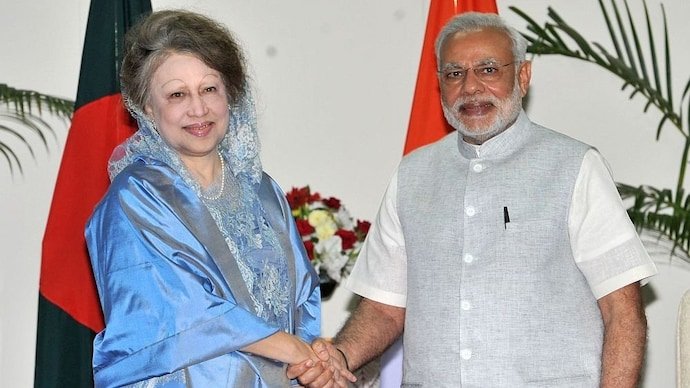
Prime Minister Narendra Modi on Tuesday paid heartfelt tributes to former Bangladesh Prime Minister and Bangladesh Nationalist Party (BNP) chairperson Khaleda Zia, describing her as a towering political figure whose contributions to Bangladesh’s development and India-Bangladesh relations will be remembered for generations.
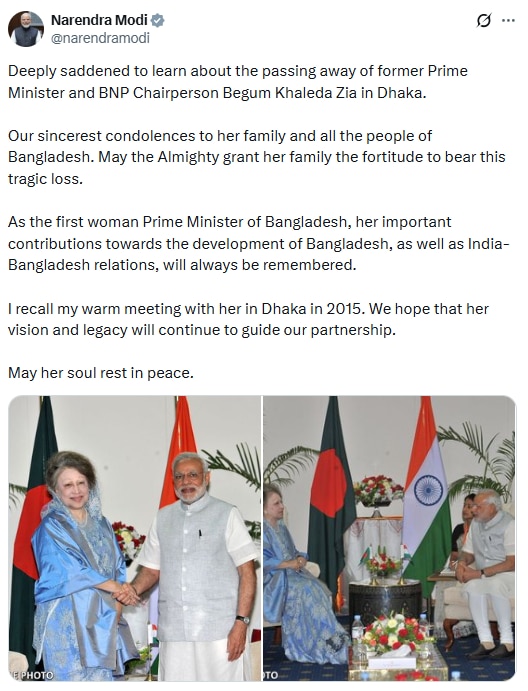
“As the first woman Prime Minister of Bangladesh, her important contributions towards the development of Bangladesh, as well as India-Bangladesh relations, will always be remembered,” PM Modi said while expressing condolences on her passing. “I hope her vision and legacy will continue to guide our partnership.”
In a message shared on social media, the Prime Minister recalled his personal interaction with Khaleda Zia during his visit to Dhaka in 2015. Posting photographs from their meeting, Modi wrote that he remembered their “cordial encounter” and underlined her role in strengthening bilateral engagement between the two neighbouring nations.
A Leader Who Shaped Bangladesh’s Democratic Journey
Khaleda Zia, Bangladesh’s first female prime minister, passed away at the age of 80 after a prolonged illness. She had been undergoing treatment for several chronic medical conditions, including heart disease, diabetes, hypertension, liver and kidney complications, arthritis, and recurring infections.
Over a political career spanning more than three decades, Zia remained one of the most influential and polarising figures in Bangladeshi politics. She played a pivotal role in restoring democracy after years of military rule and led the country through critical phases of political transition.
Her journey in public life was marked by dramatic highs and lows — from leading elected governments and enjoying mass popularity to facing corruption convictions, imprisonment, and eventually receiving a presidential pardon. Despite these challenges, her political relevance endured until the very end.
An Unexpected Entry Into Politics
Zia’s entry into politics was largely unanticipated. Until 1981, she had remained away from active public life and was primarily known as the wife of President Ziaur Rahman, a former army chief who rose to power following Bangladesh’s turbulent post-independence years.
Her life changed dramatically after President Ziaur Rahman was assassinated on May 30, 1981, during a failed military coup. In the aftermath of his death, Khaleda Zia stepped into politics to carry forward his legacy and soon emerged as a formidable leader.
She rose rapidly within the Bangladesh Nationalist Party and was appointed its chairperson in 1984, a position she held continuously until her death. Throughout her career, her principal political rival remained Sheikh Hasina, the leader of the Awami League, giving rise to the decades-long “Battle of the Begums” that defined Bangladesh’s political landscape.
Historic Electoral Triumphs and Enduring Influence
Following the fall of military ruler Hussain Muhammad Ershad in 1990, Khaleda Zia led the BNP to a landmark victory in the 1991 general elections. The win marked Bangladesh’s return to parliamentary democracy, and Zia was sworn in as prime minister.
She became the second woman leader in the Muslim world to head a government, after Pakistan’s Benazir Bhutto. BNP leaders have often highlighted that Khaleda Zia never lost a parliamentary election, underscoring her enduring electoral appeal and grassroots support.
Born on August 15, 1946, in the Dinajpur district of undivided India, Khaleda Zia leaves behind a complex yet lasting political legacy that has deeply influenced modern Bangladesh. Her life and leadership not only shaped her country’s democratic evolution but also played a significant role in defining India-Bangladesh relations over several decades.
As leaders across the region mourn her passing, Prime Minister Modi’s message reflects New Delhi’s recognition of Khaleda Zia’s historical role and the hope that her vision will continue to inspire constructive engagement between the two neighbours.
For breaking news and live news updates, like us on Facebook or follow us on Twitter and Instagram. Read more on Latest India on thefoxdaily.com.





COMMENTS 0