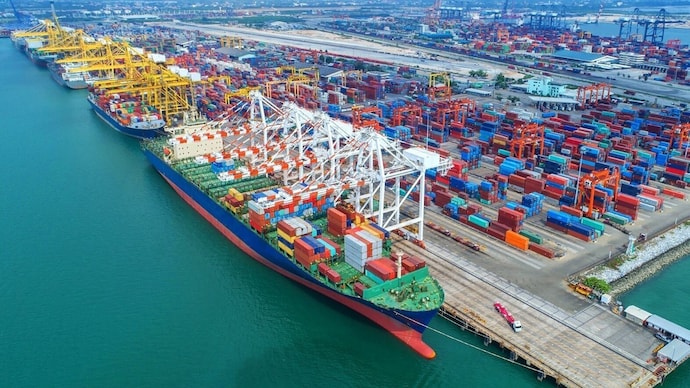
The landmark Free trade Agreement (FTA) between India and New Zealand is expected to significantly deepen economic ties and expand trade, investment, and cooperation between the two countries.
Leaders from both nations have hailed the agreement as ambitious and mutually beneficial. It is projected to strengthen strategic collaboration, improve market access, encourage investment flows, and unlock fresh opportunities for enterprises, farmers, MSMEs, innovators, students, and young people across a wide range of sectors.
Negotiations for the FTA were formally launched during New Zealand Prime Minister Christopher Luxon’s visit to India in March 2025. The agreement was concluded in a record nine months, reflecting strong political commitment and a shared vision to expand bilateral engagement.
Both countries have expressed confidence that bilateral trade could potentially triple over the next five years, building on the momentum created by the agreement. Over the next 15 years, New Zealand is expected to invest more than USD 20 billion in India.
Reacting to the development, Prime Minister Narendra Modi said the India–New Zealand partnership is set to scale new heights. In a post on X, he stated that India welcomes investments exceeding USD 20 billion from New Zealand across various sectors and that the FTA “sets the stage for doubling bilateral trade in the coming five years.”
In another post, Prime Minister Modi reiterated that the FTA lays the foundation for doubling bilateral trade over the next five years and highlighted that New Zealand has already committed more than USD 20 billion in investments across diverse industries in India.
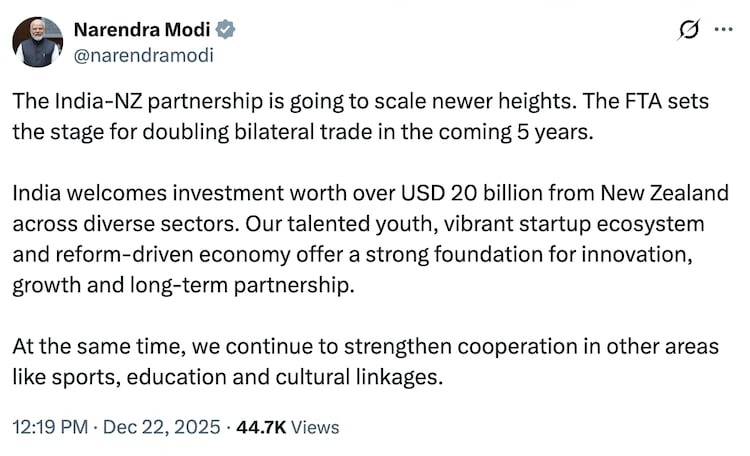
According to Modi, India’s young and innovative population, its thriving startup ecosystem, and a reform-driven economy provide a strong foundation for long-term partnership, growth, and innovation. He also noted that cooperation between the two nations continues to expand in areas such as sports, education, and cultural exchange.
Describing the agreement as a major milestone in bilateral relations, Modi said it provides a significant boost to trade and investment ties. He added that he had a “very good conversation” with Prime Minister Luxon soon after the FTA was finalised, and noted that concluding the deal within nine months reflected strong political resolve and a shared objective to strengthen economic relations.
The Prime Minister further stated that the FTA ensures enhanced market access, increased investment flows, and a wide range of opportunities for businesses, farmers, MSMEs, innovators, students, and young people.
In a separate statement, New Zealand Prime Minister Christopher Luxon said he had discussed the economic impact of the NZ–India Free Trade Agreement with Prime Minister Modi following its conclusion.
Luxon noted that the agreement reduces or removes tariffs on 95 percent of New Zealand’s exports to India and is expected to boost New Zealand exports by between USD 1.1 billion and USD 1.3 billion annually over the next 20 years. He said increased trade would create more opportunities, higher wages, and additional jobs for New Zealanders.
Describing India as one of the fastest-growing economies in the world, Luxon said the agreement gives New Zealand businesses access to a market of 1.4 billion consumers. He added that the FTA strengthens the close partnership between the two countries and supports the government’s broader objective of expanding the economy through new trade agreements.
According to Luxon, the FTA will help New Zealanders progress by opening new avenues for farmers, growers, and businesses, increasing exports, generating employment, and raising incomes.
Along with acknowledging progress in other areas of bilateral cooperation—such as defence, sports, education, and people-to-people ties—both sides reaffirmed their commitment to further deepening the relationship between India and New Zealand.
For breaking news and live news updates, like us on Facebook or follow us on Twitter and Instagram. Read more on Latest India on thefoxdaily.com.





COMMENTS 0