
A British newspaper once described Narendra Modi as “India’s first social media prime minister” after his 2014 Lok Sabha victory. Twelve years on, Prime Minister Modi appears to have refined that reputation into a powerful diplomatic tool. When India and the European Union announced the long-awaited Free trade Agreement (FTA) on Tuesday, Modi used the occasion to demonstrate how digital diplomacy now complements traditional statecraft.
Instead of issuing a single formal statement, the Prime Minister posted about the agreement in 24 official languages of the European Union — a move geopolitical experts quickly described as a “multilingual masterstroke.” With one coordinated outreach, Modi directly addressed citizens across all 27 EU member states, turning a complex trade deal into a human, relatable moment.
The India-EU trade agreement comes at a time of heightened global economic uncertainty, particularly amid disruptions triggered by US President Donald Trump’s aggressive tariff policies. Against this backdrop, the deal between India and the EU was framed not as a transactional necessity, but as a strategic partnership rooted in shared values and mutual respect.
Trump’s confrontational trade approach — including steep tariffs and pressure tactics — has unsettled both New Delhi and Brussels. India has already faced punitive tariffs of up to 50 percent, while the European Union has drawn Washington’s ire for resisting US demands on issues such as Greenland and broader geopolitical alignment.
Tariffs, in fact, have become a central weapon in Trump’s negotiating strategy, frequently used to pressure even close allies. It is within this volatile global environment that India and the EU finally sealed what has been described as the “mother of all trade deals” after nearly two decades of negotiations. The agreement was formally concluded on January 27.
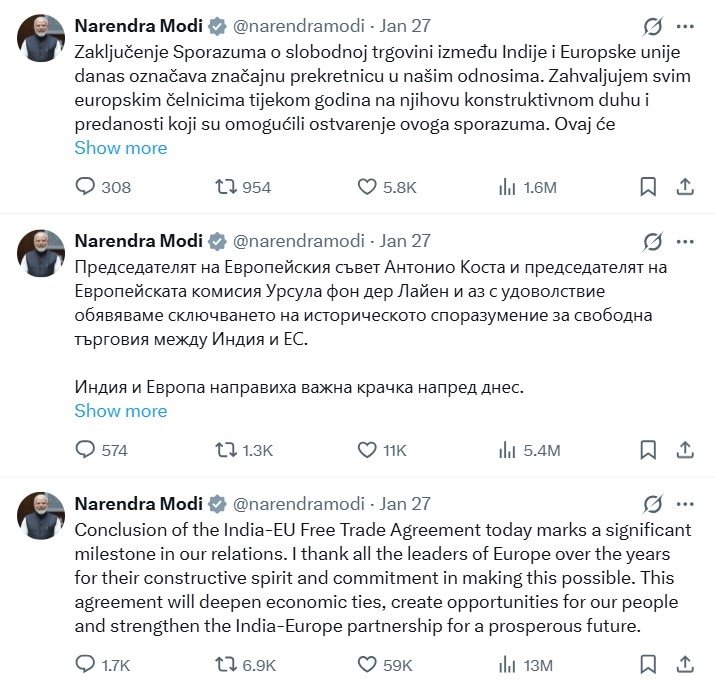
Following the announcement, PM Modi shared a message on X thanking European leaders for their sustained efforts over the years. “Today’s conclusion of the India-EU Free Trade Agreement is a major turning point in our relationship,” he wrote. “This agreement will strengthen the India-Europe partnership for a prosperous future, deepen economic ties, and create opportunities for our people.”
Why PM Modi’s Post Stood Out
What truly captured global attention, however, was what followed. The Prime Minister posted the same message in each of the EU’s 24 official languages — including French, German, Greek, Italian, Spanish, Portuguese, Swedish, Polish, Hungarian, and even Irish and Maltese.
The gesture prompted immediate reactions from European leaders. Notably, the President of Finland responded to Modi’s post in Hindi, underscoring the symbolic resonance of the outreach.
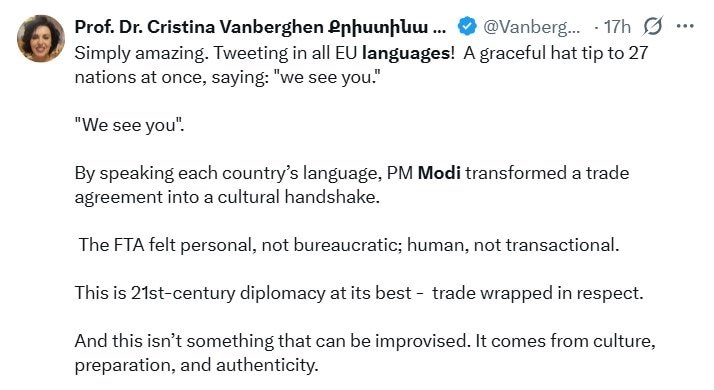
Dr. Cristina Vanberghen, political analyst and senior expert at the European Commission, described the move as “a graceful hat tip to 27 countries at once.”
“PM Modi turned a commercial agreement into a cultural handshake by speaking the language of each nation,” she wrote. “The FTA felt human rather than transactional, emotional rather than bureaucratic. Trade wrapped in respect is the epitome of 21st-century diplomacy.”
She added that such gestures cannot be improvised. “This stems from preparation, authenticity, and cultural sensitivity,” Vanberghen noted.
Geopolitical scholar Marios Karatzias echoed the sentiment, calling it “public diplomacy at its finest.”
“In the digital age, leaders like Modi are bypassing traditional channels to engage directly with global audiences,” he posted. “This shift toward emotional, authentic communication represents an effective and inspiring evolution in diplomacy.”
What the India-EU Trade Deal Includes
The Free Trade Agreement will significantly reduce tariffs between India and the European Union, though it must still undergo legal vetting before formal ratification.
According to Union Commerce Minister Piyush Goyal, the EU will eliminate tariffs on over 90 percent of Indian goods, particularly benefiting India’s labour-intensive sectors. Meanwhile, tariffs on 96 percent of European exports to India will either be removed or substantially reduced.
A key highlight is the gradual opening of India’s automobile market. Tariffs on most European auto imports have been lowered to 30–35 percent and will be progressively reduced to 10 percent over the coming years.
Finalised amid shifting geopolitical alignments and economic uncertainty, the India-EU FTA represents a strategic recalibration for both sides. Against this backdrop, PM Modi’s micro-targeted, multilingual diplomacy stood out as a defining moment — reinforcing that in modern geopolitics, how a message is delivered can be as important as the deal itself.
For breaking news and live news updates, like us on Facebook or follow us on Twitter and Instagram. Read more on Latest India on thefoxdaily.com.





COMMENTS 0