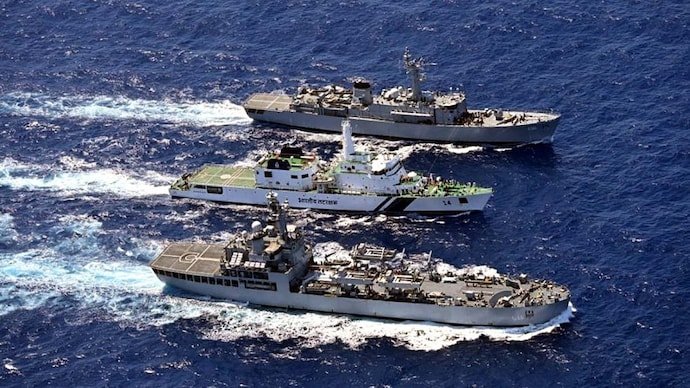
In a significant move to reinforce India’s maritime security architecture in the eastern theatre, the Indian Navy is preparing to establish a new naval facility at Haldia in West Bengal. The decision comes amid heightened Chinese naval deployments in the Indian Ocean Region (IOR) and emerging security concerns linked to Bangladesh and Pakistan, senior defence sources told India Today.
The upcoming facility will function as a naval “detachment” rather than a full-scale base, primarily tasked with deploying and supporting small, fast-response vessels. Leveraging the existing Haldia dock complex will allow the Navy to operationalise the station quickly with minimal additional infrastructure.
Initial development work will include the construction of a dedicated naval jetty and essential shore-support facilities. This approach ensures rapid deployment capability while keeping costs and timelines under control.
Defence planners indicate that the base will host 300-tonne New Water Jet Fast Attack Crafts (NWJFACs) and Fast Interceptor Crafts (FICs). Designed for high-speed maritime operations, these platforms are capable of achieving speeds of up to 40–45 knots, making them ideal for quick-reaction missions in coastal and near-shore waters.
The vessels are armed with CRN-91 naval guns and are expected to be integrated with advanced loitering munition systems such as the indigenous Nagastra, significantly enhancing their strike precision, reconnaissance, and surveillance capabilities.
The Strategic Importance of the Haldia Naval Station
Military analysts point out that several factors have driven India’s decision to strengthen its footprint in the northern Bay of Bengal. These include the People’s Liberation Army Navy’s (PLAN) growing presence in the Indian Ocean, persistent concerns over maritime infiltration, and repeated incidents of illegal sea crossings from Bangladesh into Indian territory.
The shallow waters and dense maritime traffic along the India–Bangladesh coastline make fast, agile naval platforms particularly effective for interception and deterrence missions. The Haldia station is expected to play a key role in coastal surveillance, maritime domain awareness, and rapid response operations.
The base assumes added strategic significance against the backdrop of china’s expanding naval reach, its deepening defence and infrastructure ties with Bangladesh, and Beijing’s long-standing military partnership with Pakistan. Together, these developments have reshaped the security calculus in the Bay of Bengal and the wider eastern Indian Ocean.
A Compact Station with Around 100 Naval Personnel
Officials said the Haldia facility will remain relatively compact, with an estimated complement of around 100 officers and sailors. This confirms that it is not intended to function as a full-fledged naval command but as a focused operational outpost.
Strategically located roughly 100 kilometres from Kolkata, the site offers direct access to the Bay of Bengal without requiring vessels to undertake the time-consuming transit through the Hooghly River. This geographic advantage will allow faster deployment during emergencies or high-alert situations.
India already operates major naval installations on its eastern seaboard, including the Andaman and Nicobar Command and the Eastern Naval Command headquarters at Visakhapatnam. While the Haldia site had been identified for naval use earlier, sources indicated that its development had remained on hold until now.
The move also aligns with the Navy’s broader modernisation and force expansion plans. In 2024, the Defence Acquisition Council (DAC), under the chairmanship of Defence Minister Rajnath Singh, approved the procurement of 31 New Water Jet Fast Attack Crafts and 120 Fast Interceptor Crafts.
These vessels, typically displacing around 100 tonnes and capable of carrying 10–12 personnel, are optimised for coastal patrols, anti-infiltration duties, harbour defence, and special operations.
Defence experts emphasise that India’s enhanced naval posture in the Bay of Bengal is critical for securing key maritime routes, monitoring regional security developments, and reinforcing New Delhi’s role as the primary net security provider in the Indian Ocean Region.
For breaking news and live news updates, like us on Facebook or follow us on Twitter and Instagram. Read more on Latest India on thefoxdaily.com.






COMMENTS 0