- Strengthening India’s Maritime Shield
- About the ALH Mk III (MR): India’s Indigenous Workhorse
- Contract Details and Delivery Timeline
- Key Officials and Ceremony Highlights
- Operational Impact: What Changes on the Ground (and Sea)?
- Indigenous Defense Manufacturing: A Strategic Shift
- Technological Advancements in the ALH Mk III
- Challenges and the Road Ahead
- Conclusion: A Step Forward for Maritime Security
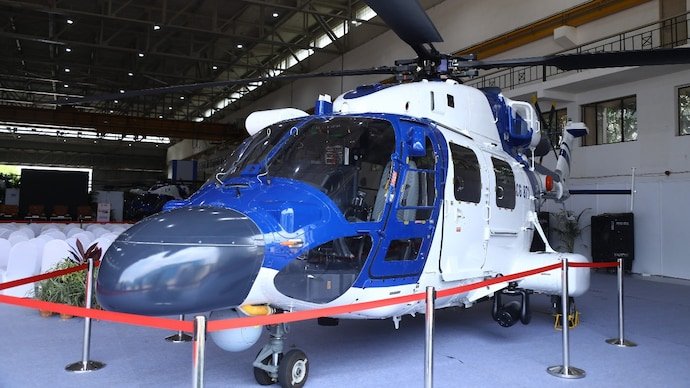
The Indian Coast Guard (ICG) has received a major boost to its maritime capabilities as Hindustan Aeronautics Limited (HAL) delivered four Advanced Light Helicopter (ALH) Mk III Maritime Role (MR) helicopters in Bengaluru on Friday. The delivery, completed within the agreed timeline under a March 2024 contract, enhances India’s ability to conduct surveillance, search and rescue missions, and coastal security operations. The helicopters were handed over during an official ceremony attended by senior Coast Guard and HAL officials, marking another milestone in India’s indigenous Defense Manufacturing journey.
Strengthening India’s Maritime Shield
India has a vast coastline stretching over 7,500 kilometers, making maritime security a complex and critical responsibility. From monitoring illegal activities to responding to emergencies at sea, the Coast Guard plays a vital role in safeguarding national interests.
The induction of four ALH Mk III helicopters is not just a routine fleet addition—it is a strategic enhancement. These helicopters will be deployed in key locations such as Kochi and Porbandar, enabling faster response times and wider operational coverage.
Why does this matter? Because maritime threats are evolving. From piracy and smuggling to environmental disasters and search-and-rescue missions, the Coast Guard needs versatile, reliable, and technologically advanced platforms—and that’s exactly what the ALH Mk III brings to the table.
About the ALH Mk III (MR): India’s Indigenous Workhorse
The ALH Mk III (MR) is the maritime variant of the Dhruv Advanced Light Helicopter, designed and manufactured in India. It represents a significant step toward self-reliance in defense production.
Key Features and Capabilities
- Twin-engine design: Ensures higher safety and reliability during operations over water
- Advanced avionics: Equipped with a modern glass cockpit for improved situational awareness
- Night operation capability: Allows missions to continue even in low-visibility conditions
- Multi-role functionality: Suitable for surveillance, rescue, logistics, and more
- Maritime adaptability: Designed specifically for operations in challenging sea environments
In simpler terms, this helicopter is like a Swiss Army knife for the Coast Guard—versatile, dependable, and ready for almost any mission thrown its way.
Contract Details and Delivery Timeline
The four helicopters are part of a broader agreement signed between HAL and the Indian Coast Guard in March 2024 for a total of nine ALH Mk III (MR) helicopters.
Notably, HAL has demonstrated consistency in its delivery commitments. Prior to this batch, the company had already delivered 16 ALH Mk III helicopters to the Coast Guard by 2022. Additionally, an order for six more helicopters was signed in March 2026, reflecting continued trust in the platform.
| Year | Event | Details |
|---|---|---|
| 2022 | Previous Deliveries | 16 ALH Mk III helicopters delivered |
| March 2024 | New Contract | 9 helicopters ordered |
| 2026 | Additional Order | 6 more helicopters signed |
| 2026 | Current Delivery | 4 helicopters handed over |
This steady pipeline of deliveries highlights HAL’s growing capability in meeting defense production demands—something that was often a concern in earlier decades.
Key Officials and Ceremony Highlights
The handover ceremony in Bengaluru was attended by senior officials from both HAL and the Indian Coast Guard. Among them were DIG Rajesh Makwana, Coast Guard Commander (Western Seaboard), and PB Rangarao, CEO of HAL’s Helicopter Complex.
The presence of high-ranking officials underscores the importance of this induction. The formal transfer of helicopter documents by the Aeronautical Quality Assurance authorities ensured that all operational and safety standards were met.
During the event, the Chief Guest commended HAL for its timely delivery, noting that such efficiency directly contributes to strengthening the Coast Guard’s operational readiness.
“Timely delivery of advanced platforms like the ALH Mk III significantly enhances the operational capability of the Indian Coast Guard,” the Chief Guest noted during the ceremony.
Operational Impact: What Changes on the Ground (and Sea)?
So, what does the addition of these helicopters actually mean in real-world terms?
1. Faster Search and Rescue Operations
Time is critical during maritime emergencies. With advanced navigation systems and extended range, the ALH Mk III can reach distressed vessels more quickly, potentially saving more lives.
2. Enhanced Coastal Surveillance
Illegal activities such as smuggling, unauthorized fishing, and infiltration can now be monitored more effectively. The helicopters provide aerial reconnaissance, giving the Coast Guard a broader and clearer view of maritime zones.
3. Improved Disaster Response
From cyclones to oil spills, natural and environmental disasters require rapid deployment. These helicopters can transport personnel, deliver supplies, and evacuate victims efficiently.
4. Support for Law Enforcement and Anti-Piracy Missions
With increasing Maritime Trade, security threats like piracy remain a concern. The ALH Mk III is equipped to assist in law enforcement operations, ensuring safer sea routes.
In short, these helicopters are not just machines—they are force multipliers.
Indigenous Defense Manufacturing: A Strategic Shift
The delivery also highlights India’s broader push toward self-reliance in defense manufacturing under initiatives like “Make in India.”
HAL, as a state-owned aerospace company, plays a crucial role in reducing dependence on foreign equipment. By producing advanced helicopters domestically, India not only saves costs but also gains greater control over maintenance, upgrades, and customization.
This shift is particularly important in today’s geopolitical Environment, where Supply Chain disruptions and international dependencies can pose risks.
And let’s be honest—there’s a certain pride in knowing that the helicopters protecting India’s coastline are built right here at home.
Technological Advancements in the ALH Mk III
The ALH Mk III is not just an upgrade—it’s a technological leap.
Glass Cockpit System
The modern glass cockpit replaces traditional analog instruments with digital displays, making it easier for pilots to access critical information quickly.
Integrated Avionics
The helicopter features advanced avionics systems that improve navigation, communication, and mission planning.
Night Vision Capability
Operations are no longer limited to daylight hours. The helicopter can perform missions in low-light conditions, increasing operational flexibility.
Enhanced Safety Features
The twin-engine configuration and advanced monitoring systems ensure higher safety standards, especially during over-water operations.
In aviation terms, these features translate into better performance, improved safety, and greater mission success rates.
Challenges and the Road Ahead
While the delivery is a positive development, challenges remain.
- Maintenance and lifecycle management: Ensuring long-term reliability requires robust support systems
- Pilot training: Advanced helicopters demand skilled operators
- Integration with existing systems: Seamless coordination with other assets is essential
However, these challenges are not new, and both HAL and the Coast Guard have been steadily improving in these areas.
The additional order placed in 2026 indicates confidence in overcoming these hurdles and scaling up operations.
Conclusion: A Step Forward for Maritime Security
The delivery of four ALH Mk III (MR) helicopters to the Indian Coast Guard marks a significant step in strengthening India’s maritime defense capabilities. With advanced features, multi-role functionality, and indigenous design, these helicopters are set to play a crucial role in safeguarding the nation’s coastline.
More importantly, this development reflects a broader trend—India’s growing confidence and capability in defense manufacturing. As additional helicopters are delivered in the coming years, the Coast Guard’s operational readiness will continue to improve.
Looking ahead, the focus will likely be on expanding the fleet, enhancing Technology, and ensuring seamless integration with other defense systems. If current trends are any indication, India’s maritime security framework is not just evolving—it’s accelerating.
And in a world where maritime threats are constantly changing, staying ahead isn’t just an advantage it’s a necessity.
For breaking news and live news updates, like us on Facebook or follow us on Twitter and Instagram. Read more on Latest India on thefoxdaily.com.






COMMENTS 0