- What Happened: Sudden Disruption in a Critical Waterway
- Indian Vessels Affected: A Diverse Fleet Stranded
- Indian Navy Steps In
- Rising Security Concerns in the Gulf
- Global Coordination Efforts
- Why the Strait of Hormuz Matters to India
- Geopolitical Tensions Behind the Crisis
- What Happens Next?
- Conclusion: A Critical Test for Maritime Stability
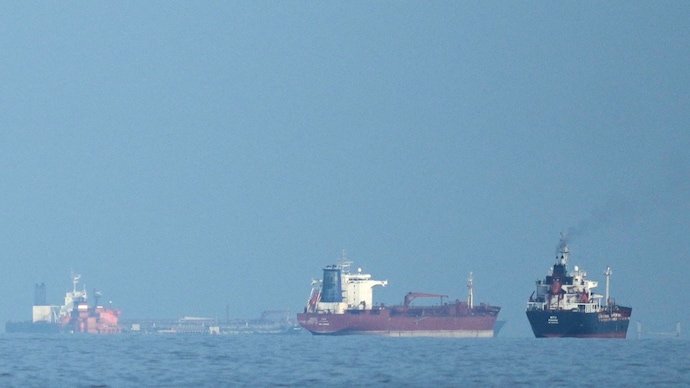
New Delhi/Persian Gulf: At least 15 Indian-flagged vessels remain stranded west of the Strait of Hormuz following the United States’ announcement of a naval blockade targeting Iranian ports. The move, triggered after failed US-Iran ceasefire talks, has disrupted one of the world’s busiest and most critical maritime trade routes.
The situation underscores growing risks to global energy flows, with India—one of the largest importers of oil—closely monitoring developments in the region.
What Happened: Sudden Disruption in a Critical Waterway
The escalation began after US Central Command confirmed that enforcement of the blockade would cover Iranian ports across the Arabian Gulf and the Gulf of Oman.
While transit between non-Iranian ports has not been formally banned, shipping activity slowed sharply immediately after the announcement. Early tracking data showed a noticeable drop in vessel movement through the Strait of Hormuz.
This sudden disruption has left multiple vessels, including Indian ships, unable to proceed through the chokepoint.
Indian Vessels Affected: A Diverse Fleet Stranded
The stranded Indian fleet includes a wide range of commercial vessels critical to energy and trade supply chains:
- LNG (Liquefied Natural Gas) carriers
- LPG (Liquefied Petroleum Gas) tankers
- Crude oil tankers
- Container ships
- A dredger
- A chemical tanker
These vessels are currently positioned west of the Strait, awaiting safe clearance amid uncertain conditions.
| Category | Status |
|---|---|
| Total Indian Vessels in Region | 25 |
| Successfully Crossed Hormuz | 10 |
| Currently Stranded | 15 |
Indian Navy Steps In
Naval Presence and Coordination
In response to the unfolding situation, the Indian Navy has intensified coordination with merchant vessels operating in the region.
At least six Indian naval ships have been deployed near the Persian Gulf to:
- Provide real-time communication support
- Monitor maritime threats
- Offer safe passage advisories
Officials have emphasised that operations are being conducted under standard protocols, with no major changes in deployment strategy so far.
Escort Operations Underway
One notable example is the LPG tanker Jag Vikram, which successfully crossed the Strait on April 11. The vessel is currently en route to Mumbai carrying approximately 20,400 tonnes of LPG and is under Indian Navy escort in the Arabian Sea.
This highlights ongoing efforts to ensure safe transit for Indian commercial shipping despite heightened risks.
Rising Security Concerns in the Gulf
The broader maritime environment in the region has become increasingly volatile.
Security agencies have reported:
- Nearly 30 incidents in the Gulf region in recent weeks
- 23 vessels targeted in separate episodes
These developments reflect a pattern of escalating risk, with both military and non-military threats affecting shipping lanes.
Global Coordination Efforts
India is not handling the situation in isolation. Maritime authorities are coordinating with 28 countries to ensure continuous monitoring and safer navigation through the region.
This international cooperation aims to:
- Share real-time intelligence
- Reduce risks to commercial shipping
- Maintain stability in critical trade routes
Why the Strait of Hormuz Matters to India
The Strait of Hormuz is a vital artery for global energy supply—and particularly crucial for India.
| Key Factor | Impact |
|---|---|
| Global Oil Trade | ~25% passes through Hormuz |
| India’s Dependence | Major share of crude imports via Gulf |
| Risk of Disruption | Higher fuel costs and supply uncertainty |
Any prolonged disruption could lead to increased fuel prices, higher Inflation, and pressure on India’s economy.
Geopolitical Tensions Behind the Crisis
The blockade follows the collapse of US-Iran negotiations in Pakistan, which failed to secure an agreement on key issues, including Iran’s nuclear programme.
In response, the US moved to tighten maritime pressure, while Iran warned of retaliation, signalling a potential escalation.
Iranian officials have stated that the country possesses “untapped leverage” to counter the blockade, raising concerns about further disruptions or even direct confrontation.
What Happens Next?
The immediate future remains uncertain, with several possible scenarios:
- Gradual resumption of shipping under naval protection
- Escalation leading to further maritime restrictions
- Renewed diplomatic efforts to stabilise the situation
For now, shipping companies, governments, and Energy Markets are closely watching developments.
Conclusion: A Critical Test for Maritime Stability
The stranding of 15 Indian vessels near the Strait of Hormuz highlights the far-reaching impact of geopolitical tensions on global trade and Energy Security.
While the Indian Navy’s presence provides a measure of reassurance, the situation remains fragile. The crisis underscores how quickly disruptions in a single chokepoint can ripple across economies and supply chains worldwide.
Forward-looking insight: If tensions persist, India and other major economies may need to accelerate diversification of energy routes and strengthen maritime security frameworks to reduce dependence on high-risk corridors like the Strait of Hormuz.
For breaking news and live news updates, like us on Facebook or follow us on Twitter and Instagram. Read more on Latest India on thefoxdaily.com.





COMMENTS 0