- What Is INS Aridhaman and Why It Matters
- Advanced Capabilities: Bigger, Quieter, Deadlier
- Second-Strike Capability: The Core of Nuclear Deterrence
- Strategic Timing: Rajnath Singh’s Visakhapatnam Visit
- INS Taragiri: A Complementary Boost to Naval Power
- Analysis: India’s Expanding Maritime Strategy
- What Comes Next: Towards a Four-Submarine Fleet
- Insight: Silent Power Beneath the Waves
- Conclusion: A Milestone in India’s Strategic Journey
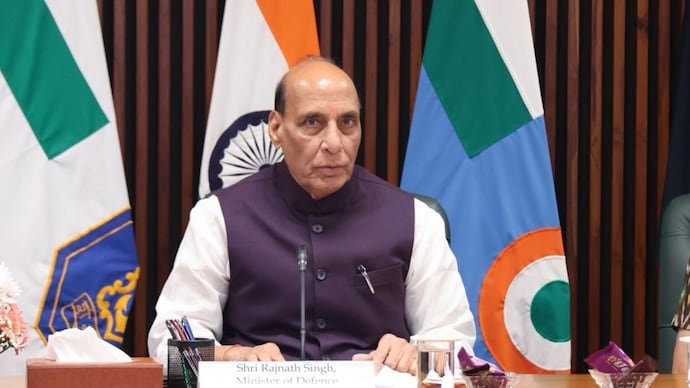
Defence Minister Rajnath Singh has hinted at the commissioning of INS Aridhaman, India’s third indigenously built nuclear-powered ballistic missile submarine (SSBN), in a cryptic Social Media post on Friday. Writing “It’s not just a word, it’s a symbol of power. ‘Aridhaman’!”, Singh sparked speculation, which was later confirmed by sources indicating that the submarine is set to be formally inducted into the Indian Navy.
The development marks a significant milestone in India’s strategic defence capabilities, particularly in strengthening its sea-based nuclear deterrence. INS Aridhaman is expected to enhance India’s ability to maintain a credible second-strike capability—an essential component of its nuclear doctrine.

What Is INS Aridhaman and Why It Matters
INS Aridhaman is the third submarine under India’s highly classified SSBN programme, following INS Arihant (commissioned in 2016) and INS Arighaat (commissioned in August 2024). These submarines form the backbone of India’s nuclear triad, which includes land-based missiles, air-delivered weapons, and sea-based deterrents.
The induction of Aridhaman is particularly important because it brings India closer to achieving “continuous at-sea deterrence”—a state where at least one nuclear-armed submarine is always deployed and operational, ensuring survivability even in the event of a first strike.
In simple terms, it’s like having a hidden insurance policy underwater—silent, invisible, and always ready.
Advanced Capabilities: Bigger, Quieter, Deadlier
INS Aridhaman represents a significant upgrade over its predecessors in both size and capability. With a displacement of around 7,000 tonnes, it is slightly larger and incorporates design improvements aimed at enhancing stealth and operational efficiency.
The submarine is powered by an upgraded 83 MW pressurised water reactor (PWR), developed by India’s Bhabha Atomic Research Centre (BARC), allowing it to remain submerged for extended periods without the need to surface.
One of its most notable advancements is its missile capacity.
| Feature | INS Arihant | INS Aridhaman |
|---|---|---|
| Displacement | ~6,000 tonnes | ~7,000 tonnes |
| Missile Tubes | 4 | 8 |
| Missile Options | K-15 / K-4 | K-15 / K-4 (higher capacity) |
| Stealth | Advanced | Improved acoustic & hull design |
Aridhaman can carry up to eight K-4 ballistic missiles with a range of approximately 3,500 km or up to 24 K-15 missiles with a range of around 750 km. This expanded payload significantly boosts India’s strike flexibility.
Second-Strike Capability: The Core of Nuclear Deterrence
The primary role of SSBNs like INS Aridhaman is to ensure a credible second-strike capability. This means that even if an adversary were to launch a devastating first strike targeting India’s land and air-based nuclear assets, submarines hidden deep underwater would still be able to retaliate.
This concept is central to nuclear deterrence, as it discourages adversaries from initiating a first strike in the first place.
An SSBN lurking underwater ensures that any nuclear attack would be met with a guaranteed response—making the cost of aggression unacceptably high.
With three operational SSBNs and a fourth in development, India is steadily moving towards a robust and survivable deterrent posture.
Strategic Timing: Rajnath Singh’s Visakhapatnam Visit
The hint about INS Aridhaman’s commissioning coincides with Rajnath Singh’s visit to Visakhapatnam, the headquarters of the Indian Navy’s Eastern Command. The city also serves as the construction hub and home port for India’s nuclear submarine fleet.
During his visit, Singh is also scheduled to commission the advanced stealth frigate Taragiri, highlighting India’s broader push to modernize its naval forces.
The dual focus on submarines and surface warships underscores India’s emphasis on strengthening its maritime capabilities across multiple dimensions.
INS Taragiri: A Complementary Boost to Naval Power
Alongside INS Aridhaman, the induction of the stealth frigate Taragiri represents another step forward in India’s naval modernization efforts.
Taragiri is equipped with a Combined Diesel or Gas (CODOG) propulsion system, enabling high-speed operations and long endurance. Its design incorporates reduced radar cross-section features, making it harder to detect during missions.
The frigate is armed with:
- Supersonic surface-to-surface missiles
- Medium-range surface-to-air missiles
- Advanced anti-submarine warfare systems
It also features a modern combat management system that integrates sensors and weapons for rapid response to threats.
Beyond combat roles, Taragiri is capable of undertaking humanitarian assistance and disaster relief (HADR) missions, reflecting the Indian Navy’s dual role in security and regional stability.
Analysis: India’s Expanding Maritime Strategy
The commissioning of INS Aridhaman and Taragiri reflects a broader strategic shift towards strengthening maritime capabilities. With increasing geopolitical competition in the Indo-Pacific region, control over sea lanes and deterrence at sea have become critical.
India’s focus on indigenously built platforms also highlights its push for self-reliance in defence manufacturing. Developing nuclear submarines domestically is a complex and resource-intensive process, achieved by only a handful of countries.
This not only enhances operational independence but also positions India as a technologically capable maritime power.
What Comes Next: Towards a Four-Submarine Fleet
Currently, India operates two SSBNs—INS Arihant and INS Arighaat—with INS Aridhaman set to become the third. A fourth submarine is already in the pipeline, expected to further strengthen the fleet.
With four SSBNs, the Indian Navy would be able to maintain continuous patrol cycles, ensuring that at least one submarine is always deployed while others undergo maintenance or transit.
This is considered the benchmark for a fully operational sea-based deterrent.
Insight: Silent Power Beneath the Waves
Unlike aircraft carriers or Fighter Jets, nuclear submarines rarely make headlines—and that is precisely their strength. Their stealth and invisibility make them one of the most effective deterrent tools in modern warfare.
INS Aridhaman’s induction is less about visible power and more about strategic assurance. It sends a message without saying a word.
In the world of nuclear deterrence, silence is often the loudest signal.
Conclusion: A Milestone in India’s Strategic Journey
The expected commissioning of INS Aridhaman marks a significant milestone in India’s defence and strategic capabilities. By enhancing its sea-based nuclear deterrent, India is reinforcing its commitment to maintaining a credible and survivable nuclear posture.
Combined with advancements in surface naval assets like Taragiri, the move reflects a comprehensive approach to maritime security and power projection.
As India continues to invest in Indigenous Defence technologies, the induction of INS Aridhaman stands as a testament to its growing capabilities—and its determination to secure its interests both above and below the seas.
For breaking news and live news updates, like us on Facebook or follow us on Twitter and Instagram. Read more on Latest India on thefoxdaily.com.






COMMENTS 0