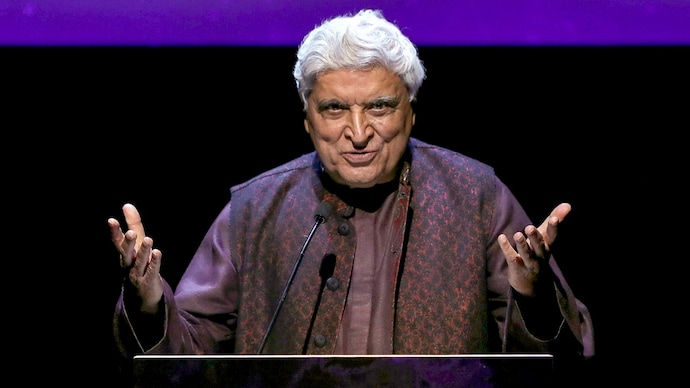
Renowned poet-lyricist and screenwriter Javed Akhtar and influential Islamic scholar Mufti Shamail Nadwi came face to face on Saturday at the Constitution Club in New Delhi for a thought-provoking discussion on the existence of God. What began as an intellectual exchange soon spilled beyond the auditorium, triggering heated reactions across social media platforms.
The nearly two-hour-long debate, titled “Does God Exist?”, was moderated by senior journalist Saurabh Dwivedi, editor of The Lallantop. The event stood out for bringing together two sharply contrasting worldviews—religious faith and atheistic skepticism—on a single public platform.
Throughout the discussion, Javed Akhtar, known for his candid opinions, questioned the moral consistency of belief in an all-powerful and compassionate God. He anchored much of his argument in human suffering, particularly referencing the ongoing conflict in Gaza and the large-scale civilian casualties.
“You must be in Gaza as well, you must have seen children being torn apart,” Akhtar said. “And you still want me to believe in you, if you are omnipotent and omnipresent?”
It was during this exchange that Akhtar made the remark that quickly went viral. In a moment blending sarcasm and social commentary, he said, “Compared to that, our Prime Minister is better—kuch to khayal karte hain (at least he takes care of US).” The comment drew laughter from some in the audience and sharp criticism from others online.
Akhtar repeatedly highlighted acts of violence committed in the name of religion, questioning why belief in God is often treated as the final answer that ends all inquiry.
“Why does everything have to end with God?” he asked. “Why should questions stop there? What kind of God allows infants to be killed by bombs? If such a God exists and allows this, then perhaps He should not exist at all.”
Responding to these arguments, Mufti Shamail Nadwi stressed that responsibility for evil lies primarily with human beings, not with the Creator.
“The Creator is not evil, but He has created the possibility of evil,” Nadwi said. “Those who misuse their free will are accountable.” He argued that crimes such as violence and rape stem from human choices rather than divine will.
Nadwi, who commands a large following online, began the debate by asserting that neither science nor scripture alone can serve as the sole yardstick for proving or disproving God’s existence.
He explained that science is limited to the physical world, while God, by definition, exists beyond it. “Those who reject revelation as a source of knowledge cannot be convinced by scripture,” he noted.
Rejecting the idea that scientific progress eliminates the need for God, Nadwi argued that science explains how the universe works, not why it exists. At one point, he challenged Akhtar directly, saying, “If you do not know, then do not claim that God does not exist.”
Akhtar responded by clarifying that admitting uncertainty was precisely his position. He said no scientist or philosopher claims absolute knowledge and cautioned against embracing absolute answers—whether religious or ideological.
A central theme of the debate revolved around the difference between belief and faith. According to Akhtar, belief is grounded in evidence, logic, and testimony, whereas faith demands acceptance without proof.
“When there is no evidence, no logic, and no witness, and yet you are asked to believe—that is faith,” he said, warning that such expectations can obstruct critical inquiry.
The discussion also touched upon morality and justice. Akhtar argued that morality is a human construct rather than a natural law, comparing it to traffic rules—essential for social order but absent in nature itself.
“Nature has no justice,” he remarked, asserting that concepts of right and wrong emerge from human society, not the natural world.
Mufti Shamail Nadwi rejected this analogy, posing a sharp counter-question: “If the majority decides something, does that make oppression right?” He argued that morality requires an objective foundation beyond human consensus.
The debate, marked by sharp exchanges and philosophical depth, has continued to resonate online, with supporters on both sides praising the discussion as rare, necessary, and reflective of India’s diverse intellectual landscape.
For breaking news and live news updates, like us on Facebook or follow us on Twitter and Instagram. Read more on Latest India on thefoxdaily.com.





COMMENTS 0