New Delhi: In a development with far-reaching strategic and economic implications, the National Green Tribunal (NGT) has refused to stall the environmental clearance granted to the Rs 81,000-crore Great Nicobar Project. The ruling effectively clears one of the biggest legal challenges facing what is widely regarded as India’s most ambitious island infrastructure initiative.
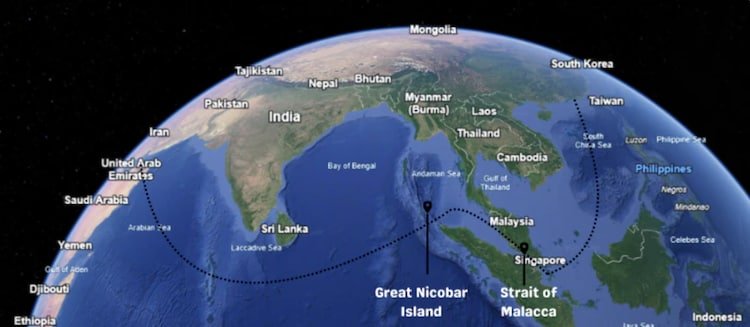
Located just about nine kilometres from Indira Point — the southernmost tip of India — Great Nicobar Island sits close to one of the world’s busiest maritime trade corridors. The government envisions transforming the island into a logistics and transshipment hub that could reshape India’s maritime footprint in the Indo-Pacific and potentially rival established global trade hubs.
The decision is being seen as a significant institutional endorsement of the project, which had faced sharp criticism from sections of the Opposition. congress MP Sonia Gandhi had, in September 2025, called for a reconsideration of the project citing ecological concerns and tribal rights issues. Multiple petitions had challenged the environmental clearance, alleging violations of coastal regulations.
What the NGT Said on the Great Nicobar Project
The six-member special bench of the NGT, led by Chairperson Justice Prakash Shrivastava, ruled that it found “no good ground” to interfere with the environmental clearance granted in 2022. The Tribunal observed that adequate safeguards had been incorporated into the approval conditions.
Framing the issue as one requiring a “balanced approach,” the bench emphasized that while compliance with the Island Coastal Regulation Zone (ICRZ) Notification, 2019 was essential, the strategic significance of the project could not be overlooked.
Quoting from the February 16 order, the Tribunal noted that development at a strategically vital location should not be prohibited merely on apprehensions, provided activities strictly adhere to ICRZ norms.
The ruling relied in part on the findings of a High-Powered Committee (HPC) headed by former Environment Secretary Leena Nandan. The committee had been constituted following an April 2023 NGT directive to review specific environmental concerns linked to the project.
The Tribunal concluded that no component of the project fell within prohibited ICRZ categories. The ICRZ framework, notified under the Environment Protection Act, classifies island coastal areas into different zones — including ecologically sensitive regions where construction is restricted or banned to preserve fragile ecosystems.
Importantly, the NGT stressed that the government must ensure strict compliance with all environmental conditions imposed as part of the clearance.
What Is the Great Nicobar Project?
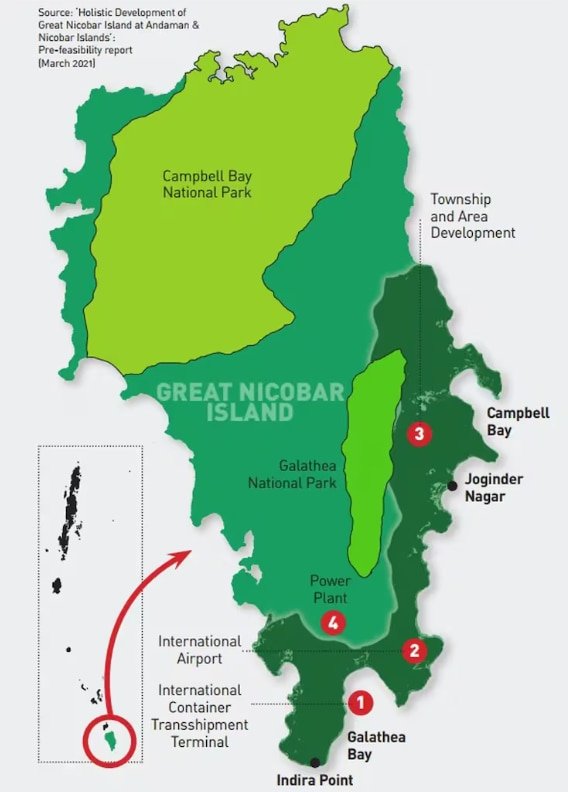
The Great Nicobar Project spans approximately 166 square kilometres and is among India’s largest greenfield infrastructure initiatives in recent years. The plan includes diversion of nearly 130 square kilometres of forest land and the felling of around one million trees — a factor that has triggered environmental debate.
The project comprises four major components:
- A deep-draft international transshipment port
- An integrated township
- A dual-use civil and military airport
- A 450 MVA gas and solar-based power plant
At the heart of the initiative is the transshipment port. India currently relies heavily on foreign ports for transshipment of a substantial portion of its cargo. The proposed hub aims to capture a significant share of East-West shipping traffic passing through the Malacca Strait — a critical maritime chokepoint through which a large share of global trade and nearly 80% of china’s oil imports transit.
The integrated township is designed to support project personnel and associated economic activity, while the dual-use airport would cater to both civilian and strategic military needs. The power plant is intended to ensure energy self-sufficiency for the island’s expanded infrastructure.
Strategic Significance in the Indo-Pacific
The NGT’s explicit acknowledgment of the project’s “strategic importance” is notable. Great Nicobar lies close to key maritime chokepoints in the eastern Indian Ocean, making it a critical vantage point for monitoring sea lanes and enhancing rapid deployment capabilities.
Control and logistical support from the island could strengthen India’s maritime posture in the Indo-Pacific, particularly at a time when China’s naval presence in the region has steadily expanded. The People’s Liberation Army Navy (PLAN) has increased patrols near the eastern approaches to the Malacca Strait to secure its energy supply routes.
For New Delhi, the project is not merely economic — it is a strategic force multiplier. By combining a deep-sea port, airfield, and military logistics infrastructure, the Great Nicobar Project seeks to anchor India’s southeastern maritime boundary with enhanced capability and visibility.
Environmental and Tribal Concerns: What the NGT Addressed
Since NITI Aayog commissioned a pre-feasibility study in 2021, the project has faced sustained scrutiny from environmental activists and civil society groups.
Petitions filed before the NGT alleged that nearly 700 hectares of the project area fell within protected coastal zones under the ICRZ 2019 notification. Environmentalist Ashish Kothari argued that the clearance violated coastal regulation norms.
After reviewing the HPC findings, the Tribunal dismissed these claims, concluding that the clearance conditions sufficiently addressed environmental safeguards.
The bench also examined concerns regarding coral reefs. Referring to reports by the Zoological Survey of India, the Tribunal noted that no coral reef existed in the immediate project area. It directed that any dispersed coral formations be translocated using scientifically approved techniques and that coral regeneration be ensured.
The NGT mandated that waterfront development must not lead to coastal erosion or irreversible shoreline alteration. Special emphasis was placed on preserving sandy beaches, which serve as critical nesting grounds for birds and marine turtles.
Environmental clearance conditions include protection measures for species such as the Nicobar macaque, saltwater crocodiles, robber crabs, leatherback sea turtles, and the Nicobar megapode.
The Tribunal made it unequivocally clear: environmental compliance is mandatory and non-negotiable.
What the Clearance Means for India
The NGT’s decision lifts a major legal cloud hanging over the Great Nicobar Project, allowing the Centre to proceed with implementation. While political and ecological debates are unlikely to disappear, the ruling provides administrative certainty.
If executed as envisioned, the Great Nicobar Project could significantly alter India’s maritime and trade landscape. It would provide the country with a deep-sea port at its southernmost frontier and a dual-use aviation hub capable of supporting both commerce and security operations.
More than just an infrastructure venture, the project represents a strategic declaration of intent — a statement that India aims to secure and shape its maritime destiny in the Indo-Pacific.
For breaking news and live news updates, like us on Facebook or follow us on Twitter and Instagram. Read more on Latest India on thefoxdaily.com.




COMMENTS 0