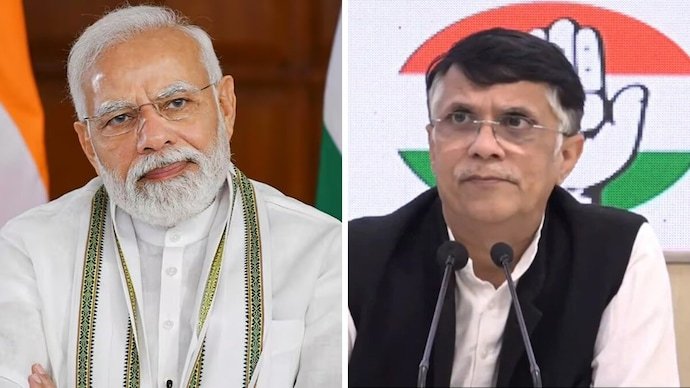
The political debate over the India–United States interim trade agreement intensified on Saturday after congress leader Pawan Khera criticized the Centre, calling the deal “all pain, no gain” for India. His remarks come at a time when global trade dynamics are once again in flux following legal developments in the United States over the scope of presidential tariff powers.
While the Union government has projected the temporary trade arrangement as a diplomatic achievement that helped ease immediate trade tensions, the Opposition argues that India may have conceded more than it gained — especially in light of recent U.S. court rulings that could alter the broader tariff framework.
Congress Claims 18.4% Effective Tariff Burden on India
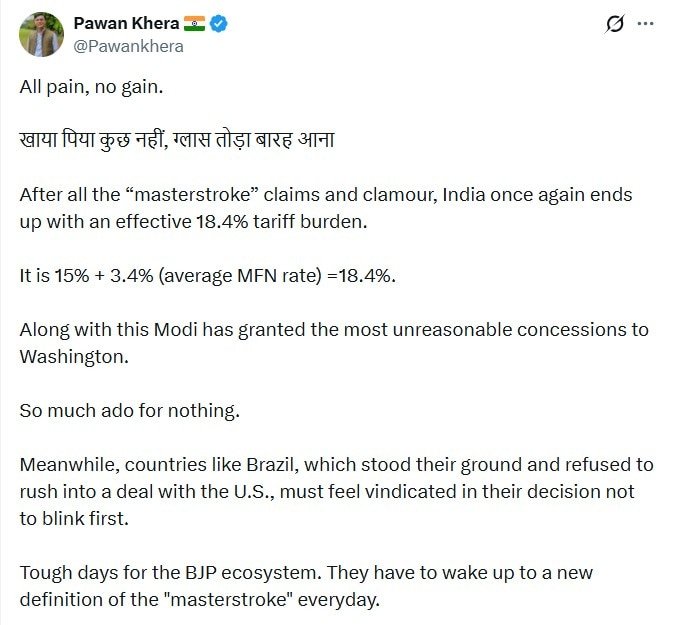
In a public statement on social media platform X, Khera contended that despite the celebratory tone surrounding the agreement, India has effectively been left with an 18.4% tariff burden — calculated as a 15% reciprocal tariff plus an average Most Favoured Nation (MFN) rate of approximately 3.4%.
“After all the ‘masterstroke’ claims and clamor, India once again ends up with an effective 18.4% tariff burden,” he said, arguing that the government may have rushed into negotiations under pressure from Washington.
According to the Congress leader, India moved swiftly to finalize the February 6 interim arrangement in order to reduce a steep 50% penal tariff allegedly imposed by the United States on certain imports linked to Russian Oil transactions. He claimed the revised framework lowered that burden to around 18%, but at a potentially high strategic cost.
US Supreme Court Ruling Shifts Global Tariff Landscape
The criticism comes in the wake of a significant ruling by the US Supreme Court, which examined the scope of emergency economic powers invoked under the International Emergency Economic Powers Act (IEEPA). The Court ruled that certain broad international tariffs imposed during the Trump administration exceeded the authority granted under the statute.
Following the decision, legal experts noted that tariff structures in several cases could theoretically revert to baseline Most Favoured Nation (MFN) rates — typically in the 3.4% to 3.5% range for many goods.
Khera argued that if the legal ceiling on tariffs was already under challenge, India may have prematurely accepted a higher reciprocal tariff rate than necessary. He suggested that countries which delayed negotiations with Washington may now find themselves in a comparatively stronger position.
The Union government had not issued an immediate response to the Congress leader’s remarks at the time of publication.
Donald Trump Signals Fresh Global Tariff Measures
Adding another layer of uncertainty, Donald Trump recently announced that his administration would raise the previously stated 10% global tariff to what he described as the “fully allowed and legally tested” 15% level.
In a post on Truth Social, Trump criticized the Supreme Court’s decision as “ridiculous” and “anti-American,” while signaling that his administration would continue pursuing tariff measures through alternative legal mechanisms.
Specifically, he referenced Section 122 of the Trade Act of 1974, which permits temporary import surcharges of up to 15% for 150 days in order to address balance-of-payments concerns. According to Trump, revised tariff measures form part of a broader economic recalibration strategy that will unfold over the coming months.
Strategic Debate: Diplomatic Win or Negotiation Misstep?
The Congress has consistently questioned the economic assumptions underlying the interim trade agreement. Party leaders argue that shifting U.S. legal interpretations and evolving global trade policy may have altered the foundation on which the deal was structured.
Khera described the agreement as a “strategic misstep,” contending that India’s negotiating leverage may have been weakened by acting early while international tariff rules were still being contested in American courts.
Supporters of the government, however, maintain that stabilizing trade relations with the United States — one of India’s largest trading partners — was critical amid global economic volatility. They argue that securing clarity and predictability, even at a higher tariff threshold, may have helped prevent escalation into a broader trade dispute.
Economic Implications for India
Trade analysts note that an 18% effective tariff burden, if sustained, could impact sectors reliant on exports to the U.S., potentially affecting pricing competitiveness and supply chain decisions. However, the long-term effect will depend on how future U.S. policy evolves and whether permanent trade frameworks replace temporary arrangements.
The broader question now confronting policymakers is whether the interim deal insulated India from immediate trade shocks — or whether evolving U.S. judicial and executive actions may render parts of the agreement less advantageous over time.
As the global tariff architecture undergoes renewed scrutiny, the India–US trade equation remains in focus — both as a diplomatic balancing act and as a test of economic strategy in an increasingly unpredictable international trade environment.
For breaking news and live news updates, like us on Facebook or follow us on Twitter and Instagram. Read more on Latest India on thefoxdaily.com.




COMMENTS 0