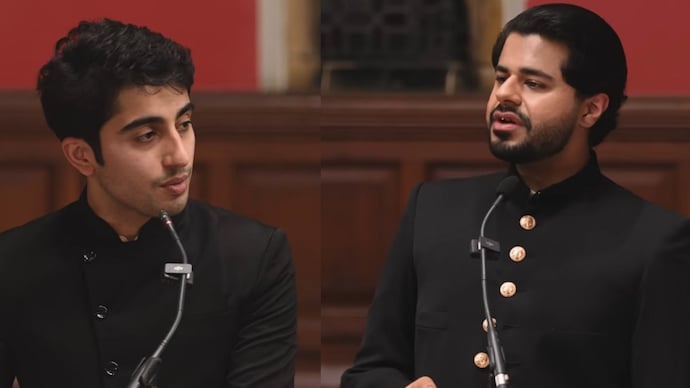
A debate on terrorism at the prestigious Oxford Union Society has drawn widespread attention after an Indian law student, Viraansh Bhanushali, delivered a powerful rebuttal to Pakistan’s long-denied involvement in cross-border terrorism. The debate, though held earlier, has recently gone viral following the release of official footage, igniting fresh global discussion on Pakistan’s terror record.
The student-led debate came against the backdrop of controversy surrounding an earlier Oxford Union event involving Indian and Pakistani politicians and intellectuals, which was allegedly disrupted. While that version collapsed amid accusations of procedural manipulation, the student debate proceeded—and delivered what many observers describe as an unfiltered, fact-based demolition of Pakistan’s narrative.
The Pakistani side was led by Moosa Harraj, President of the Oxford Union and son of Pakistan’s Federal Minister for Defence Production, Muhammad Raza Hayat Harraj. Representing India was Bhanushali, an Oxford law student and Mumbai resident who personally witnessed the trauma of the 2008 Mumbai terror attacks (26/11).
Background: How the Oxford Union Became a Battleground
The Oxford Union Society has historically hosted debates on global conflicts, but few have been as emotionally charged as those involving India and Pakistan. Just weeks before the student debate, Pakistan claimed “victory” after Indian speakers allegedly withdrew from a high-profile session.
Indian invitees—including advocate-author J Sai Deepak and Shiv Sena (UBT) MP Priyanka Chaturvedi—later revealed that invitations were issued at the last minute and lacked transparency, making participation impossible. The controversy intensified when Sai Deepak publicly criticised the episode, accusing Pakistan-linked organisers of sabotaging a reputed academic platform.
Central to both controversies was Moosa Harraj, whose involvement drew scrutiny due to his political lineage. While the political debate stalled, the student debate—released on December 18—proceeded and quickly overshadowed the earlier incident.
A Cordial Setting, A Combative Subject
Despite being referred to as “friends” during the session, the exchange between Bhanushali and Harraj was sharp, direct, and deeply ideological. While personal rapport remained intact, the subject of terrorism triggered intense disagreement.
Harraj attempted to trivialise India’s security concerns, suggesting that Indians habitually blame Pakistan for everything from personal grievances to random violence. The remark set the stage for what followed—a methodical and emotionally charged rebuttal.
Viraansh Bhanushali Opens With 26/11: “This Is Not Theory for Me”
Bhanushali began his address by anchoring the debate in lived reality. Recalling the night of November 26, 2008, he said Chhatrapati Shivaji Maharaj Terminus (CSMT)—one of the main targets—was a station his aunt passed through almost every evening.
“She survived only because she took a different train that night,” he said, noting that 166 people were not as fortunate. He described watching Mumbai burn on live television as a schoolboy, recalling the tension in his father’s silence and the fear in his mother’s voice as the city stayed awake for three nights.
Bhanushali explained that he shared this account not for sympathy, but to remind the chamber that terrorism is not an abstract policy debate for Indians—it is a lived, recurring trauma.
He further recalled the 1993 Mumbai serial bomb blasts, when RDX explosions killed over 250 people near his neighbourhood. “I grew up under the shadow of these tragedies,” he said.
“I Don’t Need Rhetoric—Just a Calendar”
One of Bhanushali’s most quoted lines came when he said, “I don’t need rhetoric to win this argument. I just need a calendar.”
He dismantled claims that India’s counter-terror actions are driven by electoral populism by mapping attacks against election timelines.
| Year | Terror Attack | Fatalities | Election Proximity |
|---|---|---|---|
| 1993 | Mumbai Serial Blasts | 257+ | No elections nearby |
| 2008 | 26/11 Mumbai Attacks | 166 | No immediate elections |
| 2016 | Pathankot Airbase Attack | 7 | Post-election period |
| 2016 | Uri Attack | 19 | Mid-term governance |
| 2019 | Pulwama Attack | 40 | Election year, but attack initiated by terror groups |
“If terrorism were about Indian votes,” Bhanushali argued, “why did it strike when there was nothing to gain politically?” He pointed out that after 26/11, a truly populist government might have launched immediate military retaliation—but instead, India pursued restraint, diplomacy, and international legal channels.
“Did restraint bring peace?” he asked. “No. It brought Pathankot. It brought Uri. It brought Pulwama.”
“When You Can’t Give Bread, You Give a Circus”
Turning his focus to Pakistan’s internal dynamics, Bhanushali delivered one of the debate’s most stinging observations. “When Pakistan cannot provide bread to its citizens, it provides them with a circus,” he said, accusing Islamabad of using manufactured conflict to divert attention from domestic crises.
He explained the symbolism behind India’s limited military responses, stating that operations were precise, proportional, and purpose-driven—not expansionist. “We neutralised launchpads. We stopped. We didn’t occupy land. That is professionalism, not populism,” he said.
Contrasting the two nations, he added, “In India, we debrief pilots. In Pakistan, you auto-tune the chorus. Poverty becomes spectacle, and war rhetoric becomes political currency.”
India’s Position: Peaceful, But Not Passive
Bhanushali concluded by stating that India does not seek war. “We want boring neighbours,” he said. “We want to trade electricity and onions.”
However, he made it clear that India would continue to defend itself as long as terrorism remains an instrument of Pakistani foreign policy. “If that makes me a populist,” he concluded, “then so be it.”
While a Pakistani student may have disrupted one Oxford Union debate, it took only one Indian student—armed with facts, memory, and moral clarity—to expose what critics call Pakistan’s hollow narrative on terrorism. As Bhanushali demonstrated, when history is examined honestly, a calendar is often enough.
For breaking news and live news updates, like us on Facebook or follow us on Twitter and Instagram. Read more on Latest India on thefoxdaily.com.




COMMENTS 0