- Opposition Questions “Double Standards”
- “A Funny Situation”: RJD’s Manoj Jha Joins the Criticism
- Congress Leader Rashid Alvi: “Friends Play Games, Not Enemies”
- Backdrop: Pahalgam Attack and Operation Sindoor
- Sport vs Politics: ICC and Organizers Defend the Fixture
- Cricket Diplomacy or Commercial Compulsion?
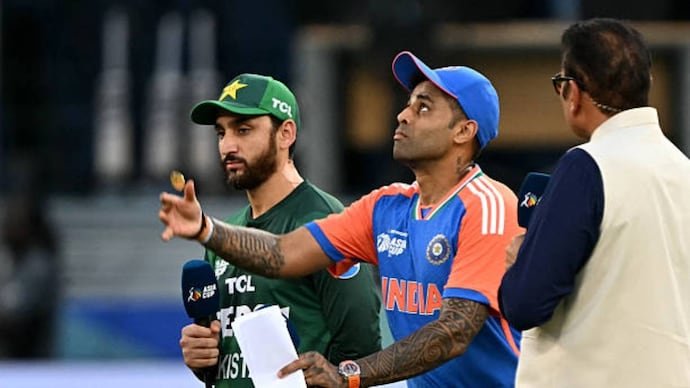
As India prepares to face arch-rivals Pakistan in a high-stakes Group A fixture of the ICC T20 World Cup in Colombo tonight, the political temperature back home has risen sharply. What is traditionally cricket’s most watched and emotionally charged encounter has now triggered a fierce political debate, with opposition leaders questioning both the timing and the rationale behind allowing the match to proceed.
While weather forecasts suggest rain could disrupt the marquee contest, it is the political thunderstorm in New Delhi that has overshadowed the sporting spectacle.
Opposition Questions “Double Standards”
Several opposition leaders have criticized the Board of Control for Cricket in India (BCCI) and the Union government led by Prime Minister Narendra Modi for permitting the India–Pakistan clash despite strained diplomatic ties and recent security concerns.
Critics argue that the Centre frequently refers to Pakistan as an adversarial nation, yet continues to allow high-profile sporting engagements that generate enormous commercial returns.
Shiv Sena (UBT) MP Sanjay Raut launched one of the sharpest attacks, alleging that financial interests linked to betting and gaming syndicates were driving the decision.
“This is not an India–Pakistan match. This is a match between Pakistan and Jay Shah,” Raut remarked, taking a swipe at the BCCI leadership. “This is not what the Indian populace wants. The people of India do not approve of India playing against Pakistan.”
He further claimed that India–Pakistan cricket matches attract the highest volume of betting activity, alleging that illegal syndicates benefit enormously from such fixtures.
“Pakistan won Rs 25,000 crore in the most recent game against us. That money eventually reaches terror networks. Some go to Pathankot, some to Uri, some to Pahalgam, and some to Pulwama,” Raut alleged, linking betting revenues to cross-border terrorism.
He also claimed that betting networks based in Rajasthan and Gujarat form part of a broader financial web, though no official evidence has been presented to substantiate these claims.
“A Funny Situation”: RJD’s Manoj Jha Joins the Criticism
RJD MP Manoj Jha echoed similar concerns, describing the situation as contradictory and politically confusing.
“We have created a very funny situation. If there are concerns, then decide clearly whether to play or not. But don’t create a narrative around handshakes and symbolic gestures,” he said.
Jha also questioned the optics of proceeding with the match in the aftermath of recent terror incidents, arguing that such decisions risk diluting India’s moral and diplomatic position.
“I am aware that billions of rupees are at stake. But either play or don’t play. Don’t use selective reasoning to justify both narratives,” he added.
Congress Leader Rashid Alvi: “Friends Play Games, Not Enemies”
Congress leader Rashid Alvi framed the issue in stark moral terms.
“Those who enter our nation and carry out acts of terrorism-how can we play any game, even cricket, with them? Friends are the ones who play games, not enemies,” Alvi stated.
He went further, asserting that had the Congress been in power, such a contest would not have been permitted under current circumstances.
Backdrop: Pahalgam Attack and Operation Sindoor
The controversy unfolds against a backdrop of heightened tensions following the recent Pahalgam terror attack and the subsequent Operation Sindoor. These events have reignited public debate over India’s engagement policy toward Pakistan, especially in areas beyond diplomacy, including cultural and sporting exchanges.
Questions have also emerged over whether traditional pre-match handshakes and ceremonial interactions should proceed as usual, adding another layer to the controversy.
Sport vs Politics: ICC and Organizers Defend the Fixture
Despite the political backlash, the ICC and tournament organizers have emphasized the sporting and commercial significance of the India–Pakistan encounter.
The fixture remains one of the most watched sporting events globally, drawing massive television ratings, digital engagement, and advertising revenues. From a cricketing standpoint, both teams enter the contest unbeaten, raising the stakes even further.
The match is also proceeding after earlier tournament disruptions, including Pakistan’s initial boycott in solidarity with Bangladesh, who were disqualified after refusing to travel to India for group-stage matches.
Cricket Diplomacy or Commercial Compulsion?
The India–Pakistan cricket rivalry has historically oscillated between diplomacy and disruption. At times, matches have served as channels of soft diplomacy; at others, they have been suspended amid political and military escalations.
The present controversy underscores the enduring sensitivity surrounding bilateral sporting ties. For the Modi government, critics allege inconsistency; for supporters, cricket remains a separate arena governed by international sporting commitments rather than bilateral diplomacy.
As rain clouds hover over Colombo and security remains tight, millions of fans across the globe await the first ball. Yet beyond the boundary ropes, the debate over whether sport can-or should-be insulated from geopolitics continues to intensify.
Tonight’s contest may last only a few hours, but the political questions it has reignited are likely to persist far longer.
For breaking news and live news updates, like us on Facebook or follow us on Twitter and Instagram. Read more on Latest India on thefoxdaily.com.




COMMENTS 0