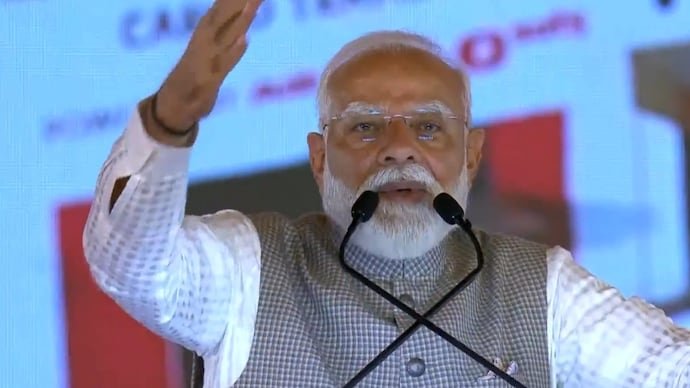
Prime Minister Narendra Modi has highlighted India’s ethanol blending initiative as a key strategy to reduce dependence on imported crude oil, especially as Global energy markets face disruption due to the ongoing conflict in West Asia and tensions around the Strait of Hormuz.
Addressing the gathering at the inauguration of the Noida International Airport in Jewar, the Prime Minister underscored the importance of domestic solutions in tackling global crises. He specifically praised farmers, particularly sugarcane growers from Western Uttar Pradesh, for their role in supporting the country’s energy transition.
Emphasising the economic impact, PM Modi noted that without ethanol blending, India would have been forced to import an additional 4.5 crore barrels of crude oil, significantly increasing the burden on foreign exchange reserves.
What Is the E20 Ethanol Blending Programme?
The ethanol blending programme involves mixing ethanol, a renewable biofuel derived primarily from sugarcane and agricultural feedstock, with petrol. The E20 target refers to a blend of 20% ethanol and 80% petrol.
The initiative is designed to reduce carbon emissions, cut fuel import costs, and support India’s agricultural economy by creating additional demand for crops like sugarcane.
| Key Aspect | Details |
|---|---|
| Ethanol Blend Target | 20% (E20 fuel) |
| Achievement Timeline | Achieved 5 years ahead of schedule |
| Nationwide Rollout | From April 1 across all states and UTs |
| Future Target | 30% ethanol blending by 2030 |
| Estimated Savings | Over ₹1.36 lakh crore in foreign exchange (10 years) |
Farmers Play a Crucial Role in Energy Transition
PM Modi credited India’s farmers for their contribution to the ethanol supply chain, noting that their efforts have directly helped the country reduce reliance on imported fossil fuels. Sugarcane growers, in particular, have become central to the production of ethanol used in fuel blending.
This shift not only strengthens Energy Security but also provides an additional revenue stream for farmers, linking agriculture with the country’s broader economic and environmental goals.
Energy Security Gains Importance Amid Hormuz Tensions
The Prime Minister’s remarks come at a time when crude oil prices are witnessing an upward trend due to the escalating conflict in West Asia. The region accounts for more than 40% of India’s oil imports, making the country highly sensitive to geopolitical disruptions.
With the Strait of Hormuz being a critical global oil transit route, any disruption in the region has direct implications for India’s fuel supply and pricing.
In this context, the ethanol blending programme is emerging as a strategic buffer, helping India reduce its exposure to volatile international markets.
Government Expands Ethanol Policy Framework
Over the past decade, the government has significantly expanded ethanol blending efforts through policy support, incentives, and infrastructure development. Oil marketing companies have been mandated to supply ethanol-blended fuel across the country, ensuring widespread availability.
Achieving the E20 target ahead of schedule marks a major milestone in India’s Energy policy, demonstrating the effectiveness of coordinated efforts between the government, industry, and the agricultural sector.
Looking ahead, the government aims to increase ethanol blending to 30% by 2030, further strengthening its push toward cleaner and more self-reliant energy systems.
Call for Unity Amid Global Crisis
Alongside highlighting policy measures, PM Modi called on citizens to remain calm and united in the face of global uncertainty. He emphasised that while the crisis may be international in nature, India must prioritise its national interests.
“We must face this situation with patience and unity. This is a global challenge, but safeguarding India’s interests is our top priority,” the Prime Minister said during his address.
He reassured the public that the government is actively taking steps to ensure that there is no shortage of fuel, despite disruptions in global supply chains.
Focus on Long-Term Energy Stability
The push for ethanol blending is part of a broader strategy to secure India’s long-term energy future. By diversifying fuel sources and reducing dependence on imports, the country aims to build resilience against global shocks.
The ongoing developments in West Asia have reinforced the urgency of such measures, highlighting the importance of domestic energy solutions in maintaining economic stability.
As India navigates the evolving geopolitical landscape, initiatives like E20 ethanol blending are expected to play a critical role in shaping a more sustainable and self-reliant energy ecosystem.
For breaking news and live news updates, like us on Facebook or follow us on Twitter and Instagram. Read more on Latest India on thefoxdaily.com.






COMMENTS 0