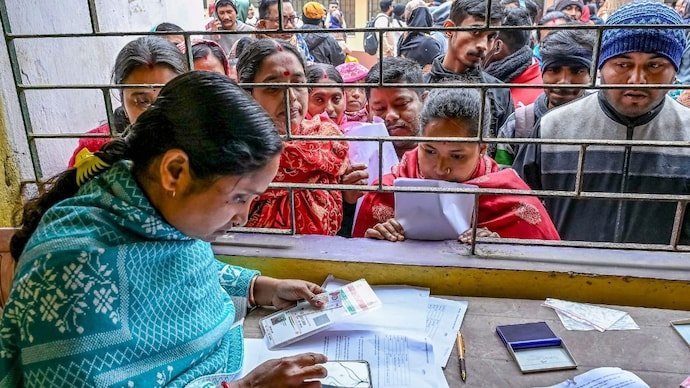
New Delhi: The Supreme Court on Monday directed the Election Commission of India (ECI) to publish the names of nearly 1.25 crore voters in West Bengal whose entries have been flagged for so-called “logical discrepancies” during the ongoing Special Intensive Revision (SIR) of the state’s electoral rolls.
A three-judge bench comprising Chief Justice of India Surya Kant, Justice Dipankar Datta and Justice Joymalya Bagchi took note of the scale of the exercise, observing that close to two crore notices have already been issued to voters seeking verification and confirmation of their details.
The bench explained that the notices fall into three broad categories — mapped, unmapped, and logical discrepancies. The present directions of the court specifically concern voters whose names have been flagged under the logical discrepancy category.
Clarifying what constitutes a logical discrepancy, the court said such cases include mismatches in a parent’s name, implausible age gaps between parents and children, and inconsistencies in the recorded ages of grandparents in the electoral database.
Given the magnitude of the revision exercise, the Supreme Court directed that the names of voters flagged for logical discrepancies must be publicly displayed at gram panchayat bhavans, block offices and ward offices across West Bengal. The court said affected voters must be given ten days to raise objections after publication, followed by additional time to submit supporting documents.
The bench further ruled that “such persons shall be given an opportunity to present documents and also be heard, either in person or through an authorised representative, where the document is not found satisfactory,” emphasising the importance of procedural fairness.
The matter is of particular significance as West Bengal is scheduled to hold Assembly elections later this year. The apex court was hearing petitions that alleged arbitrariness and procedural lapses in the ongoing SIR process, which critics argue could potentially impact large sections of the electorate.
The Supreme Court also issued a series of administrative directions to ensure transparency and orderliness. Municipal authorities were instructed to provide written reasons for their final decisions on objections and to issue acknowledgement receipts for documents submitted by voters. The state government was asked to ensure adequate manpower at hearing venues, while the Director General of Police was directed to take steps to prevent any law and order issues during the process.
During the hearing, the court expressed strong displeasure with the Election Commission for issuing directions through informal channels. “Using WhatsApp for everything is not an option. Circulars have to be issued,” CJI Surya Kant remarked.
Justice Joymalya Bagchi highlighted the human impact of the exercise, noting that over one crore individuals had already been served notices. “Please be mindful of the stress that people are facing. Where needed, we will give instructions,” he said.
Senior advocate Kapil Sibal, appearing for the petitioners, questioned the basis of the multiple objections being raised. He urged the court to closely examine the criteria used to identify logical discrepancies and pointed to serious logistical shortcomings in the process.
“Please investigate the so-called logical discrepancy. The voter list already contains all these names. Let the ECI publish a detailed list and provide hearing dates,” Sibal submitted. He also pointed out that while nearly 1,900 hearing venues were required, only about 300 had been approved so far.
Responding on behalf of the Election Commission, senior counsel Rakesh Dwivedi argued that several discrepancies were too glaring to ignore. “There are cases where a parent and child are only 15 years apart. About 324 voters have been linked to one individual. Shouldn’t such errors be examined?” he asked.
However, Justice Bagchi questioned whether such criteria alone should automatically trigger suspicion. “How can a 15-year age gap between a mother and child be decisive? Child marriages are a reality in our country,” he observed.
The court was also informed that notices had been issued to several eminent individuals, including Nobel laureate Amartya Sen. Senior advocate Kalyan Bandyopadhyay submitted that “Nobel Laureate Amartya Sen has been called. MPs have been called. There is also an issue of Class 10 certificates not being accepted.”
Taking note of these concerns, the bench directed the Election Commission to accept Madhyamik (Class 10) admit cards containing dates of birth as valid proof during hearings. It also allowed affected voters to seek assistance from a lawyer, family member, neighbour or political party representative, provided proper authorisation is furnished.
The Election Commission informed the court that the draft electoral rolls were published after a three-phase process that began on December 4, 2025. The exercise reportedly identified over 58 lakh voter names for deletion. Voters have been given time until February 2026 to complete the second phase, which allows them to verify details and resolve inconsistencies.
The Supreme Court made it clear that while electoral roll purification is necessary, it must be carried out with transparency, sensitivity and strict adherence to due process, particularly when such a large number of citizens are affected.
For breaking news and live news updates, like us on Facebook or follow us on Twitter and Instagram. Read more on Latest India on thefoxdaily.com.





COMMENTS 0