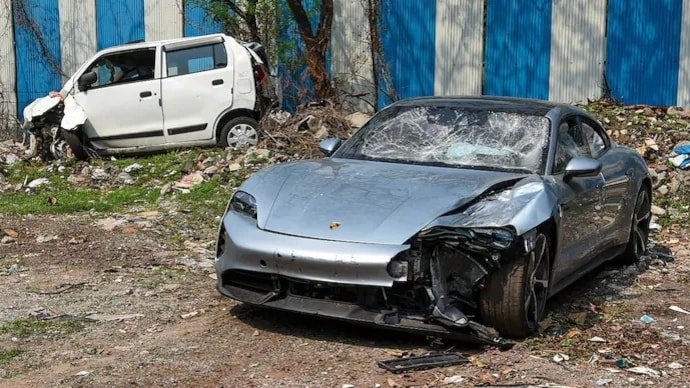
The Supreme Court on Monday granted bail to three accused in the high-profile 2024 Pune Porsche crash case, which had triggered nationwide outrage after two young tech professionals lost their lives. The accused — Aditya Avinash Sood, Ashish Satish Mittal, and Amar Santosh Gaikwad — were arrested for allegedly exchanging their blood samples with those of the juvenile occupants of the luxury car in an attempt to manipulate forensic evidence.
The order was passed by a bench comprising Justices BV Nagarathna and Ujjal Bhuyan. The court observed that the accused had already undergone prolonged incarceration without substantial progress in the trial, making continued detention unjustified at this stage.
During the hearing, the bench noted that the petitioners had remained in custody for over three years while the trial was still far from completion. As many as 159 prosecution witnesses are yet to be examined, indicating a significant delay in judicial proceedings.
“Even if it is ultimately established that the juvenile caused the accident, he is being proceeded against separately before the Juvenile Justice Board (JJB). Continued incarceration of these appellants, despite the absence of trial progress and the likelihood of prolonged delay due to the large number of witnesses, would result in serious prejudice,” the bench observed.
The Pune Porsche crash had sparked intense public anger as the main accused was just 17 years old at the time of the accident. Driving under the influence, the teenager rammed a high-end Porsche into a scooter, killing two IT professionals — Aneesh Awadhiya and Ashwini Koshta — on the spot.
Public outrage intensified further when the Juvenile Justice Board initially granted bail to the minor within hours of the incident. The conditions imposed — including writing a 300-word essay on road safety, working with the traffic police for 15 days, undergoing de-addiction treatment, and attending counselling sessions — were widely criticised as being grossly inadequate for the gravity of the offence.
Investigations later revealed an alleged attempt to tamper with evidence. On August 19 last year, Sood and Mittal were arrested after authorities discovered that their blood samples had allegedly been substituted for those of the juveniles present in the car at the time of the crash. In December, the Bombay High Court rejected bail pleas filed by Sood, Mittal, and six other accused linked to the blood-swapping conspiracy.
Earlier this year, on January 13, the Supreme Court had issued a notice to the Maharashtra government, seeking an explanation for the failure of the NDPS Court to file charges despite the petitioners being in custody since March 2022.
While granting bail, the apex court allowed the prosecution to impose stringent conditions to safeguard its interests. Among the conditions laid down, the petitioner has been barred from leaving his hometown of Ankleshwar in Gujarat, except for attending court hearings. He must also report locally every Sunday and surrender his passport to the trial court.
The Supreme Court also delivered strong remarks on parental accountability, particularly criticising the parents of the main accused. Justice Nagarathna remarked that parents must be held responsible for lapses in parenting, although the court refrained from elaborating further to avoid prejudicing the ongoing trial.
“The only ground that weighs in favour of the petitioners is long incarceration, despite the tragic loss of two lives. Ultimately, the balance between liberty and justice has to be considered,” the bench stated.
The judges did not mince words while addressing the broader issue of reckless driving by minors from affluent backgrounds. “Driving at full speed during celebrations cannot result in the death of pedestrians and then be brushed aside. This is not an isolated incident. The law needs to evolve. Parents who provide money without supervision must accept responsibility. Giving children ATM cards instead of time and guidance has consequences,” the bench observed.
Following widespread criticism of the initial Juvenile Justice Board order, Pune Police sought a review. The JJB subsequently revised its decision and sent the juvenile to an observation home, from where he was released in June last year.
Notably, the list of accused in the blood sample manipulation case also includes Vishal Agarwal and Shivani Agarwal, the parents of the minor driver, further underlining the depth of alleged complicity in the aftermath of the fatal crash.
For breaking news and live news updates, like us on Facebook or follow us on Twitter and Instagram. Read more on Latest India on thefoxdaily.com.





COMMENTS 0