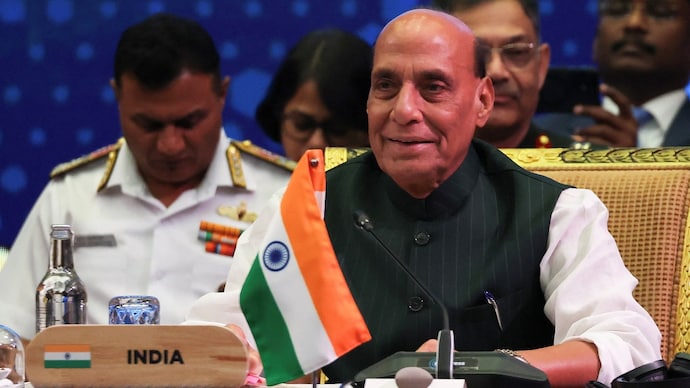
Defence Minister Rajnath Singh on Sunday stated that Sindh, despite not being a part of India today, continues to hold deep cultural and civilizational ties with the country. Speaking at a public function, he asserted that Sindh, which was a part of undivided India before the 1947 Partition, may one day rejoin India.
His comments have drawn attention at a time when diplomatic tensions between India and Pakistan have intensified following the recent Operation Sindoor in May.
Addressing the Sindhi Samaj Sammelan event in New Delhi, Singh highlighted that “civilisationally, Sindh will always remain a part of India,” adding that geopolitical borders are never permanent and could change in the future.
“Sindh may not be a part of India today, but in terms of civilization, it belongs to us. Borders are not static—they can change. Who knows, tomorrow Sindh may return to India,” he stated.
Historical Significance of Sindh
Sindh holds immense cultural value for India and is home to a large section of Sindhi-origin people now living across India. The region is also the birthplace of the ancient Indus Valley Civilization, which forms the foundation of South Asian cultural history.
Rajnath Singh invoked veteran BJP leader Lal Krishna Advani to emphasize the unbroken emotional bond Sindhi Hindus share with the region, even decades after Partition. Quoting Advani, Singh said many Sindhi Hindus of his generation still have not reconciled with the separation of Sindh from India.
He also highlighted the spiritual importance of the Indus River, revered historically by both Hindus and Muslims of Sindh.
| Aspect | Significance of Sindh |
|---|---|
| Cultural Heritage | Birthplace of the Indus Valley Civilization; shared traditions with India. |
| Religious Importance | Indus River revered by Hindus and many Muslims, considered sacred in history. |
| Sindhi Community | Large population in India retains strong emotional ties to the region. |
| Partition History | Sindh was part of undivided India before 1947. |
“Sindhi people—no matter where they currently reside—will always be our own,” Singh said, reaffirming the cultural bond.
The timing of his remarks and the larger geopolitical backdrop suggest that Pakistan may issue a strong diplomatic response in the coming days.
Rajnath Singh Brings Up the CAA
At the same event, Rajnath Singh addressed the Citizenship Amendment Act (CAA), defending its necessity for protecting persecuted minorities in neighboring countries, including Sindhi Hindus.
He argued that for decades, minority communities suffered severe discrimination and violence in various neighboring nations, yet previous administrations driven by appeasement politics failed to support them.
Singh said while Prime Minister Narendra Modi recognized the long-standing struggles of Hindu communities facing persecution, successive governments offering shelter to other migrant groups neglected Hindus when they needed it the most.
“Minority communities in many neighboring countries have faced horrors—forced conversions, burned homes, murdered children, and abused daughters. Those who fled to India were humiliated by governments seeking to appease certain vote banks,” he stated.
He added that while many people from neighboring countries were offered refuge in India, the Hindu community—deserving of equal compassion—was often ignored. According to Singh, this injustice was a key reason for introducing the CAA.
The Citizenship (Amendment) Act, 2019 provides a path to Indian citizenship for Hindu, Sikh, Buddhist, Jain, Parsi, and Christian migrants from Pakistan, Bangladesh, and Afghanistan who entered India before December 31, 2014.
Singh concluded by asserting that India will continue to protect civilizational values while prioritizing National Security and Human Rights.
For breaking news and live news updates, like us on Facebook or follow us on Twitter and Instagram. Read more on Latest India on thefoxdaily.com.






COMMENTS 0