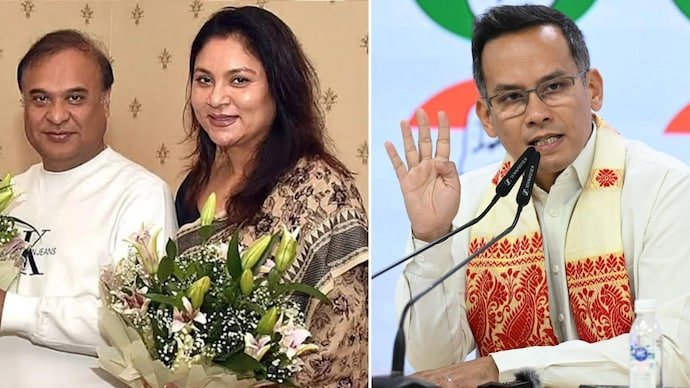
A Political Controversy has erupted in Assam after Riniki Bhuyan Sharma, wife of Chief Minister Himanta Biswa Sarma, strongly denied allegations made by Congress leaders regarding foreign passports and overseas assets. Responding publicly on Social Media platform X, Riniki dismissed the claims as “laughable” and categorically stated that neither she nor her family holds any assets or business interests outside India.
The accusations, raised by Congress leaders including Gaurav Gogoi and Pawan Khera, alleged that Riniki possessed multiple foreign passports and undisclosed properties abroad. The BJP leader’s family has rejected these claims outright, calling them politically motivated and based on fabricated documents.
What Are the Allegations?
The controversy began when Congress leaders alleged that Riniki Bhuyan Sharma held passports from multiple countries, including the UAE, Egypt, and Antigua and Barbuda. They also claimed she owned properties in Dubai and operated a company in Wyoming, USA.
Additionally, the Congress questioned whether these alleged assets were disclosed in the election affidavit of Chief Minister Himanta Biswa Sarma, suggesting potential legal and compliance concerns.
These claims quickly gained traction online, sparking debate across political circles and social media platforms.
Riniki Bhuyan Sharma’s Response
Responding directly to the allegations, Riniki issued a strong rebuttal, denying all claims and challenging her political opponents to provide evidence.
“Neither I, nor my children, nor my husband have any business interests or assets in Dubai or anywhere outside India. Today’s claims are laughable,” she wrote.
She further escalated the exchange by questioning Congress leader Gaurav Gogoi, asking whether his family had any foreign financial links and urging transparency.
Her response quickly went viral, with supporters sharing her statement and criticising the opposition for what they described as unverified accusations.
Claims of Forged Documents
Riniki Bhuyan Sharma and Chief Minister Himanta Biswa Sarma both alleged that the documents cited by Congress were fabricated and manipulated. According to their statements, the controversy was built on digitally altered materials sourced from questionable online platforms.
They pointed out several inconsistencies in the alleged documents:
- The UAE “Golden Visa” cited is not a passport and cannot be issued as citizenship documentation.
- The Egyptian passport shown allegedly belongs to another individual, with mismatched details and facial features.
- The Antigua and Barbuda passport reportedly contained errors in expiry dates and machine-readable zones (MRZ).
- The Wyoming-based company mentioned was described as a fabricated or misrepresented entity.
According to Riniki, these discrepancies clearly indicate that the allegations lack authenticity and were deliberately constructed to mislead.
“These inaccuracies expose the claims as completely false and misleading,” she asserted.
Political Context: Assam Elections in Focus
The timing of the controversy has added a political dimension to the issue. Riniki Bhuyan Sharma suggested that the allegations were strategically raised ahead of the upcoming Assam Assembly Elections.
She argued that such claims are often used as political tools to influence public perception and divert attention from key issues.
This perspective has been echoed by several BJP supporters, who view the controversy as part of a broader pattern of pre-election narratives.
Congress Stand and Counterarguments
On the other hand, Congress leaders maintain that their questions are rooted in transparency and accountability. By raising concerns about alleged foreign assets, they argue that public figures must be held to strict disclosure standards.
However, the absence of independently verified evidence has led to criticism from political opponents, who accuse the Congress of relying on unsubstantiated claims.
This back-and-forth highlights the increasingly confrontational nature of political discourse, particularly in the digital age.
Legal Angle: What Could Follow?
Chief Minister Himanta Biswa Sarma has indicated that legal action may be pursued against those spreading what he describes as misinformation. According to statements, complaints have already been filed, and further steps are under consideration.
If the matter proceeds legally, it could involve:
- Verification of documents presented publicly
- Investigation into the origin of alleged materials
- Potential defamation proceedings
Such developments would shift the issue from political debate to judicial scrutiny, where claims would need to be backed by concrete evidence.
Analysis: Politics, Perception, and Proof
This controversy reflects a broader trend in modern Politics, where allegations can spread rapidly through social media, often outpacing verification processes. In such an environment, perception can sometimes overshadow facts at least temporarily.
For political leaders, this creates both risk and opportunity. While allegations can damage reputations, swift and direct responses like Riniki’s can also help control the narrative.
At the same time, the episode underscores the importance of evidence-based discourse. Without verifiable proof, claims no matter how sensational struggle to hold long-term credibility.
And perhaps there’s a subtle irony here: in trying to create a storm, unverified claims often end up strengthening the very figures they aim to challenge.
Public Reaction and Social Media Impact
Riniki Bhuyan Sharma’s response gained significant traction online, with many users sharing her statement and expressing support. The viral nature of the post reflects the growing role of social media as a platform for direct political communication.
However, it also highlights how quickly controversies can escalate, especially when amplified by partisan narratives.
Conclusion
The passport and foreign assets controversy involving Riniki Bhuyan Sharma has added a new layer to Assam’s political landscape ahead of elections. While the allegations have been firmly denied and dismissed as fabricated, the issue continues to generate debate.
As the situation unfolds, the focus is likely to shift toward evidence, legal proceedings, and political messaging. For now, the episode serves as a reminder of the fine line between accusation and proof in contemporary politics.
In the end, in a space where claims travel fast, credibility still depends on one thing facts that can stand scrutiny.
For breaking news and live news updates, like us on Facebook or follow us on Twitter and Instagram. Read more on Latest India on thefoxdaily.com.






COMMENTS 0