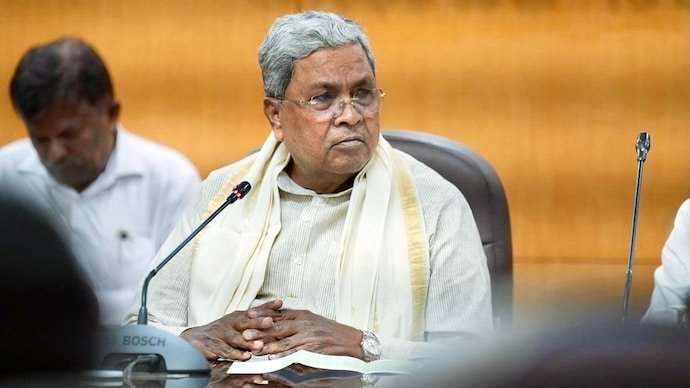
Nearly a year ago, Karnataka Chief Minister Siddaramaiah openly shared his ambition of becoming the longest-serving chief minister of the state during an interaction with a Kannada television channel. Today, that aspiration is on the brink of becoming a historic reality.
Siddaramaiah now stands within touching distance of overtaking the record held by D Devaraj Urs, a towering figure in Karnataka Politics and a leader from a backward community with whom Siddaramaiah shares remarkable ideological, political, and social parallels. His journey to this milestone has not been without challenges, as he navigated internal party turbulence and persistent speculation about differences with his deputy, DK Shivakumar.
To mark this significant achievement, Bengaluru is set to host a traditional Nati Koli Oota (country chicken feast) on January 6. The event will celebrate Siddaramaiah’s impending status as Karnataka’s longest-serving chief minister, blending political symbolism with cultural tradition.
The grand celebration is being organized under the banner of “Ahinda”, a Kannada acronym originally coined by Devaraj Urs to represent minorities, backward classes, and Dalits. Over the decades, Ahinda has evolved into a powerful socio-political identity that continues to shape Karnataka’s electoral and governance landscape.
Siddaramaiah is set to surpass Devaraj Urs, who held the office of chief minister for a cumulative total of 2,792 days—approximately 7.6 years—across two terms. This record has remained unchallenged for decades, making Siddaramaiah’s achievement particularly significant.
Beyond tenure, the similarities between Siddaramaiah and Urs run deep. Both leaders emerged as formidable voices of social justice and champions of marginalized communities, reshaping Karnataka’s political narrative in eras dominated by entrenched power structures.
After the princely state of Mysore was officially renamed Karnataka in 1973, Devaraj Urs became its first chief minister under the new name. Prior to his leadership, political power in the state was largely concentrated in the hands of the dominant Lingayat and Vokkaliga communities. Urs, hailing from the Arasu caste, marked a decisive shift by becoming Karnataka’s first chief minister from a backward community.
Widely regarded as a crusader for the underprivileged and minorities, Urs implemented transformative policies aimed at social empowerment, land reforms, and political inclusion. His governance laid the foundation for broader participation of backward communities in the state’s political process.
Following Urs’s legacy, Karnataka witnessed the rise of several chief ministers from backward communities, including Sarekoppa Bangarappa, M Veerappa Moily, and eventually Siddaramaiah, each contributing to the gradual democratization of political power.
Siddaramaiah, a prominent leader from the Kuruba Gowda community—which, according to the 2011 Socio-Economic and Caste Census, has a population of 4,372,847—has actively worked to revive and modernize Urs’s Ahinda ideology. He is widely acknowledged as a contemporary torchbearer of inclusive politics in Karnataka.
Much like Urs, Siddaramaiah challenged the traditional dominance of Lingayat and Vokkaliga-centric politics. His political ascent gained momentum following the 2006 alliance between the BJP and the JD(S), which had facilitated the return of leaders from these communities to the chief minister’s post. Siddaramaiah first assumed office as chief minister in 2013, marking a turning point in state politics.
In the aftermath of the 2018 Assembly elections, the congress returned to power in coalition with the JD(S). However, despite Congress being the senior partner, the chief minister’s position went to HD Kumaraswamy. The alliance proved short-lived, collapsing amid defections that eventually paved the way for a BJP-led government.
Both Urs and Siddaramaiah have also grappled with intense internal party conflicts involving influential national leaders. Urs was expelled from the Congress in 1979 after a bitter fallout with then Prime Minister Indira Gandhi, particularly over differences related to the Emergency imposed in 1975.
Siddaramaiah’s political journey includes a significant stint with the Janata Dal (Secular), founded by former Prime Minister HD Deve Gowda. Although Siddaramaiah served as deputy chief minister in the JD(S)-Congress coalition government in 2005, ideological and leadership differences soon surfaced.
A failed rotational power-sharing arrangement denied Siddaramaiah the chief minister’s post, prompting him to consolidate Ahinda support independently. After being asked to step down as deputy chief minister, Siddaramaiah claimed he was expelled from the JD(S) by Deve Gowda, leading him to join the Congress in 2006.
Under the leadership of both Urs and Siddaramaiah, the Congress party recorded landmark electoral victories in Karnataka. The Urs-led Congress swept the 1972 Assembly elections, winning 165 out of 216 seats with an impressive vote share of 52.17 percent.
Similarly, in the 2023 Assembly elections under Siddaramaiah’s stewardship, the Congress secured a decisive mandate by winning 135 of 224 seats with a vote share of 42.88 percent. This victory marked the party’s most emphatic win in Karnataka in the last 34 years.
Another striking similarity between the two leaders lies in their political adaptability. Both Urs and Siddaramaiah have been associated with the Janata movement as well as the Congress at different stages of their careers. Like Urs, Siddaramaiah is currently serving his second term as chief minister.
Urs and Siddaramaiah have each demonstrated an exceptional ability to command mass public support, strengthening their influence within the party and shaping the broader political discourse of the state.
With just one week to go, Siddaramaiah is poised to eclipse Devaraj Urs’s record and etch his name in history as Karnataka’s longest-serving chief minister—an achievement that underscores his enduring political relevance and the lasting impact of Ahinda politics in the state.
For breaking news and live news updates, like us on Facebook or follow us on Twitter and Instagram. Read more on Latest India on thefoxdaily.com.





COMMENTS 0