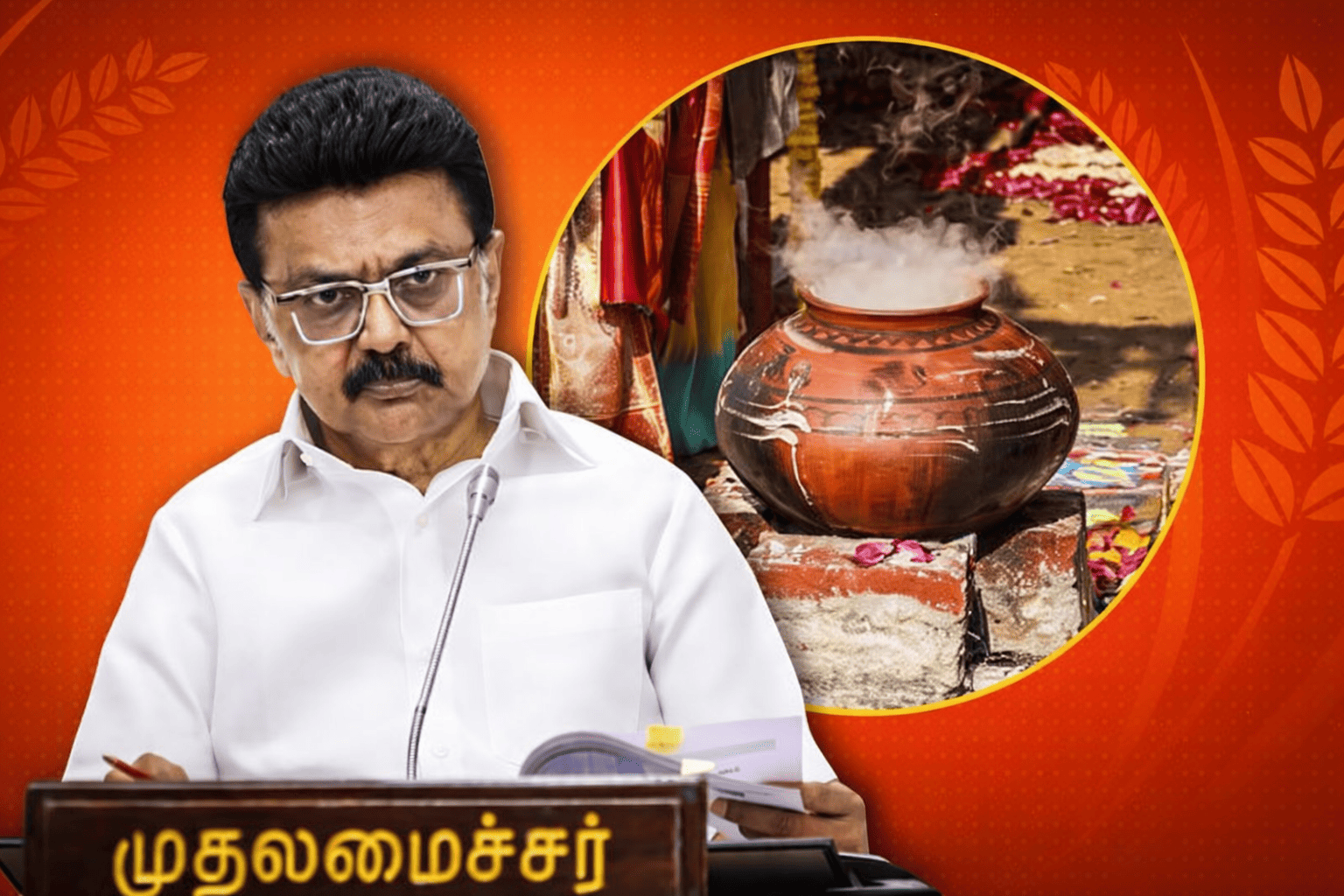
As a journalist who has closely observed Tamil Nadu’s political and cultural churn for years, it is impossible to miss the symbolism in the air this Pongal season. Across the state, as milk boils over in millions of clay pots and jaggery-laced steam rises into January skies, another aroma is unmistakable—the scent of electoral positioning.
Chief Minister M K Stalin’s declaration of Pongal as a “Dravidian festival” rooted in social justice, equality, and a distinct cultural identity is not merely a festive greeting. It is a calibrated political message. With the 2026 Assembly elections on the horizon, the act of naming itself becomes an assertion of ownership over culture, history, and collective memory.
The question, therefore, is not whether Pongal deserves celebration—it always has—but whether rebranding it reshapes its essence or merely reframes it for political consumption. Is this a rhetorical flourish, or has the milk truly begun to boil over?
THE “DRAVIDIAN” TAG: LABEL OR POLITICAL CLAIM?
At the heart of the debate lies nomenclature. Is Pongal fundamentally a Tamil festival, a Dravidian one, or part of a broader Indian civilisational rhythm? The Dravidian movement has historically excelled at cultural reinterpretation, often recasting long-standing traditions through the prism of ideology.
By affixing the “Dravidian” label to a harvest festival that predates modern political thought by over two millennia, the DMK is doing more than celebrating agrarian life. It is staking a claim. This is cultural eminent domain—where heritage is repurposed to reinforce political identity.
The timing is no coincidence. Elections are won not only on policies and promises but also on identity. By positioning Pongal as uniquely Dravidian, Stalin is attempting to erect a cultural firewall against the perceived encroachment of northern political narratives, particularly those associated with the BJP. The logic is simple: if cultural identity is inseparable from a political model, dissent becomes cultural betrayal.
Yet, historical honesty demands balance. Long before “Dravidian” entered political vocabulary, Pongal was celebrated during the Sangam Age as a thanksgiving to nature, the sun, and the soil. It belongs as much to the land as it does to the people who till it—far beyond the reach of any modern secretariat.
THE GREAT INDIAN HARVEST: MANY NAMES, ONE SPIRIT
Across India, the same solar transition is marked with different rituals, foods, and names. From Bihu in Assam and Lohri in punjab to Makar Sankranti in Andhra Pradesh, Karnataka, Maharashtra, and beyond, the essence remains unchanged: gratitude for harvest, reverence for nature, and hope for prosperity.
Tamil Nadu’s Sakkarai Pongal and Ven Pongal may differ in flavour from Andhra’s Chakkara Pongal, Karnataka’s Payasam, Maharashtra’s til-gul, Uttar Pradesh’s khichdi, Bihar’s dahi chura, Bengal’s payesh, Gujarat’s chikki, or the Northeast’s pitha—but culturally, they are variations of the same civilisational meal.
Even Kerala, which celebrates Vishu in April, aligns symbolically with this cycle through rituals such as the lighting of the sacred Makara Vilakku at Sabarimala. To argue that Pongal exists in isolation from this wider Indian continuum is to ignore the sun itself—the very force all these festivals acknowledge.
Pongal is undeniably Tamil in expression, but it is also unmistakably national in spirit. It is Indian, dressed in veshti, speaking Tamil.
SECULARISM AND SELECTIVE NATIONALISM
One of the DMK’s most prominent interventions has been the promotion of “Samathuva Pongal,” projecting the festival as a secular, inclusive celebration centred on farmers rather than deities. This reframing has successfully encouraged participation across religious lines in Tamil Nadu.
By shifting focus from Surya, the sun god, to the uzhavar, the farmer, the movement made Pongal publicly acceptable as a cultural rather than religious event. Yet, this selective secularisation raises a deeper question.
If Pongal can be de-religionised to include everyone locally, why does acknowledging its national parallels provoke resistance? If a non-Hindu Tamil can celebrate Pongal without ideological discomfort, why is it deemed “anti-Dravidian” to accept that a farmer in Maharashtra or Bihar is expressing the same gratitude under a different name?
Tamil pride need not come at the cost of national belonging. Embracing a global Tamil identity while fearing a shared Indian one reveals an unresolved contradiction.
JALLIKATTU AND THE POLITICS OF SYMBOLISM
Jallikattu offers a parallel case study. Once a local cattle-taming tradition, it has been elevated into a powerful emblem of Dravidian resistance and Tamil pride. While this pride is legitimate, it is worth remembering that similar traditions exist across the Deccan and other regions.
Bulls, after all, do not carry party cards. To reduce ancient human-animal bonds to electoral symbolism risks flattening history into campaign rhetoric.
THE 2026 ELECTORAL RECIPE
The political calculus becomes clearer when viewed alongside policy. With a Rs 3,000 Pongal cash assistance reaching over 2.2 crore ration card holders, the DMK is blending welfare with symbolism. The message is subtle but unmistakable: the sweetness in the pot flows from the “Dravidian Model.”
Branding it “Dravidian Pongal” ties cultural celebration directly to governance, hoping the aftertaste lasts until polling day. It is astute political marketing—but elections, like cooking, ultimately reveal substance beyond froth.
A ROSE BY ANY OTHER NAME
Pongal, regardless of the label attached, will taste the same on January 15. Its spirit transcends ideology—a timeless bond between humans, nature, and gratitude. Culture, like Sakkarai Pongal, is too sticky to be monopolised by any single hand.
Tamil Nadu can celebrate its Tamilness with pride while acknowledging its place within a larger national mosaic. The Pongal pot boils only because the entire stove is lit—not just one burner.
As children shout “Pongalo Pongal” while knocking on doors for treats, they remind US of a simple truth: festivals belong to people before they belong to politics. The milk has boiled over, the whistle has blown—but the horizon is far wider than any fence.
For breaking news and live news updates, like us on Facebook or follow us on Twitter and Instagram. Read more on Latest India on thefoxdaily.com.






COMMENTS 0