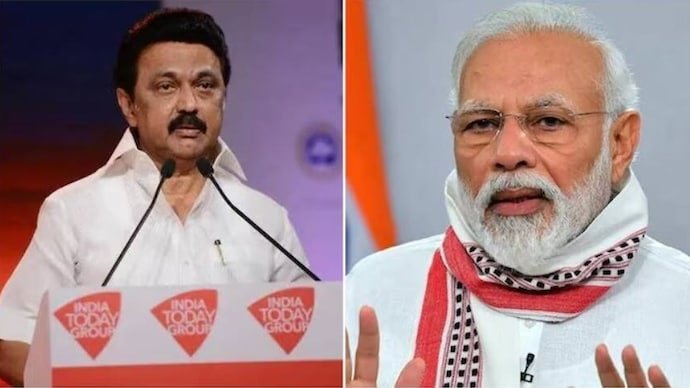
Tamil Nadu Chief Minister M K Stalin on Sunday raised serious concerns over Sri Lanka’s proposed new Constitution, cautioning that the ongoing changes could marginalise minority communities and revive ethnic tensions. In a detailed letter to Prime Minister Narendra Modi, Stalin stressed that India must ensure the rights of Sri Lankan Tamils are fully protected during the constitutional reform process.
Referring to statements from Tamil political leaders in both Sri Lanka and India, Stalin warned that constitutional revisions which fail to address long-standing grievances could perpetuate injustice and instability. “Any new constitution risks continuing the cycle of discrimination and unrest, potentially leading to renewed conflict and humanitarian crises, unless it is firmly rooted in equality and devolution of power,” he wrote.
Concerns Over the Unitary State Model
The Chief Minister expressed concern that the Sri Lankan government, led by President Anura Kumara Dissanayake, is pushing ahead with constitutional changes “under the guise of resolving ethnic issues,” while seemingly reinforcing the unitary ‘Ekkiyarajya’ model. According to Stalin, such a framework disregards the legitimate political aspirations of Tamils and risks deepening their marginalisation.
Highlighting Tamil Nadu’s historical and emotional connection with Sri Lankan Tamils, Stalin said the state has consistently stood at the forefront of advocating for their rights and dignity. “Given the deep historical, cultural, and emotional bonds, it is my responsibility as Chief Minister to draw your attention to this issue,” he told the Prime Minister.
The Continued Relevance of the Thimpu Principles
Stalin underlined the enduring relevance of the Thimpu Principles, formulated during the 1985 peace talks in Bhutan. These principles call for the recognition of Tamils as a distinct people in Sri Lanka, acknowledgment of the Northern and Eastern Provinces as their traditional homeland, affirmation of the right to self-determination, and the establishment of a federal governance structure.
He noted that a genuinely federal system would guarantee equality, non-discrimination, and political dignity for all citizens, including Tamils living in Sri Lanka’s hill country. Emphasising India’s role, Stalin stated, “India, as a regional power with a longstanding commitment to peace and justice in Sri Lanka, has both a moral and strategic imperative to act.”
The Chief Minister also recalled India’s historical involvement, including the Indo-Sri Lanka Accord of 1987, as evidence of New Delhi’s responsibility to ensure a just and lasting political solution.
Decades of Discrimination and Ongoing Risks
Stalin pointed out that Sri Lankan Tamils have endured more than seven decades of systematic discrimination, violence, and denial of basic rights. He argued that post-independence constitutions enacted in 1947, 1972, and 1978—each grounded in a unitary state structure—enabled ethnic oppression and institutionalised inequality.
Even sixteen years after the end of the civil war, Stalin warned that the existing framework continues to allow land alienation, demographic manipulation, and the erosion of Tamil identity in their ancestral regions. These unresolved issues, he said, pose a continuing threat to peace and reconciliation.
Call for Strong Indian Diplomatic Engagement
Urging decisive action, Stalin called on the Indian government to engage with Sri Lankan authorities at the highest diplomatic levels to ensure that constitutional reforms genuinely address Tamil concerns. He stressed the importance of power-sharing, provincial autonomy, and protections for ethnic and linguistic minorities.
“Such an approach would be consistent with India’s constitutional values of federalism, pluralism, and minority protection,” Stalin wrote, adding that any deterioration in the situation of Sri Lankan Tamils could have wider implications for regional stability and India–Sri Lanka relations.
The Chief Minister concluded by asserting that a fair, inclusive, and federal constitutional framework in Sri Lanka is not only essential for lasting peace on the island but also aligns with India’s role as a responsible regional leader committed to justice and harmony.
For breaking news and live news updates, like us on Facebook or follow us on Twitter and Instagram. Read more on Latest India on thefoxdaily.com.






COMMENTS 0