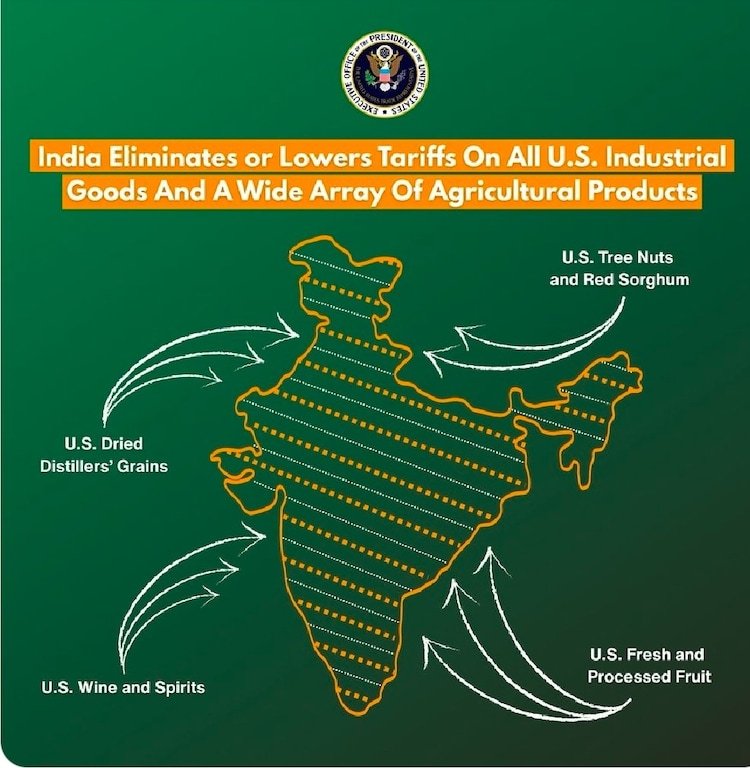
A map of India released by the Trump administration quietly became a major talking point on social media as Washington and New Delhi unveiled the framework for an interim trade agreement. The map, published by the Office of the United States Trade Representative (USTR), showed Pakistan-occupied Kashmir (PoK) and the entire Jammu and Kashmir region as part of India. It also depicted Aksai Chin—claimed by china—as Indian territory.
While India has always maintained that Jammu and Kashmir are integral parts of the country, the significance of the map lies not in India’s position, but in the apparent shift from earlier US representations.
The United States has traditionally avoided taking a definitive cartographic position on the Kashmir dispute, often marking PoK with a separate boundary in deference to Pakistan’s claims. The latest map, however, appears to disregard those sensitivities altogether.
Why the American Map of India Matters
Historically, US government maps—particularly those issued by the State Department—have used dotted or distinct boundary lines around PoK, reflecting Washington’s cautious diplomatic stance. The new map released alongside the trade framework does not follow that convention.
The timing is especially notable. After a turbulent phase in bilateral relations—during which President Donald Trump imposed tariffs of up to 50% on Indian goods, the highest among US allies—India and the US are now resetting ties. Under the interim deal, tariffs on most Indian exports have been reduced to 18%, among the lowest applied to Asian economies.
The map also comes amid concerns that Trump had sought to reverse the long-standing US policy of “de-hyphenation” between India and Pakistan, a strategy initiated under the George W. Bush administration to treat the two countries as distinct diplomatic tracks.
Equally striking is the depiction of Aksai Chin, a disputed region in northeastern Ladakh that China claims as its own. Despite repeated Indian objections, many international maps—including those used by US agencies in the past—have avoided clearly marking the region as Indian territory.
India’s Ministry of External Affairs has long protested what it calls misrepresentation of its borders by foreign governments and international organisations, particularly with respect to Jammu & Kashmir and Arunachal Pradesh. The latest US map appears to address those objections more directly than before.
Reactions from Strategic and Defence Experts
The map drew swift reactions from defence analysts and geopolitical commentators, many of whom praised the US move.
Retired Major Gaurav Arya described it as “excellent work,” awarding the map “full marks” to the United States.
Another commentator called it “a big hit to Pakistan, (Army chief) Asim Munir, and the Washington-visit propaganda,” referencing Islamabad’s recent diplomatic outreach to the Trump administration.
Pakistan’s Army Chief Asim Munir has visited the United States three times in the past six months and reportedly met President Trump twice, including at a high-profile lunch in June. Notably, it marked the first time a US president engaged Pakistan’s army chief without civilian leadership present.
A journalist noted on social media that “everything else is secondary to trade,” pointing out that the map clearly diverges from the long-held US position that PoK is shown separately from India.
Trade Deal Context and Strategic Implications
The interim trade agreement—expected to be formally signed by mid-March—has brought significant relief to Indian exporters after a year of punitive tariffs. India has secured concessions on steel, aluminium, copper, pharmaceuticals, automobiles, and auto parts, while holding firm on sensitive sectors such as agriculture and dairy.
Whether the map signals a deliberate strategic shift by Washington, an attempt to placate India after a difficult year with Trump, or merely an administrative decision remains unclear.
What is clear, however, is that the map has given India strong symbolic leverage. By visually reinforcing New Delhi’s position on its most sensitive territorial disputes, the US has—intentionally or not—tilted the narrative in India’s favour.
For breaking news and live news updates, like us on Facebook or follow us on Twitter and Instagram. Read more on Latest India on thefoxdaily.com.






COMMENTS 0