We habitually interpret the world through polished Western instruments. The Cartesian scalpel, the Kantian moral imperative, Carr’s selective realism, the liberal international order—these have become the default coordinates through which global power is mapped. GDP, warships, alliances, deterrence: the language of strategy dominates our understanding of geopolitics.
Yet surface currents alone cannot explain the movement of rivers. Beneath visible alignments lie deeper civilizational structures—long memories of power, legitimacy, and purpose—that continue to shape how states act, even when they speak in modern idioms.
To flip the lens is to unmoor ourselves from the civilizational grammar inherited from Europe’s Age of Discovery and attend instead to older, non-Western patterns of political self-understanding. It is to ask not merely what states do, but how they imagine order itself.
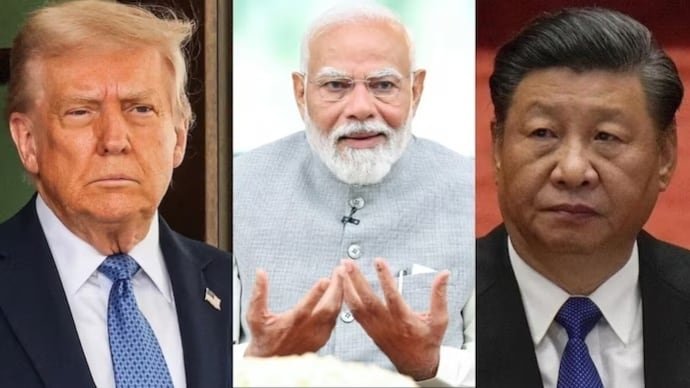
This reframing yields an unexpected geometry. If we cease to view the world from 1648 and instead look from 324 BCE, the year of Chandragupta Maurya’s rise, a tripartite structure comes into focus. China appears as a vast, revanchist, imperial, bureaucratic, and deeply hierarchical force—a modern Mughal of the East. America resembles a postmodern nomad, a self-appointed carrier of freedom armed with missionary zeal and mercantile cunning, an Anglophone Timur. Between them stands India, absorbing, reflecting, and occasionally deflecting both, as the living heir to a dharmic cosmopolis forged in the Mauryan age.
I. The Mughal Surrogate of the Chinese Order
At first glance, comparing imperial China with the Mughal Empire seems counterintuitive. Geography, culture, and chronology appear to separate them. Yet beneath these differences lies a shared logic of power.
Like the Mughals, imperial China grounded legitimacy in a moralized conception of order. The Mandate of Heaven functioned much like the Mughal ideal of sulh-i-kul—universal peace sustained through centralized authority and bureaucratic discipline. In both systems, the ruler stood as a cosmic axis, charged with harmonizing society through hierarchy and ritual.
Confucianism, much like Akbar’s Din-i-Ilahi, was less a rigid theology than an ethic of governance—emphasizing proper conduct, filial obligation, ritual propriety, and the moral calibration of power.
This civilizational instinct survives in contemporary China. Despite its Marxist vocabulary, the Chinese Communist Party governs in a distinctly Confucian mode: ritualized, hierarchical, puritanical, and obsessed with “stability maintenance” (weiwen). Beneath its ideological veneer, it behaves like a dynasty—rewarding conformity, punishing disruption, and fearing chaos more than tyranny. The citizen remains, in the classical sense, a subject.
Xi Jinping is not Stalin. He more closely resembles a modern Yongle Emperor, seeking to reconstruct tributary relationships through initiatives like the Belt and Road. Often framed in Western discourse as an autocrat, he is better understood as a mandarin among technocrats, presiding over a bureaucratic empire whose highest virtue is order.
This is Mughal China: centripetal, moralized, and deeply hierarchical in its conception of sovereignty.
II. Chaos in the Name of Freedom: Kissingerian America
If China represents imperial order, America represents its inversion. The United States is an evangelical republic, wielding liberty as both banner and weapon. Animated by exceptionalism and cloaked in moral purpose, it understands power as a restless project.
To call it “Kissingerian” is to invoke a worldview in which power and principle coexist uneasily, where order is temporary and peace merely an intermission. Jeffersonian ambition fused with Protestant millenarianism produced a civilizational paradigm that moves outward, never inward—treating borders as obstacles to be crossed rather than sanctities to be preserved.
The world must be made safe for democracy; failing that, for markets; failing that, for an American conception of order. Vietnam, Iraq, Libya, and Afghanistan each began as missions and ended as tragedies, yet all were framed as steps along a civilizational arc.
America cannot remain still. Its institutions are mercurial, its society volatile to the point of brilliance. It creates relentlessly—start-ups, platforms, drones, ideologies—often without knowing how they will be governed. Its power lies in acceleration.
History offers a precedent. The Mongols were mobile, meritocratic, technologically adept, and indifferent to sedentary order. They shattered empires not out of malice but momentum. In this sense, the United States is their contemporary heir. Wall Street is the new Silk Road; Silicon Valley, a digital Samarkand.
America builds horizontal networks where China erects vertical hierarchies. America accelerates where China endures. Our era is defined by this tension between libertarian dynamism and imperial control.
III. India as the Mauryan Imperium: Dharmic Reflex and Strategic Fluidity
India, as it so often has, occupies the middle—not merely geographically, but civilizationally. It is amphibious, capable of engaging hierarchy without surrendering to it, and freedom without fetishizing it.
The Mauryan state possessed one of the ancient world’s most sophisticated bureaucracies. The Arthashastra, often misread as an Indian Prince, articulates not cynicism but realism—one rooted in flux. Unlike Confucian ritual harmony or Western abstractions of rights, the Indian worldview assumes impermanence.
Dharma is not law but process. It is the discipline of alignment with changing reality—a balance among duty, desire, power, and truth.
The Mauryans governed a centralized yet plural empire. Ashoka ruled through edicts that invited moral reflection rather than imposed dogma. Unity was not enforced; multiplicity was managed.
This intuition persists in modern India. Its democracy is chaotic yet anchored. Its bureaucracy is sclerotic yet durable. Its political culture absorbs contradiction without fragmentation.
This is India’s civilizational genius: cohabitation rather than convergence, dialogue rather than synthesis. It is the epistemology of the Nasadiya Sukta—the courage to live gracefully amid uncertainty.
IV. Beyond the Cold War: A Three-Body Problem
China offers order, efficiency, and continuity—at the cost of compression and control. America offers liberty, dynamism, and pluralism—at the cost of volatility and overreach. India offers something harder to define: comfort with ambiguity, pluralism without consensus, and a strategic culture shaped more by negotiation than conquest.
In essence: China seeks tribute. America seeks conversion. India seeks conversation.
V. Toward a Dharmic World Order
What would it mean for India to consciously inhabit its Mauryan inheritance?
It would require resisting the gravitational pull of bipolar alignment and recovering the insight that influence need not become hegemony, and power need not be zero-sum.
Practically, this could mean reimagining the Global South as a sangha—a fellowship of difference. It could mean building infrastructure and cultural corridors without replicating Chinese hierarchy or Western conditionality. It could mean grounding global institutions in subsidiarity rather than centralization.
Above all, it would require narrative. Civilizations are sustained not only by armies and economies, but by stories that explain why they matter.
The 21st century will not belong to a single empire or ideal. It will be shared, contested, and co-authored. In that polyphonic future, India’s greatest contribution may be its capacity for equilibrium—for leading without dominating, and for governing without claiming final truth.
For breaking news and live news updates, like us on Facebook or follow us on Twitter and Instagram. Read more on Latest India on thefoxdaily.com.




COMMENTS 0