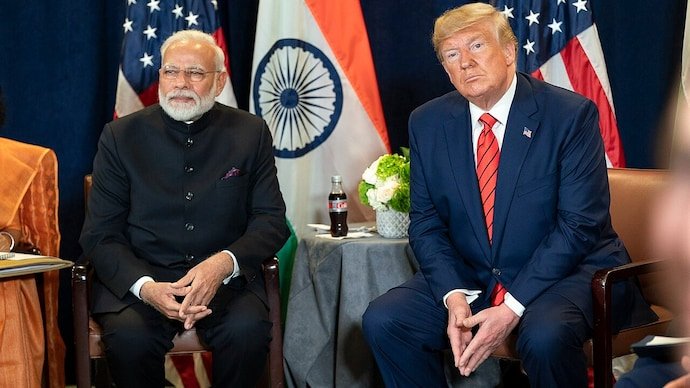
As someone who has closely followed India–US relations, global trade negotiations, and geopolitical power plays for years, this latest move by President Donald Trump fits a familiar pattern. Whenever an international crisis erupts—be it Iran, Ukraine, or Russia—India inevitably ends up in Washington’s crosshairs. On Tuesday, just hours after US Ambassador-designate Sergio Gor publicly described India as America’s “most essential partner,” Trump announced a new punitive tariff regime targeting countries that continue to trade with Iran.
The implications for India are significant. As one of Iran’s top five trading partners, New Delhi now faces the prospect of a cascading tariff burden that could push total duties on Indian exports to the United States as high as 75%. This includes existing tariffs, reciprocal duties, and now an additional Iran-linked penalty.
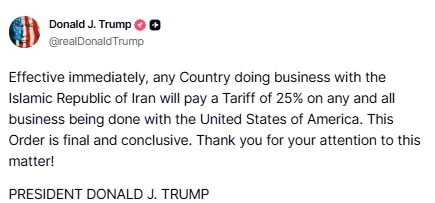
Trump justified the move by tightening economic pressure on Iran, which is currently witnessing its largest anti-government protests in years. He warned that any country doing business with Tehran would face an “immediate” 25% penalty on trade with the United States. “This order is final and conclusive,” Trump declared, leaving little room for diplomatic ambiguity.
For India, the situation is especially precarious. In the absence of a finalized India–US trade agreement, Indian goods already face a steep 50% tariff—the highest imposed by Washington on any country. This includes a 25% reciprocal duty and a separate 25% punitive levy imposed earlier for India’s continued purchases of Russian oil. The newly announced Iran-related tariff threatens to add yet another 25%, taking the cumulative burden to an unprecedented 75%.
Compounding the pressure is another US proposal—already approved by Trump—that would impose a staggering 500% tariff on countries continuing to buy Russian oil in violation of sanctions. Nations such as India, china, and Brazil are explicitly named in this plan, underscoring the widening scope of Washington’s economic coercion.
India’s relationship with Iran is not transactional alone. It is rooted in decades of energy cooperation, cultural exchanges, and strategic infrastructure projects—most notably the Chabahar Port. The port has long been viewed in New Delhi as a gateway to Afghanistan and Central Asia, offering India access to the region while bypassing Pakistan.
Timing Raises Serious Questions
While China remains Iran’s largest trading partner, the timing of Trump’s announcement has raised eyebrows in diplomatic and economic circles. The tariff threat came just hours before Indian and US officials were scheduled to meet for yet another round of talks on the long-pending bilateral trade agreement.
Many observers interpret the move less as an Iran-focused sanction and more as a pressure tactic aimed squarely at India. The message appears clear: accept US terms on trade or face escalating economic consequences.
Recent remarks by US Commerce Secretary Howard Lutnick have reinforced this perception. Lutnick revealed that the collapse of the India–US trade deal was not due to policy disagreements but because Prime Minister Narendra Modi allegedly declined to personally call President Trump to finalize the agreement.
The disclosure suggested that personal diplomacy—and presidential ego—may now weigh as heavily as economic fundamentals in Washington’s trade decisions.
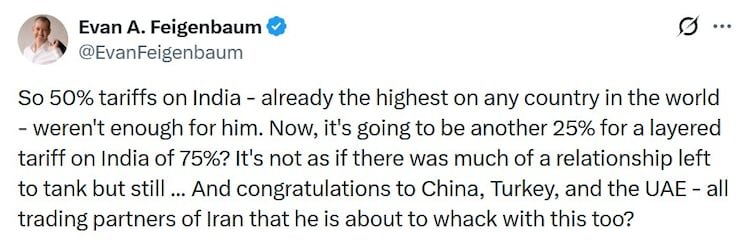
With India already facing the highest tariff rates globally, critics question whether Washington is deliberately piling on pressure. Former US Deputy Assistant Secretary of State Evan A. Feigenbaum captured the mood succinctly, tweeting, “It’s not like there was much of a relationship left to tank, but still.”
What It Means for India–Iran Trade
The Iran-linked tariff threat worsens India’s already strained trade environment. Official data shows that India and Iran recorded total bilateral trade of $1.68 billion (around Rs 14,000 crore) in 2024–25. India’s exports stood at $1.24 billion, while imports were valued at $440 million.
It is important to note, however, that India’s trade with Iran has been steadily declining since 2019, when New Delhi halted Iranian oil imports following earlier US sanctions. Since then, bilateral trade has shrunk by nearly 87%, falling from $17.6 billion in 2019 to about $2.3 billion in 2024.
India’s key exports to Iran include basmati rice, organic chemicals, pharmaceuticals, tea, sugar, pulses, fruits, and meat products. Iran has traditionally been one of the largest overseas markets for Indian basmati rice, and additional US-linked penalties could severely disrupt this trade.
On the import side, India sources methanol, petroleum bitumen, liquefied propane, dates, apples, and chemical products from Iran. If US enforcement is strict, Indian companies may be forced to scale back engagement with Tehran to protect their access to the American market—hurting exporters across agriculture, chemicals, and pharmaceuticals.
Will Chabahar Port Be Impacted?
The future of the strategically vital Chabahar Port remains a critical concern. India is developing the Shahid Beheshti terminal at the port, which sits near the Gulf of Oman and the Strait of Hormuz—one of the world’s most important maritime chokepoints.
For now, there is limited indication that the new tariff announcement will directly derail Chabahar’s development. India secured a six-month waiver from US sanctions for the port last year, although that exemption—originally granted in 2018—has faced repeated uncertainty and was revoked again in September 2025. The current waiver expires on April 29.
Strategically, Chabahar allows India to access Afghanistan and Central Asia while counterbalancing China’s growing presence at Pakistan’s Gwadar Port. It also enables New Delhi to monitor Chinese movements in the Persian Gulf, giving the port immense geopolitical value beyond trade.
Viewed in totality, the optics are stark. Even as US officials publicly praise India as a critical partner, Washington has moved swiftly to penalize New Delhi—using Iran trade as leverage. The decision risks further straining India–US relations at a time when both countries claim to seek deeper strategic alignment.
Whether Iran is the justification or merely the pretext, Trump’s tariff decision signals that India is once again navigating a complex and increasingly transactional relationship with the United States—one where economics, geopolitics, and personal diplomacy are tightly intertwined.
For breaking news and live news updates, like us on Facebook or follow us on Twitter and Instagram. Read more on Latest India on thefoxdaily.com.




COMMENTS 0