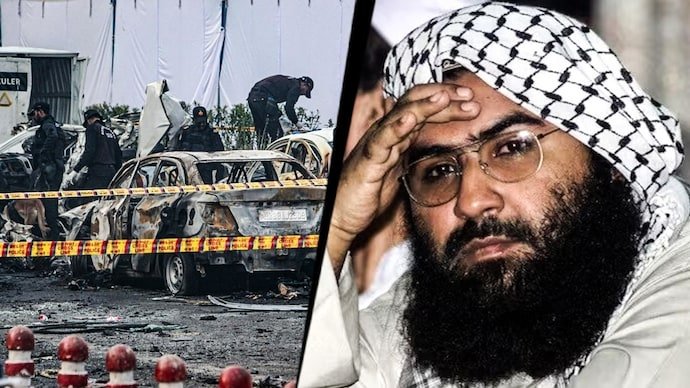
A United Nations sanctions monitoring report has linked Pakistan-based terror outfit Jaish-e-Mohammed (JeM) to multiple attacks, including the deadly November 10 blast near Delhi’s Red Fort that reportedly killed 15 people. The findings have reignited debate over the operational status of the group, despite repeated claims that it has been dismantled.
The observations appear in the thirty-seventh report of the UN Analytical Support and Sanctions Monitoring Team, submitted under Resolution 2734 (2024) to the Security Council’s 1267 Sanctions Committee. The committee oversees sanctions against ISIL (Da’esh), Al-Qaida and affiliated entities.
According to the report, one Member State informed the monitoring team that Jaish-e-Mohammed had claimed responsibility for a series of attacks, including the explosion near the Red Fort in New Delhi. The reference, though based on inputs from a specific country not identified in the document, indicates that JeM remains cited in ongoing terrorist activity assessments.
Red Fort Blast and Ongoing Investigation
The November 10 incident near the historic Red Fort followed weeks of investigation by Jammu and Kashmir Police into what officials described as a “white-collar terror module” with alleged links to Jaish-e-Mohammed and another banned outfit, Ansar Ghazwat-ul-Hind (AGuH).
The case was later transferred to the National Investigation Agency (NIA), India’s premier counterterrorism body. Authorities have arrested nine individuals so far, including three doctors suspected of facilitating logistical and financial aspects of the network.
Investigators reportedly recovered a one-minute-and-twenty-second video clip from the mobile phone of Umar-un-Nabi, identified as the car-borne assailant who died in the explosion. In the footage, he is allegedly seen referencing plans to carry out a suicide attack, reinforcing suspicions of an organized terror conspiracy rather than an isolated act.
The UN monitoring team stated that the reported claim of responsibility reflects continued operational signaling by JeM, although the report also notes differing views among Member States.
Contrasting Global Assessments
Significantly, the UN document records divergent positions among Member States. While one country highlighted JeM’s claimed involvement in recent attacks, another described the organization as “defunct.” The identities of the countries were not disclosed.
Pakistan has consistently maintained that banned organizations such as Jaish-e-Mohammed and Lashkar-e-Taiba (LeT) have been rendered inactive under domestic anti-terror legislation. Islamabad has also pointed to prosecutions and administrative actions as evidence of its compliance with international counterterror financing obligations.
However, the monitoring report’s references to JeM’s continued claims of responsibility have prompted fresh scrutiny of those assertions.
Organisational Developments Within JeM
The UN report also documents internal developments within Jaish-e-Mohammed. It notes that Masood Azhar — a UN-designated global terrorist — announced the formation of a women-only wing named Jamaat ul-Muminat in October last year.
Although the new unit is not separately listed under UN sanctions, the report describes it as intended to support the organization’s broader activities. The mention suggests that the group may be seeking structural adaptation despite international sanctions and asset freezes.
Regional Security Context
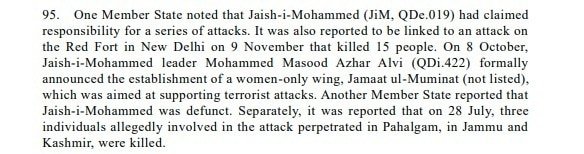
The report further references developments in Jammu and Kashmir, including the killing of three individuals allegedly involved in the April 2025 Pahalgam attack. That incident, attributed to The Resistance Front (TRF) — described as a proxy of Lashkar-e-Taiba — resulted in the deaths of 26 civilians and heightened tensions in the region.
Subsequently, India launched Operation Sindoor in May, targeting what officials described as terrorist infrastructure across the border. The operation triggered a brief four-day military escalation, underscoring the fragile security environment in the region.
The cumulative effect of these incidents has intensified diplomatic and security concerns, particularly regarding the continued presence and adaptability of UN-designated groups operating in South Asia.
Implications for Counterterror Policy
The UN monitoring team’s findings do not constitute a judicial determination but serve as an analytical assessment based on intelligence inputs from Member States. Nonetheless, such references often carry weight in shaping international counterterror financing and sanctions enforcement mechanisms.
Security analysts note that discrepancies between national claims of dismantling extremist networks and multilateral monitoring assessments can complicate diplomatic engagement and counterterror coordination.
As investigations into the Red Fort blast continue and the NIA pursues prosecution against those arrested, the UN report is likely to remain central to discussions about regional security, compliance with international sanctions regimes, and the ongoing threat posed by banned terror outfits.
For breaking news and live news updates, like us on Facebook or follow us on Twitter and Instagram. Read more on Latest India on thefoxdaily.com.




COMMENTS 0