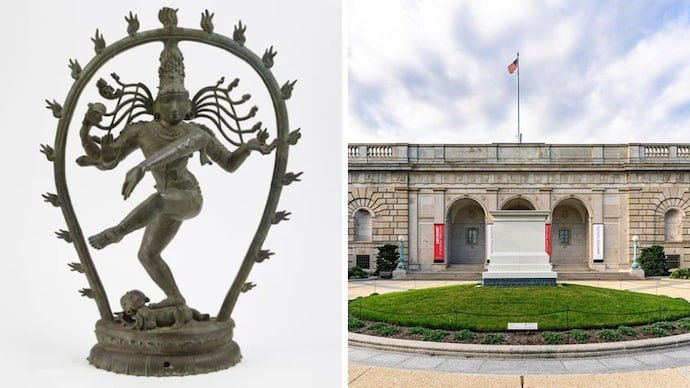
Washington: Three historic bronze sculptures that were unlawfully removed from Indian temples will be returned to the Government of India, the Smithsonian’s National Museum of Asian Art announced on Wednesday.
The decision follows detailed provenance research that established the sculptures had been taken illegally from temples in Tamil Nadu. The museum said the return reflects its commitment to ethical collection practices and transparency.
The sculptures identified for repatriation are Shiva Nataraja (Chola period, circa 990), Somaskanda (Chola period, 12th century), and Saint Sundarar with Paravai (Vijayanagar period, 16th century). All three were originally created for use in temple rituals and ceremonial processions.
While all three will be returned to India, the Indian government has agreed to place one sculpture — Shiva Nataraja — on a long-term loan to the museum. According to the museum, this arrangement will allow it to display the work while fully acknowledging its origins, removal, and eventual repatriation.
The sculpture will be featured in the museum’s exhibition, The Art of Knowing in South Asia, Southeast Asia, and the Himalayas, accompanied by interpretive material explaining its history.
The museum credited its provenance research team, curators of South and Southeast Asian Art, and collaboration with the Photo Archives of the French Institute of Pondicherry for uncovering the evidence that led to the decision.
Archival photographs taken between 1956 and 1959 showed the sculptures in active worship at temples across Tamil Nadu. After reviewing the findings, the Archaeological Survey of India confirmed that the artifacts had been removed unlawfully.
Museum Director Chase Robinson said the repatriation underscores the institution’s evolving approach to cultural stewardship.
“The National Museum of Asian Art is dedicated to advancing transparency in our collection and stewarding Cultural Heritage responsibly,” Robinson said.
Details of the Three Sculptures
Shiva Nataraja was removed in 1957 from the Sri Bhava Aushadesvara Temple in Tirutturaippundi Taluk, Tanjavur district, Tamil Nadu. In 2002, it was sold to the National Museum of Asian Art by the Doris Wiener Gallery in New York. Museum researchers later discovered photographic evidence showing the sculpture at the temple, concluding that false documentation had been submitted to complete the sale.
Somaskanda and Saint Sundarar with Paravai entered the museum’s collection in 1987 as part of a gift of approximately 1,000 objects from Arthur M. Sackler. Research conducted with the French Institute of Pondicherry revealed that Somaskanda had been photographed in 1959 at the Visvanatha Temple in Alattur hamlet, Mannarkudi Taluk, Tamil Nadu.
The sculpture of Saint Sundarar with Paravai was photographed in 1956 at a Shiva temple in Veerasolapuram hamlet, Kallakuruchchi Taluk, Tamil Nadu.
Founded in 1923, the National Museum of Asian Art houses collections spanning Asia from antiquity to the present. It is part of the Smithsonian Institution, the world’s largest museum and research complex, which attracts an estimated 20 to 30 million visitors annually.
For breaking news and live news updates, like us on Facebook or follow us on Twitter and Instagram. Read more on Latest India on thefoxdaily.com.




COMMENTS 0