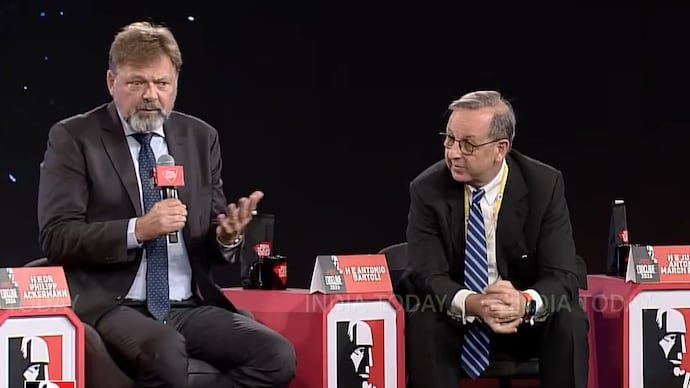
European diplomats have expressed growing concern that the escalating geopolitical tensions in the Middle East involving the United States, Israel, and Iran could destabilize Global energy markets and shift international focus away from the prolonged Russia–Ukraine conflict. The war between Russia and Ukraine, now entering its fifth year, continues to have significant geopolitical and economic consequences, but European leaders fear it may be overshadowed by new conflicts in the Middle East.
Speaking at the India Today Conclave 2026, Germany’s Ambassador to India, Philipp Ackermann, voiced strong opposition to the United States lifting restrictions on Russian Oil exports. According to him, easing Sanctions or price caps on Russian oil could strengthen Moscow’s financial capacity to sustain or expand its military operations in Ukraine.
“My position is that lifting the price ceiling on Russian oil is not a good idea because we do not want Russia to have the financial resources to continue the war in Ukraine,” Ackermann said during the event. He also emphasized Europe’s strict stance on Russian energy imports, stating that European nations have drastically reduced their reliance on Russian oil since the sanctions were introduced.
“We do not purchase Russian oil — not a single drop reaches us,” he added, highlighting Europe’s commitment to maintaining economic pressure on Moscow.
Western countries and the European Union imposed sweeping sanctions on Russian crude oil exports in 2022 after Russia launched its full-scale invasion of Ukraine. The restrictions included price caps and bans aimed at reducing Russia’s energy revenues while minimizing disruption to global oil markets.
However, Ackermann warned that the ongoing conflict in the Middle East could already be worsening global energy instability. The crisis intensified after the United States and Israel reportedly launched strikes on Iran on February 28, followed by retaliatory actions from Tehran.
One of the most significant developments has been Iran’s decision to restrict certain shipping activities through the Strait of Hormuz, one of the world’s most critical maritime oil transit routes. According to reports, Iran has prohibited ships linked to the United States and Israel from entering the strait while allowing tankers destined for countries like India to pass through.
Ackermann said the situation has effectively disrupted the flow of energy supplies and created new uncertainties for global oil markets.
“Effectively, the Strait of Hormuz is closed. Europe’s economies are slowing down, energy prices are increasing, and people are becoming dissatisfied,” he stated. “These are the consequences of a conflict in which Europe is not directly involved.”
Despite not participating militarily in the conflict, European governments remain actively engaged in diplomatic discussions with their international partners. Ackermann stressed that European leaders are closely communicating with the United States to understand its strategic plans regarding the Middle East crisis.
“This war is not ours. No European country is part of this conflict,” he said. “But that does not mean we remain silent. We speak with the Americans and ask what the broader plan is.”
Ackermann also suggested that the European Union may be expanding its diplomatic influence in the Middle East amid the ongoing crisis. According to him, shifting geopolitical dynamics could create space for the EU to play a stronger role in diplomatic negotiations and regional stability.
“In the current situation, the European Union is becoming more influential in the Middle East, while the influence of the United States and Israel is, to be honest, not as strong as it once was,” he said. “However, there is currently no major way for Europe to influence the conflict directly in a manner that could quickly lead to peace.”
At the same time, Ackermann warned that the world’s attention drifting away from the Russia–Ukraine War is deeply concerning for European nations. The conflict has already resulted in massive human and economic losses, and European leaders believe sustained global attention is necessary to push for a resolution.
“Hundreds of thousands of people have died in the Russian war of aggression,” he said. “Now global attention is shifting elsewhere, but we should not give up on efforts to end that conflict.”
Italy’s Ambassador to India, Antonio Bartoli, echoed similar concerns and emphasized that Europe strongly prefers diplomacy over military confrontation in the Middle East crisis.
“We did not want this conflict. We are not participating in it, and we will not participate in it,” Bartoli said while discussing Europe’s position on the situation involving Iran.
He noted that Italy continues to engage in diplomatic efforts with regional partners across the Middle East in an attempt to reduce tensions and prevent further escalation.
Bartoli also raised concerns about Iran’s nuclear program, stating that the country has reportedly reached uranium enrichment levels exceeding 60 percent. According to him, such levels are significantly higher than those required for civilian nuclear energy programs.
He compared Iran’s nuclear activity with countries such as the United Arab Emirates, which operate nuclear programs strictly under international agreements designed for peaceful energy generation.
“Such enrichment levels could potentially be used in developing atomic weapons and long-range missiles capable of reaching Europe,” Bartoli warned.
The Italian envoy added that Italy continues to coordinate closely with European allies and Middle Eastern partners while pursuing diplomatic solutions. He also noted that Italian Prime Minister Giorgia Meloni has been maintaining communication with several European leaders regarding the evolving situation.
Spain’s Ambassador to India, Juan Antonio March Pujol, also supported the call for diplomacy and highlighted the importance of strengthening international institutions such as the United Nations.
Pujol referenced remarks made earlier by India’s External Affairs Minister S. Jaishankar about the historical context of international institutions.
“Minister Jaishankar once said that one percent of India’s history is represented at the United Nations,” Pujol said. “If we look at it from a global perspective, the 80 years of the UN represent just 0.0005 percent of human history.”
According to him, this perspective highlights the importance of strengthening global institutions rather than weakening them. Spain supports reforms that would allow the United Nations to adapt to modern geopolitical realities.
Pujol also reiterated Spain’s support for India’s bid to become a permanent member of the UN Security Council, arguing that expanding representation could strengthen the institution’s effectiveness.
“We should not weaken the United Nations but adapt and strengthen it,” he said.
He further warned that instability in the Middle East could quickly affect Europe, particularly through refugee flows and economic disruptions.
“The consequences of conflict in the region are always felt in Europe,” Pujol explained. “The Syrian civil war alone forced around eight million people to become refugees. Any new instability could create similar challenges for Europe and the world.”
Overall, European diplomats made it clear that the continent is deeply concerned about the widening geopolitical tensions involving Iran and their potential impact on global energy markets, economic stability, and international security.
While Europe continues to advocate for diplomatic solutions, officials also stressed that the prolonged Russia–Ukraine conflict must not be ignored by the international community.
European leaders reaffirmed their commitment to working with global partners to prevent further escalation in the Middle East while simultaneously pushing for continued efforts to bring an end to the war in Ukraine.
| Key Issue | Details |
|---|---|
| Main Concern | US removing sanctions and price cap on Russian oil |
| European Position | Opposes lifting restrictions as it may fund Russia’s war in Ukraine |
| Event Discussed | India Today Conclave 2026 |
| German Representative | Philipp Ackermann, Ambassador to India |
| Italian Representative | Antonio Bartoli, Ambassador to India |
| Spanish Representative | Juan Antonio March Pujol, Ambassador to India |
| Major Energy Route Concerned | Strait of Hormuz |
| Global Conflict Impact | Middle East tensions affecting energy markets |
| Ongoing Conflict Mentioned | Russia–Ukraine War |
| International Organization Highlighted | United Nations and UN Security Council reform |
As geopolitical tensions continue to evolve, European diplomats say maintaining diplomatic engagement and strengthening international cooperation will be essential to prevent further global instability and economic disruption.
For breaking news and live news updates, like us on Facebook or follow us on Twitter and Instagram. Read more on Latest India on thefoxdaily.com.

COMMENTS 0