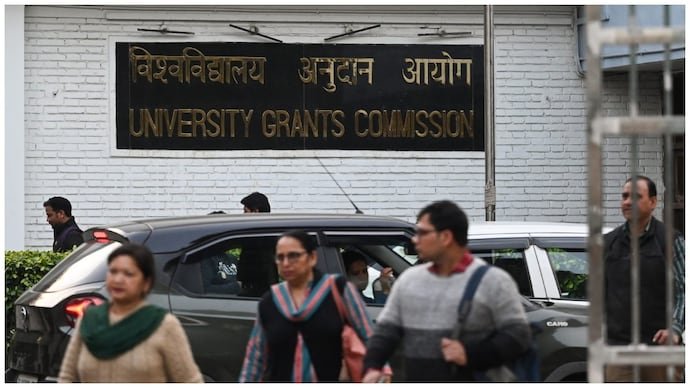
New Delhi: In a significant intervention, the Supreme Court on Thursday stayed the implementation of the University Grants Commission’s (UGC) newly notified anti-discrimination regulations, citing concerns over vague language, selective protections, and the potential for misuse. The apex court observed that the rules, in their present form, could have far-reaching consequences and may even risk deepening social divisions.
A Bench comprising Chief Justice Surya Kant and Justice Joymalya Bagchi issued notices to the Union government and the UGC, seeking their responses to the legal challenge against the regulations. Until further orders, the court directed that the earlier 2012 advisory guidelines on anti-discrimination will continue to remain in force.
The UGC had introduced the revised regulations earlier this month, mandating all universities and higher educational institutions to constitute Equity Committees to address complaints of discrimination and promote inclusivity on campuses. As per the rules, these committees must include representatives from Scheduled Castes (SCs), Scheduled Tribes (STs), Other Backward Classes (OBCs), women, and persons with disabilities.
However, the court took serious note of the fact that the grievance redressal mechanism under the new framework does not extend protection to Students belonging to the general category. This exclusion, petitioners argued, makes the regulations inherently discriminatory and constitutionally suspect.
The issue has already sparked protests across several states, with students and civil society groups raising apprehensions that the rules could be misused or selectively enforced. Critics have also warned that the regulations, instead of fostering equality, may create a sense of alienation among sections of the academic community.
During the hearing, the Bench remarked that the guidelines were “capable of dividing society” and could have a “grave impact” if allowed to operate without refinement. The Chief Justice observed that judicial intervention was necessary at this stage to prevent unintended consequences.
“If we do not intervene, it will lead to a dangerous impact, divide society, and have serious repercussions,” Chief Justice Surya Kant said. He added that, “Prima facie, the language of the regulation is vague, and experts need to examine and modulate it so that it cannot be exploited.”
Representing the petitioners, counsel argued that the regulations adopt an exclusionary framework by denying institutional safeguards to individuals outside the SC, ST, and OBC categories. Such selective protection, they contended, could foster hostility and undermine the very objective of social harmony within universities.
Emphasising constitutional values, the petitioners’ counsel asserted that “all citizens must be protected”, calling it a core mandate of the Constitution. They maintained that equality before the law cannot be achieved through regulations that differentiate access to grievance mechanisms.
Justice Joymalya Bagchi, during the proceedings, expressed concern over the narrow definition of discrimination under the regulations and reiterated the court’s commitment to ensuring a free, fair, and equitable academic environment. He also questioned why critical issues such as ragging were excluded from the ambit of the 2026 regulations.
Senior advocate Indira Jaising, appearing in support of stricter anti-discrimination measures, acknowledged the concerns raised by the Bench but stressed the need for robust legal safeguards to address caste-based discrimination. She underscored that the demand for such regulations stems from the constitutional promise of equality and the aspiration for an inclusive society.
The UGC framed the new regulations following a 2019 Public Interest Litigation (PIL) filed in the Supreme Court by Radhika Vemula and Abeda Salim Tadvi, mothers of Rohit Vemula and Payal Tadvi, respectively. Both students died by suicide after allegedly facing sustained caste-based discrimination at their educational institutions.
The PIL sought the establishment of an effective and enforceable mechanism to eliminate caste discrimination on university campuses. While acknowledging the gravity of the issue, the Supreme Court has now made it clear that any regulatory framework must be precise, inclusive, and constitutionally sound.
The matter will be heard next after the Centre and the UGC submit their responses, with the court expected to closely examine whether the regulations, in their current form, align with the principles of equality, fairness, and social justice.
For breaking news and live news updates, like us on Facebook or follow us on Twitter and Instagram. Read more on Latest India on thefoxdaily.com.


COMMENTS 0