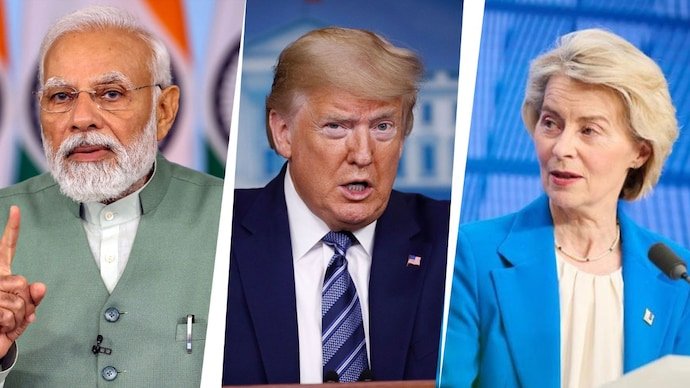
The long-awaited India-European Union Free Trade Agreement (FTA), often described as the “mother of all trade deals,” was formally unveiled this week, and it is precisely the kind of development that former US President Donald Trump would find difficult to endorse. For a leader who has frequently ridiculed Europe, pressured it over his Greenland ambitions, and sought to strong-arm India with steep tariffs, the sight of Brussels and New Delhi sealing a historic economic partnership is nothing short of unsettling.
From Trump’s perspective, the India-EU FTA represents more than just a commercial arrangement. It signals open defiance at a time when US-India trade negotiations remain stalled—not due to policy deadlocks, but largely because Prime Minister Narendra Modi has refused to indulge Trump’s preference for transactional diplomacy driven by personal validation. Compounding this discomfort is the fact that the European Union itself has put its own trade deal with the United States on hold.
The term “daddy,” originally used by the NATO chief in a lighter context, has since evolved into political shorthand for portraying Trump as an authoritarian figure who prefers to dominate allies and adversaries alike. Against this backdrop, the India-EU trade agreement appears to challenge that very worldview.
On Monday, US Treasury Secretary Scott Bessent openly accused Europe of indirectly financing the Russia–Ukraine war by continuing energy trade routed through India. His remarks underscored just how deeply the India-EU deal has rattled Washington. “We imposed 25% tariffs on India’s purchases of Russian oil,” Bessent said in an interview with ABC News. “And what happened last week? The Europeans signed a trade deal with India.”
What Bessent did not acknowledge, however, is that Trump himself deserves partial credit for pushing India and the EU toward the finish line. Negotiations for this agreement have stretched over two decades. Without Trump’s aggressive tariff threats and his tendency to alienate allies, New Delhi and Brussels may not have found the urgency to conclude the pact.
Prime Minister Modi appeared to allude to this reality in a carefully worded statement announcing the deal. In what many viewed as a subtle jab at Trump, Modi said, “The world order is in disarray. This agreement will help bring stability amid global unrest.”
Behind the Push for the India-EU Trade Deal
The timing of the agreement is crucial. India is currently facing a cumulative tariff burden of nearly 50% from the United States—25% as reciprocal tariffs and another 25% linked to its purchase of Russian oil. Over the past year, Trump and his aides have repeatedly criticized India, labeling it everything from the “Kremlin’s laundromat” to accusing it of prolonging the Ukraine conflict by calling it “Modi’s war.” These attacks were widely seen as attempts to pressure India into signing a trade deal skewed heavily in America’s favour.
India, however, chose a different path. It resisted the intimidation without resorting to personal attacks on the US president, maintaining diplomatic restraint while quietly expanding its global trade options.
Europe, too, has felt the brunt of Trump’s volatility. His anger over the EU’s opposition to his Greenland ambitions, coupled with repeated insults branding Europe as “weak” and threats of higher tariffs, pushed Brussels to freeze the EU-US trade agreement. Several European nations have also declined invitations to participate in Trump’s proposed Gaza Board of Peace.
Against this backdrop, the India-EU FTA is a strategic recalibration. Both sides are consciously diversifying their economic partnerships away from overdependence on the United States and china, especially as major powers increasingly use export controls to protect critical technologies. Notably, the European Union is already India’s largest trading partner, according to PTI data.
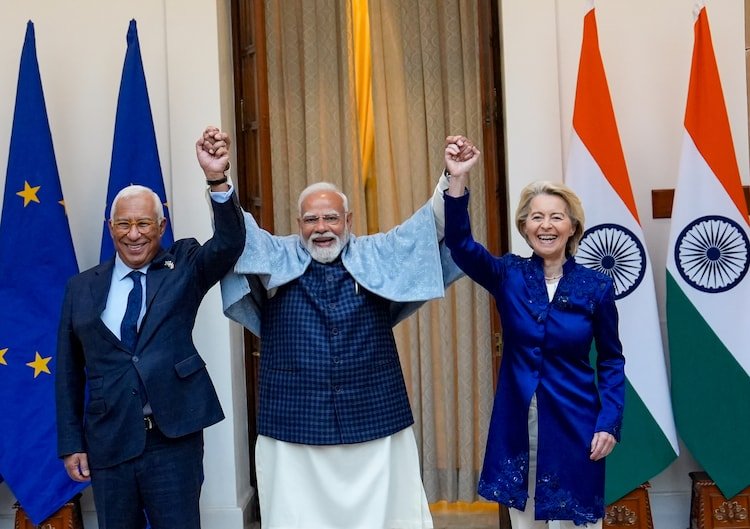
What the Trade Deal Means for India and Europe
The India-EU trade agreement sends a clear message to Washington: India will not capitulate under pressure. In recent months, New Delhi has accelerated its trade diplomacy, signing key agreements with Oman, the United Kingdom, and New Zealand.
India understands that Trump respects strength over submission. By standing firm, Prime Minister Modi has navigated global turbulence without yielding to coercive tactics.
A telling contrast emerged when Trump threatened Canada with 100% tariffs if it pursued a trade agreement with China. Within days, Ottawa suspended its pact with Beijing. India, by contrast, chose strategic diversification rather than retreat.
Crucially, the European Union acknowledged India’s red lines in sensitive sectors such as dairy and agriculture. These areas have been excluded from the FTA, reflecting India’s long-standing commitment to protecting its farmers. The United States, on the other hand, has consistently pushed for broader access to these politically sensitive sectors.
While Europe has expressed concern over India’s ties with Russia, it has avoided hostile rhetoric, punitive measures, or public threats. This measured approach has helped foster trust between New Delhi and Brussels.
As the EU’s fourth-largest economy, India offers long-term stability and a rapidly expanding market. Despite occasional disagreements, India has never attempted to pressure or publicly undermine Europe, reinforcing a relationship based on mutual respect.
Once implemented next year, the trade agreement is expected to deliver significant benefits to both sides. It will cushion the impact of US tariffs on Indian labour-intensive sectors such as textiles, chemicals, gems, and jewellery by offering duty-free or preferential access to European markets.
The FTA will eliminate duties on over 95% of traded goods and ease barriers in services including telecommunications and accounting, further boosting Indian exports. Given that the EU is already India’s largest trading partner, the gains could be substantial.
Europe stands to benefit as well. India will reduce import duties on EU automobiles from as high as 110% to around 40%, opening up the world’s third-largest automobile market to brands such as Mercedes-Benz, BMW, and Volkswagen.
The India-EU FTA demonstrates that meaningful trade agreements can be achieved through constructive dialogue rather than threats and intimidation—a lesson that Washington may find hard to ignore.
Will Trump Return to the Negotiating Table?
The key question now is whether the India-EU Free Trade Agreement will compel the United States to pursue a realistic and balanced trade deal with India. Many experts believe it will.
“If India secures a strong agreement with the EU, it will be a major step toward bringing America back to the negotiating table,” said Gautam Singhania, Managing Director of the Raymond Group.
Geopolitical realignments are already visible. Canada, another country frequently criticized by Trump, has moved closer to India following the assassination of Khalistani terrorist Hardeep Singh Nijjar. Canadian Prime Minister Mark Carney is expected to visit India in March to finalize agreements on minerals, energy, and uranium.
While Trump’s return to the White House has shaken confidence in America’s role across Europe and Asia, India under Prime Minister Modi has demonstrated that it can chart an independent course amid shifting global trade dynamics—even in the face of sustained US pressure.
For breaking news and live news updates, like us on Facebook or follow us on Twitter and Instagram. Read more on Latest India on thefoxdaily.com.




COMMENTS 0