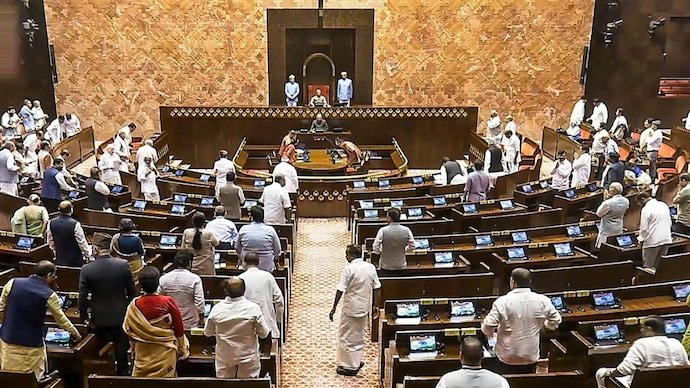
The proposed introduction of the Central Armed Police Forces (CAPF) Bill in the Rajya Sabha faced strong resistance from opposition parties, resulting in a delay. The objection was not just political—it centered largely around alleged procedural violations and concerns over the manner in which the government attempted to table the legislation.
Despite the Rajya Sabha’s Business Advisory Committee allocating eight hours for discussion, the Bill could not be introduced as scheduled due to the uproar and coordinated protest by opposition members.
Main Reason: Procedural Irregularities
The primary reason behind the opposition’s objection was the government’s failure to follow established parliamentary procedures. Members argued that the CAPF Bill was not circulated at least 48 hours in advance, which is considered a standard practice to allow MPs adequate time to review and prepare.
Trinamool Congress MP Derek O’Brien raised the issue in the House, urging the government to adhere to due process and respect parliamentary norms. According to opposition leaders, introducing such an important bill without proper notice undermines transparency and informed debate.
| Issue Raised | Opposition Concern | Impact |
|---|---|---|
| 48-hour Notice Rule | Bill not circulated in advance | Limited time for MPs to review |
| Procedural Norms | Violation of parliamentary protocol | Undermines legislative transparency |
| Hasty Legislation | Rushed introduction of Bill | Reduced scope for debate |
Opposition Walkout and Wider Political Resistance
Following the objection, members of the Trinamool Congress staged a walkout from the Rajya Sabha, signaling strong dissatisfaction with the government’s approach. Other opposition parties, including Congress, Aam Aadmi Party (AAP), and CPI(M), also backed the protest.
These parties warned the government against pushing through significant legislation without adequate discussion and consultation. The coordinated resistance highlighted broader concerns about legislative processes and the role of opposition voices in Parliament.
Government Response and Delay
In response to the mounting opposition, the government decided to temporarily hold back the introduction of the CAPF Bill. A senior minister acknowledged that differences had emerged and would need to be resolved before proceeding further.
Soon after, Home Minister Amit Shah held discussions with leaders from various opposition parties in the presence of Parliamentary Affairs Minister Kiren Rijiju. The talks aimed to build consensus not only on the CAPF Bill but also on other pending legislation, including the Women’s Reservation Bill.
Opposition leaders, including Jairam Ramesh, John Brittas, Supriya Sule, and Pramod Tiwari, also held internal consultations with Leader of Opposition Mallikarjun Kharge to strategize their next steps.
What the CAPF Bill Proposes
The CAPF Bill aims to introduce a unified administrative framework for India’s five central armed police forces:
- Central Reserve Police Force (CRPF)
- Border Security Force (BSF)
- Indo-Tibetan Border Police (ITBP)
- Sashastra Seema Bal (SSB)
- Central Industrial Security Force (CISF)
Currently, each of these forces operates under separate laws governing recruitment, promotions, and service conditions. The proposed legislation seeks to standardize these processes across all forces.
Key Features of the CAPF Bill
| Provision | Details |
|---|---|
| Unified Framework | Standard rules for recruitment and service conditions |
| IPS Deputation (IG Level) | 50% posts to be filled by IPS officers |
| IPS Deputation (ADG Level) | Minimum 67% posts via deputation |
| Top Positions (SDG & DG) | 100% filled through deputation |
| Career Management | Streamlined promotions and postings |
Background: Supreme Court Context
The Bill follows a Supreme Court ruling from October last year, which rejected the Centre’s plea to review its earlier 2025 judgment. That ruling had directed a cadre review within six months and called for reducing IPS deputation in CAPFs.
The proposed law appears to take a different approach by formalizing and expanding deputation at senior levels, making it a contentious issue among stakeholders.
Conclusion: Procedure vs Policy Debate
While the CAPF Bill addresses important structural reforms in India’s central armed police forces, its delayed introduction highlights a critical issue in parliamentary functioning—balancing legislative efficiency with procedural fairness.
The opposition’s objection underscores the importance of transparency, adequate notice, and meaningful debate in lawmaking. As discussions continue, the focus will remain not only on the content of the Bill but also on how it is introduced and debated in Parliament.
For breaking news and live news updates, like us on Facebook or follow us on Twitter and Instagram. Read more on Latest India on thefoxdaily.com.






COMMENTS 0