During a heated debate in Parliament on Monday, Rahul Gandhi referred to an episode involving “four Chinese tanks entering Indian territory” at an unmarked location, which he said occurred in Doklam in 2020. The congress leader cited an article based on the unpublished memoir of former Army Chief General MM Naravane (Retd), attempting to highlight what he described as a serious security lapse.
Critics were quick to point out that the well-known Doklam standoff between Indian and Chinese forces took place in 2017, not 2020, and accused Rahul Gandhi of getting his facts wrong. On the surface, that criticism appears valid. However, the situation is more nuanced. While Gandhi did misidentify the location, the incident he was referring to did occur in 2020, making his statement partially correct.
This apparent contradiction has caused widespread confusion. To understand why Rahul Gandhi’s claim is both right and wrong, it is important to look closely at the source he relied upon and the broader context of India–china military tensions during that period.
It is clear from his speech in Parliament, his remarks to the media, and the Congress party’s social media posts that Rahul Gandhi was drawing from an article published in The Caravan magazine. The piece is based on General Naravane’s unreleased memoir titled Four Stars of Destiny, which is currently under review by the Ministry Of Defence.
Because the memoir has not yet been officially cleared for publication, and given its sensitive nature, only limited details that have already entered the public domain are being discussed. The Congress had also shared portions of the article on social media, further amplifying the debate.
Responding to BJP MP Tejasvi Surya in Parliament, Rahul Gandhi said, “This is from the memoirs of (former) Army Chief Naravane, and it is about when four Chinese tanks were entering Indian territory; they were taking a ridge in Doklam.” He later clarified that he was referring to a public discussion held in 2023 during the promotional events surrounding the book.
It is worth noting that the primary Doklam standoff occurred in 2017, while General Naravane served as Army Chief from 2019 to 2022. The violent clashes in Galwan Valley in June 2020 also took place during his tenure, marking a period of intense military confrontation along the LAC.
Tank Movement Took Place at Rechin La, Not Doklam
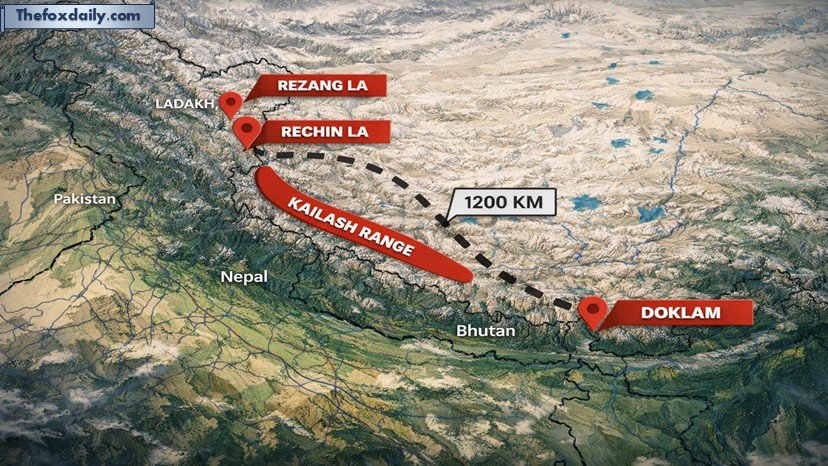
A closer reading of The Caravan article, titled “Naravane’s Moment of Truth,” reveals that the incident involving Chinese tanks did not occur in Doklam. Instead, it took place at Rechin La in eastern Ladakh. Geographically, Doklam and Rechin La are separated by nearly 1,200 kilometres in a straight line.
Rechin La is located roughly 30 kilometres from the historic Rezang La mountain pass in Ladakh. Although the exact distance between Rechin La and the Galwan Valley is not clearly marked on public maps, both areas lie along the LAC and are approximately 150 kilometres apart in a straight line.
According to the unpublished memoir, during a tense standoff on the evening of August 31, 2020, “four Chinese tanks, supported by PLA infantry, advanced towards Indian positions on the Kailash Range.” This strategically vital range lies in the Trans-Himalayan region, extending into Tibet and Nepal from the end of the Zanskar Range.
The article notes that the Chinese tanks came within a few hundred metres of Indian positions on the Kailash Range, which Indian forces had secured only hours earlier after a high-risk manoeuvre. In this rugged terrain, even small gains in elevation translate into significant strategic advantages.
The incident unfolded against the backdrop of escalating tensions in Ladakh, which had already witnessed the deadly Galwan clash in June 2020. According to the report, then Northern Army Commander Lieutenant General YK Joshi (Retd) informed General Naravane at around 8:15 pm about the advancing Chinese armour.
While there was a suggestion to use medium artillery, General Naravane reportedly opted for a measured response. He ordered Indian tanks to move into forward positions, facing the Chinese armour directly with their barrels lowered, instead of opening fire. The move worked as a strategic bluff, and according to the article, China “blinked first,” halting its advance.
Tensions Around Doklam Also Persisted in 2020
Although the major Doklam standoff is widely associated with 2017, tensions in the region did not entirely subside in the years that followed. In fact, Doklam is mentioned multiple times in the 30-page Caravan article, albeit in a different context.
The 2017 Doklam crisis involved a 73-day face-off at the India-Bhutan-China tri-junction, triggered when Indian troops intervened to stop Chinese road construction in territory claimed by Bhutan. The standoff eventually ended with a mutual disengagement.
During the Ladakh crisis in 2020, there were reports and discussions about renewed Chinese infrastructure activity near the Doklam tri-junction. While no major confrontation on the scale of 2017 was officially confirmed, the area remained part of the broader strategic calculus during that period.
However, the detailed description of Chinese tank movements cited by Rahul Gandhi clearly pertains to Rechin La in Ladakh, not to Doklam. This distinction is crucial to understanding where his claim went wrong.
Why Doklam and Rechin La Got Mixed Up
The confusion likely stems from the broader narrative of sustained tensions along the LAC in 2020. The Caravan article discusses multiple flashpoints, including Doklam, Galwan, and eastern Ladakh, which may have contributed to the overlap in public understanding.
Some references to Doklam in the article remain unverified, and as previously noted, the Ministry of Defence is still reviewing General Naravane’s memoir. As of February 2026, the book, which was expected to be published by Penguin in April 2024, has not yet been released.
While The Caravan reportedly accessed the full typescript, only selected excerpts have entered the public domain, including those published by the Press Trust of India in December 2023.
In summary, Rahul Gandhi was incorrect in attributing the incident involving four Chinese tanks to Doklam. The event took place at Rechin La in Ladakh. However, he was not entirely wrong in linking the episode to 2020, a year marked by intense India-China military tensions across multiple sectors.
Doklam did feature in discussions and strategic assessments during the wider 2020 standoff, but the specific tank movement described in General Naravane’s memoir belongs to the Rechin La episode. This is why Rahul Gandhi’s statement is both factually flawed and contextually rooted in real events.
For breaking news and live news updates, like us on Facebook or follow us on Twitter and Instagram. Read more on Latest India on thefoxdaily.com.



COMMENTS 0